.png)
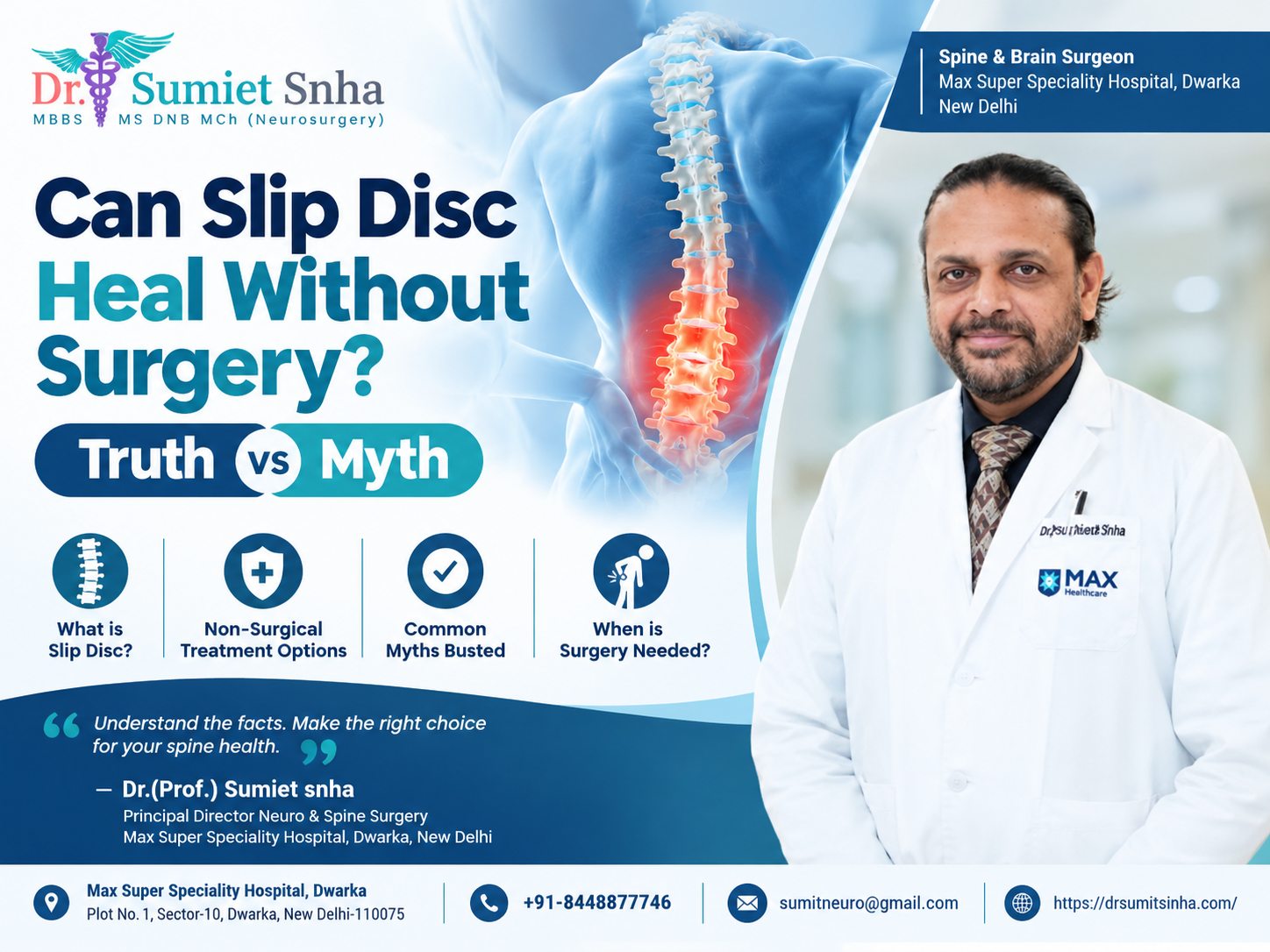
Can Slip Disc Heal Without Surgery? Truth & Myths
If you've ever been told you have a "slip disc," the first question that probably crossed your mind was: do I really need surgery? It's a fair worry — back pain is scary, and the internet is full of conflicting advice. Some websites say surgery is unavoidable, while others claim you can fix everything with a few stretches. The real answer sits somewhere in between, and it depends entirely on your specific case.
In this article, we'll break down whether a slip disc can heal without surgery, what actually happens inside your spine during recovery, and which claims are simply myths. We've also included expert input from Dr. (Prof.) Sumiet Snha, a senior neurosurgeon with over 25 years of clinical experience, to make sure the information here is medically sound and not just internet guesswork.
What Exactly Is a Slip Disc?
A slip disc — medically called a herniated or prolapsed disc — happens when the soft, gel-like cushion between your spinal bones pushes out through a crack in its tougher outer layer. This can press on nearby nerves, causing pain, tingling, numbness, or weakness that often travels down the arm or leg depending on where in the spine it occurs.
Most people picture this as a "disc slipping out of place," but that's not quite accurate. The disc doesn't move — it bulges or ruptures. Understanding this distinction matters because it directly affects how the body attempts to repair itself.
Can a Slip Disc Heal Without Surgery? The Truth
Here's the truth most people don't hear often enough: a slip disc can heal without surgery in a large number of cases. Research and long-term clinical observation both show that many herniated discs shrink or dry out naturally over several weeks to months. The body treats the herniated material almost like foreign tissue and gradually reabsorbs it through a natural inflammatory process.
Studies in spine literature have repeatedly documented this phenomenon of spontaneous disc resorption, especially in cases where the herniation is large enough to trigger a stronger immune response. In simpler terms — sometimes a bigger disc bulge actually has a better chance of shrinking on its own than a small one.
That said, "can heal without surgery" doesn't mean "will heal without any treatment or care." Proper management, rest, physiotherapy, and lifestyle changes play a huge role in how well and how fast the healing happens.
How Does the Body Heal a Slip Disc Naturally?
When a disc herniates, your immune system sends inflammatory cells to the area. Over time, these cells break down the leaked disc material, and swelling around the compressed nerve gradually reduces. As inflammation settles, nerve-related symptoms like pain, tingling, and weakness often improve on their own.
This natural healing process typically takes anywhere from six weeks to six months, depending on the size of the herniation, your age, activity levels, and how well you follow medical advice. This is exactly why doctors usually recommend a structured non-surgical approach before even considering an operation.
Non-Surgical Treatment Options for Slip Disc
If you're exploring non-surgical treatment for slip disc, here are the most commonly recommended approaches.
Physiotherapy and Exercise for Slip Disc Recovery
Physiotherapy for slip disc is often the backbone of recovery. Targeted exercises strengthen the muscles supporting your spine, improve flexibility, and take pressure off the affected disc. A trained physiotherapist will design a plan based on which part of your spine is affected, so you're not guessing with random online workout videos.
Medications and Injections
Anti-inflammatory drugs and muscle relaxants help manage pain during the initial healing phase. In more painful cases, epidural steroid injections can reduce nerve inflammation, giving the body enough time and comfort to heal naturally without surgery.
Lifestyle and Posture Changes That Support Healing
Simple adjustments at your desk, while sleeping, or during daily activities can significantly reduce strain on the spine. Weight management and core strengthening also matter — extra body weight and weak core muscles increase pressure on spinal discs, which can slow down recovery considerably.
Common Myths About Slip Disc Treatment
There's a lot of misinformation floating around, so let's clear up a few myths:
Myth 1: A slip disc always needs surgery. False. Surgery is usually the last resort, reserved for specific situations discussed below.
Myth 2: Bed rest for weeks is the best cure. False. Prolonged bed rest can actually weaken your muscles and delay recovery. Controlled movement and physiotherapy work far better.
Myth 3: Once you have a slip disc, it can never heal completely. False. Many patients recover full function with the right non-surgical treatment for slip disc issues.
Myth 4: Cracking your back or random stretching videos online will fix it. False, and potentially risky. Unsupervised exercises without a proper diagnosis can sometimes worsen the herniation.
When Does a Slip Disc Actually Need Surgery?
While a slip disc can heal without surgery in most cases, there are situations where surgery becomes necessary rather than optional.
Warning Signs You Should Never Ignore
- Severe or worsening leg/arm weakness
- Loss of bladder or bowel control (a medical emergency called cauda equina syndrome)
- Unbearable pain that doesn't respond to 6–12 weeks of proper non-surgical treatment
- Significant nerve compression confirmed on MRI along with progressive symptoms
In these cases, minimally invasive spine surgery techniques today allow for quicker recovery, less pain, and smaller incisions compared to traditional open surgery.
Expert Opinion: What Doctors Say
According to Dr. (Prof.) Sumiet Snha, Vice Chairman – Neurosciences (Neurology & Spine), "The vast majority of slip disc cases I see in clinical practice respond very well to structured non-surgical treatment. Surgery is only advised when there is a clear red flag — significant weakness, unbearable pain despite conservative treatment, or nerve compression that isn't improving. Patients should never fear a slip disc diagnosis; with the right guidance, most people return to a normal, active life without ever going under the knife."
About Dr. (Prof.) Sumiet Sinha
Dr. (Prof.) Sumiet Snha, Vice Chairman – Neurosciences (Neurology & Spine), MBBS | MS | DNB | MCh (AIIMS), New Delhi, is one of the best neurosurgeons in Gurgaon, currently practicing at Max Hospital. With 25+ years of experience, he trained at AIIMS, New Delhi, and later worked with global experts including Prof. Hiroshi Sano (Japan), Prof. Louise Vialle (Brazil), and Prof. B. Meyer (Germany). He is a certified AO Spine International faculty, ATLS-certified, and an accomplished peripheral nerve surgeon with 250+ successful complex nerve surgeries. He specializes in minimally invasive spine surgery and has served as Principal Director – Neuro & Spine Surgery at Max Hospital, Dwarka, and Secretary of the Neurotrauma Society of India.
Frequently Asked Questions (FAQs)
1. Can a slip disc heal completely without surgery?
Yes, in most cases a slip disc can heal without surgery through physiotherapy, medication, and lifestyle changes, especially when diagnosed early and managed properly.
2. How long does it take for a slip disc to heal naturally?
Natural healing usually takes between six weeks and six months, depending on the severity of the herniation and how consistently you follow your treatment plan.
3. What is the fastest way to recover from a slip disc without surgery?
A combination of guided physiotherapy for slip disc, anti-inflammatory medication, posture correction, and avoiding activities that strain the spine tends to speed up recovery the most.
4. Is walking good for a slip disc?
Yes, gentle walking is generally encouraged as it improves blood flow and prevents stiffness, but high-impact activities should be avoided until your doctor confirms it's safe.
5. Can physiotherapy really cure a slip disc?
Physiotherapy doesn't "cure" the herniation itself, but it strengthens supporting muscles, reduces nerve pressure, and plays a major role in non-surgical treatment for slip disc recovery.
6. What foods help in slip disc recovery?
Anti-inflammatory foods rich in omega-3s, calcium, and vitamin D — like leafy greens, fish, and nuts — can support disc and bone health during recovery, alongside proper medical treatment.
7. Is bed rest necessary for a slip disc?
No. Short rest during acute pain is fine, but prolonged bed rest can weaken muscles and delay healing. Controlled movement is usually more effective.
8. Can a slip disc come back after healing without surgery?
It's possible if the underlying causes — poor posture, weak core muscles, or repeated heavy strain — aren't addressed, which is why long-term lifestyle changes matter.
9. When should I be worried about my slip disc?
You should seek immediate medical attention if you notice worsening weakness, numbness, or any loss of bladder or bowel control.
10. What happens if a slip disc is left completely untreated?
Untreated cases can lead to prolonged pain, worsening nerve damage, and in severe situations, permanent weakness — so proper diagnosis and treatment are always advisable.
11. Is slip disc surgery painful, and how long is recovery?
With modern minimally invasive spine surgery techniques, pain and recovery time are significantly reduced compared to traditional open surgery, often allowing patients to return to routine activities within a few weeks.
12. Who is the best doctor for slip disc treatment in Gurgaon?
Dr. (Prof.) Sumiet Snha, Vice Chairman – Neurosciences (Neurology & Spine) at Max Hospital, Gurgaon, is a highly experienced neurosurgeon with 25+ years of expertise in spine and nerve surgery, known for prioritizing non-surgical treatment for slip disc whenever possible.
Conclusion
So, can a slip disc heal without surgery? For most patients, yes — with patience, the right non-surgical treatment for slip disc, and guidance from an experienced spine specialist. Surgery isn't something to fear, but it also isn't always necessary. The safest path is getting an accurate diagnosis early, following a structured recovery plan, and consulting a trusted expert like Dr. (Prof.) Sumiet Snha before jumping to conclusions about what your treatment should look like.
If your symptoms are mild to moderate, give conservative treatment a genuine chance. But if you notice warning signs like worsening weakness or loss of bladder control, don't delay — seek medical attention immediately.
.jpg)
.jpg)
.jpg)



Write a Comment