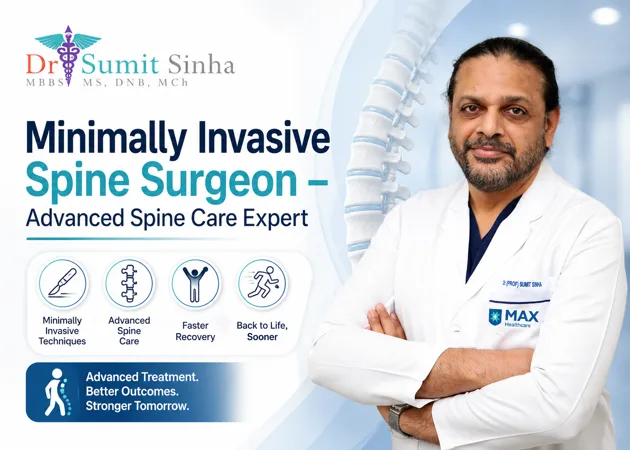
Spine problems affect millions of people around the world. Back pain, leg pain, numbness, and weakness can make everyday life extremely difficult. For decades, the only surgical option available was traditional open spine surgery, which involved large incisions, significant blood loss, and months of recovery. Today, minimally invasive spine surgery (MISS) has changed the way surgeons treat spinal conditions, offering patients faster recovery, less pain, and better outcomes.
As an experienced minimally invasive spine surgeon, Dr. Sumiet Sinha has helped hundreds of patients regain their quality of life through advanced, evidence-based MISS techniques. This comprehensive guide explains everything you need to know about minimally invasive spine surgery, including who it benefits, what conditions it treats, how it works, and what to expect during recovery.
Understanding the Spine and Why Surgery May Be Needed
The human spine is a complex structure made up of 33 vertebrae, intervertebral discs, nerves, muscles, and ligaments. It serves as the body's central support column and protects the spinal cord. When any part of this structure is damaged, compressed, or degenerates over time, it can cause severe pain and neurological symptoms.
Common spinal conditions that may require surgical intervention include:
• Herniated disc (slipped disc) causing nerve root compression
• Lumbar spinal stenosis (narrowing of the spinal canal)
• Degenerative disc disease leading to instability or chronic pain
• Spondylolisthesis (slippage of one vertebra over another)
• Spinal tumours, infections, or fractures
• Cervical myelopathy (compression of the spinal cord in the neck)
While conservative treatments such as physiotherapy, pain medications, and injections are always the first line of management, surgery becomes necessary when these measures fail to provide relief or when neurological symptoms worsen. This is where minimally invasive spine surgery offers a life-changing alternative to traditional open procedures.
What Makes a Procedure Minimally Invasive?
Minimally invasive spine surgery refers to surgical techniques that use small incisions, specialised retractors, and advanced imaging to access the spine while causing minimal disruption to the surrounding muscles and tissues.
In conventional open spine surgery, large cuts are made through the back, and muscles are stripped away from the vertebrae. This extensive tissue damage contributes to post-operative pain, prolonged recovery, and higher complication rates. Minimally invasive spine surgery, on the other hand, uses tubular retractors that gently dilate the muscles rather than cut through them. The surgeon operates through a tube that is only 16 to 22 mm in diameter, guided by real-time fluoroscopy (X-ray imaging) and sometimes a microscope or endoscope.
Key technologies that make MISS possible include:
• Tubular retractor systems for muscle-sparing access
• Intraoperative fluoroscopy and O-arm navigation for precise implant placement
• Neuromonitoring to protect spinal cord and nerve roots during surgery
• Endoscopy and microscopy for high-definition visualisation
• Minimally invasive pedicle screw systems for spinal fusion
Common Minimally Invasive Spine Procedures Performed by Dr. Sumiet Sinha
1. Microdiscectomy
A microdiscectomy is one of the most commonly performed minimally invasive spine surgery procedures. It involves removing the portion of a herniated disc that is pressing on a nerve root, thereby relieving sciatica (leg pain), numbness, or weakness. The procedure uses a small incision and an operating microscope, offering faster recovery than open discectomy.
2. Minimally Invasive Lumbar Decompression (MILD)
For patients with lumbar spinal stenosis, a minimally invasive decompression removes bone spurs, thickened ligaments, or disc material that is compressing the spinal canal. This procedure relieves leg pain and cramping during walking (neurogenic claudication) with minimal tissue disruption.
3. Minimally Invasive Lumbar Fusion (MIS-TLIF and MIS-PLIF)
When the spine is unstable or when decompression alone is insufficient, spinal fusion may be required. Transforaminal Lumbar Interbody Fusion (TLIF) and Posterior Lumbar Interbody Fusion (PLIF) performed with minimally invasive techniques use percutaneous pedicle screws and interbody cages inserted through small incisions. These procedures treat spondylolisthesis, degenerative disc disease, and recurrent disc herniation.
4. Endoscopic Spine Surgery
Endoscopic spine surgery is the most advanced form of minimally invasive spine procedure, using a pencil-thin endoscope with a camera and working channel. It allows the surgeon to directly visualise the disc, nerve roots, and spinal canal on a high-definition monitor. This technique is performed under local anaesthesia in select cases, making it suitable for patients who may not tolerate general anaesthesia.
5. Vertebroplasty and Kyphoplasty
These are minimally invasive procedures for spinal compression fractures, typically caused by osteoporosis. Bone cement is injected into the fractured vertebra under fluoroscopic guidance to stabilise it and relieve pain. Kyphoplasty additionally uses a balloon to restore vertebral height before cement injection.
6. Percutaneous Pedicle Screw Fixation
In complex spinal instability or deformity correction, percutaneous pedicle screws can be placed through small stab incisions using navigation guidance. This technique reduces blood loss and muscle damage compared to open screw placement.
Minimally Invasive Spine Surgery vs. Open Spine Surgery: A Detailed Comparison
Patients frequently ask whether minimally invasive spine surgery is better than traditional open surgery. While each case is unique, the evidence strongly supports MISS for appropriate candidates.
Blood Loss: MISS typically results in significantly less intraoperative blood loss, reducing the need for transfusions.
Hospital Stay: Most minimally invasive spine surgery patients are discharged within 24 to 48 hours, compared to 5 to 7 days for open procedures.
Post-operative Pain: Because MISS avoids extensive muscle stripping, post-operative pain is considerably lower and opioid requirements are reduced.
Recovery Time: Return to daily activities is typically 2 to 4 weeks with MISS, versus 3 to 6 months with open surgery.
Infection Risk: Smaller incisions translate to a lower risk of wound infection and deep surgical site complications.
Scar: Incisions in MISS are typically less than 2 cm, resulting in minimal scarring.
Who Is a Good Candidate for Minimally Invasive Spine Surgery?
Not every spine patient is a candidate for minimally invasive spine surgery. A thorough clinical evaluation including history, physical examination, and advanced imaging (MRI, CT scan) is essential to determine the right surgical approach. Dr. Sumiet Sinha customises each treatment plan based on the patient's condition, anatomy, and overall health.
Good candidates for MISS generally include patients who:
• Have a single-level or two-level spinal problem
• Have failed at least 6 weeks of conservative management
• Have worsening neurological deficits such as progressive weakness or bowel/bladder dysfunction
• Are medically fit for surgery
• Have no severe spinal deformity that would require extensive correction
Patients with complex spinal deformity, severe osteoporosis, infection, or tumours may require conventional open techniques or a combined hybrid approach. Dr. Sumiet Sinha will always discuss all available options transparently to help you make an informed decision.
The Role of Advanced Technology in Minimally Invasive Spine Surgery
The success of minimally invasive spine surgery depends heavily on advanced intraoperative technology. Dr. Sumiet Sinha works with state-of-the-art systems that enhance precision and patient safety.
3D Navigation and Robotic Assistance
Intraoperative 3D navigation systems, such as the O-arm combined with Stealthstation navigation, provide real-time three-dimensional imaging of the spine during surgery. This allows surgeons to place pedicle screws and implants with sub-millimetre accuracy, dramatically reducing the risk of misplacement and revision surgery. Robotic spine surgery platforms integrate with navigation systems to further automate screw trajectory planning.
Neuromonitoring
Continuous intraoperative neurophysiological monitoring (IONM) tracks the electrical activity of the spinal cord and nerve roots throughout the procedure. This early warning system alerts the surgical team to any traction or compression on neural structures, enabling immediate corrective action and reducing the risk of neurological injury.
Endoscopy
High-definition endoscopic systems allow surgeons to perform complex decompression procedures through a 7 mm cannula, visualising the disc, nerves, and vertebral structures in extraordinary detail. Endoscopic spine surgery represents the frontier of minimally invasive spinal care.
What to Expect: Before, During, and After Minimally Invasive Spine Surgery
Before Surgery
Your journey begins with a comprehensive consultation with Dr. Sumiet Sinha. After reviewing your symptoms, imaging studies, and treatment history, an appropriate minimally invasive spine procedure will be recommended. Pre-operative investigations including blood tests, ECG, and anaesthesia evaluation are completed. You will be given specific instructions about fasting, medications to stop before surgery, and what to bring to hospital.
During Surgery
Minimally invasive spine surgery is performed under general or spinal anaesthesia, usually in about 1 to 3 hours depending on the complexity. You will be positioned prone (face down) or lateral (on your side) depending on the approach. Antibiotics are given prophylactically. Continuous monitoring of vital signs, blood loss, and nerve function is maintained throughout. The operating team uses fluoroscopy or navigation to confirm instrument and implant positioning at every step.
Immediately After Surgery
Most patients wake up in the recovery room with significantly reduced pain compared to pre-surgery levels. You will be assisted to sit up and walk within a few hours of surgery. A physiotherapist will guide you on safe postures, mobility, and initial exercises. Oral pain medications are prescribed, and most patients are comfortable without requiring strong opioids.
Recovery at Home
After discharge, recovery from minimally invasive spine surgery continues at home. General milestones include:
• Week 1 to 2: Walking short distances frequently; avoiding bending, lifting, or twisting; wound care
• Week 3 to 6: Gradual increase in activity; return to desk work for many patients; formal physiotherapy begins
• Month 2 to 3: Return to driving, light physical work, and recreational activities
• Month 3 to 6: Full recovery for most procedures; fusion procedures may take 6 to 12 months for bone graft incorporation
Dr. Sumiet Sinha provides detailed post-operative instructions and closely follows up every patient with in-person and teleconsultation appointments to monitor progress and address any concerns.
Outcomes and Success Rates of Minimally Invasive Spine Surgery
Patients often wonder whether minimally invasive spine surgery is as effective as open surgery. The clinical evidence is reassuring. Multiple peer-reviewed studies and systematic reviews confirm that MISS achieves equivalent or superior outcomes compared to traditional open surgery for most conditions.
For lumbar microdiscectomy, success rates in terms of leg pain relief exceed 85 to 90%. Minimally invasive lumbar fusion procedures achieve fusion rates comparable to open surgery (85 to 95%) with significantly better perioperative outcomes. Endoscopic procedures show promising results with very low complication rates.
As with all surgical procedures, results depend on the patient's underlying condition, duration of symptoms, and adherence to post-operative rehabilitation. Patients with short-duration symptoms and well-preserved disc structure tend to achieve the best outcomes.
Risks and Complications: An Honest Overview
Dr. Sumiet Sinha believes in transparent communication about both the benefits and limitations of minimally invasive spine surgery. While MISS has a strong safety profile, no surgical procedure is entirely without risk. Potential complications include:
• Durotomy (inadvertent tear of the spinal fluid sac) in less than 2% of cases
• Infection at the surgical site (less than 1% with prophylactic antibiotics)
• Nerve injury causing temporary or, rarely, permanent weakness or numbness
• Implant-related issues such as screw misplacement or hardware failure
• Failure to achieve adequate decompression requiring revision surgery
• Anaesthesia-related complications
The overall complication rate for minimally invasive spine surgery is substantially lower than for equivalent open procedures. Dr. Sumiet Sinha discusses each of these risks in detail during the pre-operative consultation to ensure fully informed consent.
Why Choose Dr. Sumiet Sinha as Your Minimally Invasive Spine Surgeon?
Choosing the right minimally invasive spine surgeon is one of the most important decisions you will make on your road to recovery. Dr. Sumiet Sinha brings a combination of world-class training, extensive clinical experience, and a deeply patient-centred approach to every case.
Dr. Sinha has performed hundreds of minimally invasive spine surgeries including microdiscectomies, percutaneous fusions, endoscopic procedures, and complex spinal stabilisation. He utilises advanced imaging, intraoperative navigation, and neuromonitoring in every case to maximise precision and safety.
Patients consistently highlight Dr. Sinha's communication style, his willingness to explore non-surgical options first, and his commitment to achieving the best possible long-term outcome. His multidisciplinary approach integrates neurosurgery, orthopaedic spine principles, interventional pain management, and rehabilitation to provide comprehensive, personalised spinal care.
Key highlights of Dr. Sumiet Sinha's practice:
• Advanced fellowship training in minimally invasive and endoscopic spine surgery
• Expertise in complex spinal fusion, deformity correction, and revision spine surgery
• High-volume MISS practice with consistent outcomes data
• Dedicated patient education and pre/post-operative counselling
• Collaborative care with physiotherapists, pain specialists, and rehabilitation physicians
Frequently Asked Questions About Minimally Invasive Spine Surgery
Is minimally invasive spine surgery painful?
Most patients experience significantly less pain after minimally invasive spine surgery compared to open surgery. Mild discomfort at the incision site is normal for the first few days and is well-controlled with oral medications.
How long does minimally invasive spine surgery take?
Procedure duration varies from 45 minutes for a simple microdiscectomy to 3 to 4 hours for multi-level fusion surgeries. Dr. Sumiet Sinha will provide a procedure-specific estimate during your consultation.
Will I need physiotherapy after MISS?
Yes, physiotherapy is an integral part of recovery from minimally invasive spine surgery. A structured rehabilitation programme helps restore strength, flexibility, and function while protecting the surgical repair.
Can I avoid spine surgery altogether?
Surgery is always a last resort. Dr. Sumiet Sinha will evaluate whether conservative treatments such as physiotherapy, epidural steroid injections, or pain management can adequately manage your condition before recommending surgery.
How do I know if I am a candidate for minimally invasive spine surgery?
A detailed consultation including a review of your symptoms, clinical examination, and MRI imaging is necessary to determine candidacy. Contact Dr. Sumiet Sinha's clinic to schedule a comprehensive spine evaluation.
Conclusion
Minimally invasive spine surgery has transformed the management of spinal conditions, offering patients a safe, effective, and recovery-friendly alternative to traditional open spine operations. Whether you are suffering from a herniated disc, spinal stenosis, spondylolisthesis, or a compression fracture, MISS may hold the key to a faster return to a pain-free life.
Dr. Sumiet Sinha, a highly skilled and experienced minimally invasive spine surgeon, is committed to delivering world-class spinal care through advanced technology and personalised attention. If you or a loved one is struggling with a spinal condition, do not delay seeking expert evaluation. Early intervention often leads to better surgical and functional outcomes.

0 Comments