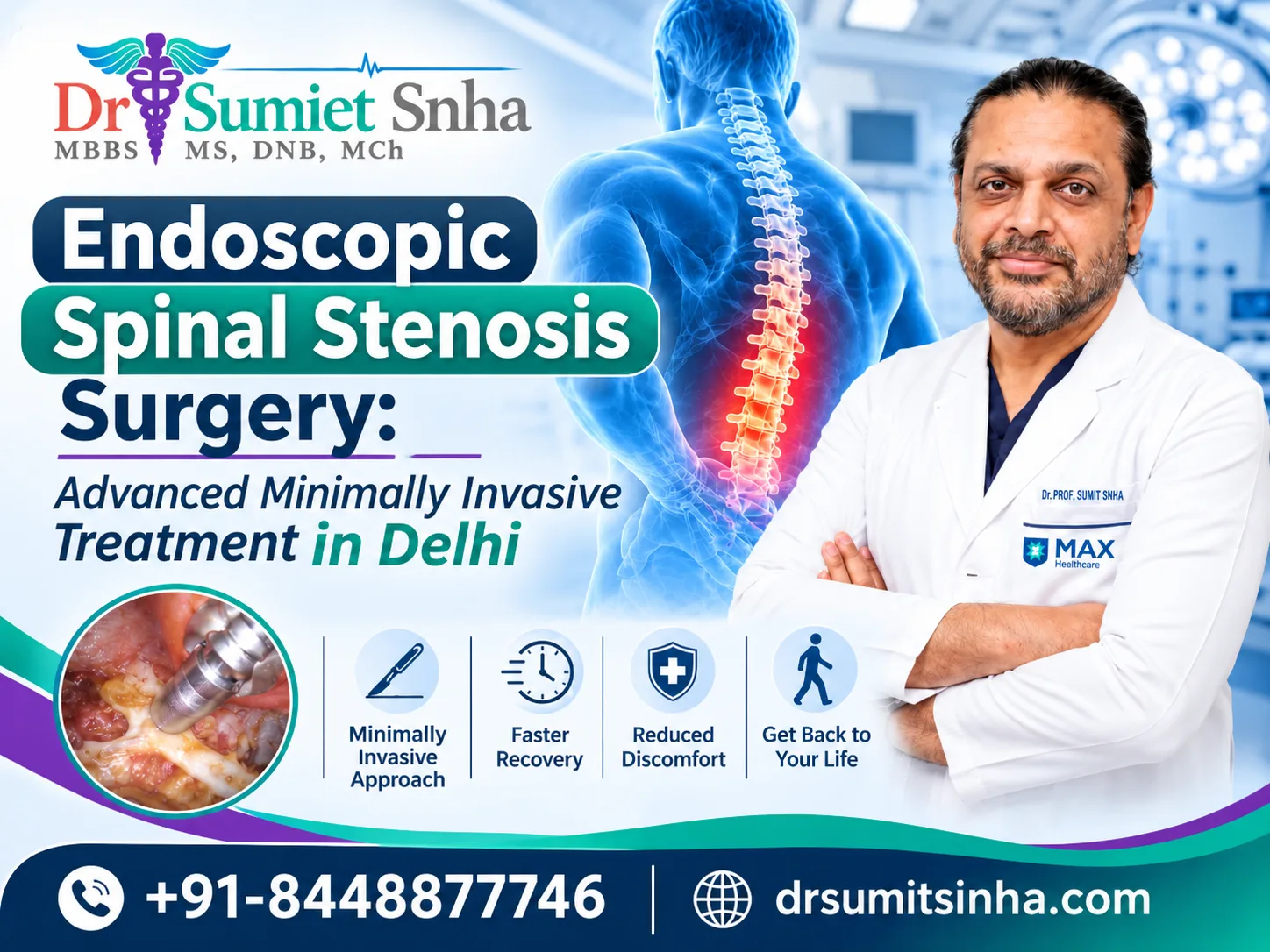
Endoscopic Spinal Stenosis Surgery in Delhi is an advanced minimally invasive spine treatment that may help relieve pressure on the spinal nerves caused by spinal canal narrowing. This procedure uses specialised endoscopic instruments and a small incision to access the affected area of the spine. For patients experiencing persistent back pain, leg pain, numbness, tingling or difficulty walking due to spinal stenosis, Endoscopic Spinal Stenosis Surgery may be considered after a detailed clinical evaluation.
Under the guidance of an experienced spine surgeon, patients can understand the available treatment options, potential benefits, risks and expected recovery based on their individual condition.
What Is Spinal Stenosis?
Spinal stenosis is a condition in which the spaces within the spinal canal become narrower, putting pressure on the spinal cord or the nerves travelling through the spine. This narrowing can occur in different regions, particularly the cervical spine (neck) and lumbar spine (lower back).
Spinal stenosis commonly develops due to age-related changes in the spine. However, previous injuries, congenital spinal conditions and degenerative changes may also contribute to the condition.
When the narrowing becomes significant, patients may experience symptoms that interfere with everyday activities, including walking, standing, sitting and maintaining balance.
What Is Endoscopic Spinal Stenosis Surgery?
Endoscopic Spinal Stenosis Surgery is a minimally invasive surgical technique designed to create more space for compressed spinal nerves.
During the procedure, the surgeon uses a specialised endoscope equipped with a camera and light source. This allows the surgeon to view the affected spinal structures on a monitor and perform the required decompression using specialised surgical instruments.
Depending on the patient's condition, the procedure may involve removing small portions of bone, thickened ligament or other structures contributing to nerve compression.
Unlike traditional open procedures, an endoscopic approach generally uses a smaller incision and aims to minimise disruption to the surrounding muscles and soft tissues.
However, the suitability of this technique depends on the location, severity and specific characteristics of spinal stenosis.
Common Causes of Spinal Stenosis
Spinal stenosis can develop gradually due to several structural and degenerative changes.
Some common causes include:
Age-related degeneration: Natural ageing can cause changes in spinal discs, joints and supporting ligaments.
Herniated or Bulging Discs: Disc material may protrude into the spinal canal and contribute to nerve compression.
Osteoarthritis: Degenerative joint changes can lead to bone spur formation and narrowing of the spinal canal.
Thickened Ligaments: Spinal ligaments may become thicker over time, reducing the available space for nerves.
Congenital Spinal Narrowing: Some individuals are born with a naturally narrower spinal canal.
Previous Spinal Injuries: Trauma or earlier spinal conditions may contribute to structural narrowing.
Identifying the underlying cause is important when deciding the most appropriate treatment.
Symptoms That May Indicate Spinal Stenosis
The symptoms of spinal stenosis vary depending on the affected spinal region and the extent of nerve compression.
Common symptoms include:
Persistent lower back or neck pain.
Pain radiating from the lower back into the buttocks and legs.
Numbness and tingling in the arms, hands, legs or feet.
Muscle weakness in the affected limbs.
Difficulty standing or walking for extended periods.
Leg discomfort that increases while walking and improves with sitting or bending forward.
Reduced balance or coordination in some patients.
If these symptoms persist or progressively worsen, consulting a qualified spine specialist can help identify the underlying cause.
Important: New loss of bladder or bowel control, numbness around the groin or saddle area, or rapidly progressing leg weakness requires immediate emergency medical assessment.
When Is Endoscopic Spinal Stenosis Surgery Recommended?
Not every patient diagnosed with spinal stenosis requires surgery. Many patients initially benefit from non-surgical treatment depending on the severity of their symptoms.
A spine specialist may consider Endoscopic Spinal Stenosis Surgery when:
Persistent pain does not improve adequately with conservative treatment.
Nerve compression causes significant discomfort or functional limitations.
Walking becomes increasingly difficult due to nerve-related leg symptoms.
Imaging studies show spinal canal narrowing corresponding to the patient's symptoms.
Progressive neurological symptoms require surgical evaluation.
A suitable anatomical condition allows minimally invasive decompression.
The final decision should be based on the patient's medical history, neurological examination and imaging findings.
How Is Endoscopic Spinal Stenosis Surgery Performed?
The procedure is planned according to the location and severity of spinal stenosis. The general stages may include:
1. Preoperative Evaluation
The surgeon reviews the patient's symptoms, medical history and previous treatments. A neurological examination is performed to assess muscle strength, sensation and reflexes.
2. Imaging and Surgical Planning
MRI, CT scans or X-rays may be recommended to identify the exact location of spinal narrowing and understand the surrounding spinal structures.
3. Anaesthesia and Positioning
The patient receives the appropriate anaesthesia, and the surgical team positions the patient according to the planned procedure.
4. Endoscopic Access
A small incision is made to introduce the endoscope and specialised instruments towards the affected spinal region.
5. Nerve Decompression
Using the endoscopic camera for visual guidance, the surgeon carefully removes the structures responsible for nerve compression, where necessary.
6. Completion and Monitoring
After the required decompression, the instruments are removed and the incision is closed. The patient is monitored during the initial recovery period.
The exact surgical steps may vary depending on the patient's spinal anatomy and treatment requirements.
Benefits of Endoscopic Spinal Stenosis Surgery
For appropriately selected patients, an endoscopic approach may offer several potential advantages compared with conventional open surgery.
These may include:
Smaller surgical incision compared with traditional open approaches.
Reduced disruption to surrounding muscles and soft tissues.
Less postoperative discomfort in some patients.
Reduced blood loss in selected procedures.
Shorter hospital stay in suitable cases.
Earlier mobilisation, depending on the procedure and individual recovery.
Targeted access to the affected spinal region.
It is important to understand that outcomes vary between patients. Endoscopic surgery is not suitable for every type of spinal stenosis, and the expected benefits should be discussed with the treating surgeon.
Diagnosis Before Endoscopic Spinal Stenosis Surgery
Accurate diagnosis is essential before planning any spinal procedure.
A specialist may recommend the following investigations:
MRI Scan: Helps identify spinal canal narrowing, disc abnormalities, ligament thickening and nerve compression.
CT Scan: Provides detailed information about the spinal bones, joints and bone spurs.
X-Ray: Helps assess spinal alignment, degenerative changes and certain structural abnormalities.
Neurological Examination: Evaluates muscle strength, reflexes, sensation and functional limitations.
These findings help determine whether surgical decompression is appropriate and which surgical approach may be suitable.
Recovery After Endoscopic Spinal Stenosis Surgery
Recovery after Endoscopic Spinal Stenosis Surgery varies according to the patient's age, general health, severity of spinal stenosis and the exact procedure performed.
Some patients may begin walking under medical supervision relatively early after surgery. However, complete recovery and return to regular activities may take longer.
General recovery recommendations may include:
Follow the surgeon's postoperative instructions.
Avoid heavy lifting and strenuous activities until medically cleared.
Begin walking and prescribed movements gradually.
Attend scheduled follow-up appointments.
Take prescribed medication as directed.
Follow physiotherapy recommendations when advised.
Avoid returning to demanding physical activities too early.
Regular follow-up helps monitor recovery and identify any complications that may require attention.
Possible Risks and Complications
Although minimally invasive techniques aim to reduce surgical tissue disruption, Endoscopic Spinal Stenosis Surgery still carries potential risks.
Possible complications include:
Infection at the surgical site.
Bleeding.
Nerve irritation or injury.
Dural tear or cerebrospinal fluid leakage.
Persistent or recurrent symptoms.
Incomplete nerve decompression.
Need for additional treatment or surgery.
The possibility of complications depends on the patient's condition, surgical complexity and overall health. Patients should discuss the benefits and risks with their surgeon before making a treatment decision.
Meet Dr. (Prof.) Sumiet Snha – Neurosurgeon and Spine Surgeon in Delhi
Dr. (Prof.) Sumiet Snha is an experienced Minimally Invasive and Endoscopic Neurosurgeon and Spine Surgeon with extensive training in the treatment of complex brain, spine and peripheral nerve conditions.
He completed his neurosurgical training at the prestigious All India Institute of Medical Sciences (AIIMS), New Delhi, and previously served as a Professor of Neurosurgery at AIIMS.
His professional qualifications include MBBS, MS, DNB, MCh (AIIMS) and FACS. He has also received international training and worked with renowned neurosurgical specialists in Japan, Brazil and Germany.
His areas of clinical expertise include:
Endoscopic Spine Surgery
Endoscopic Treatment of Lumbar Canal Stenosis
Minimally Invasive Spine Surgery
Cervical and Lumbar Disc Surgery
Spinal Tumour Surgery
Complex Brain and Spine Procedures
Peripheral Nerve Surgery
With experience in minimally invasive and endoscopic surgical techniques, Dr. (Prof.) Sumiet Snha evaluates patients individually to determine the most appropriate treatment approach.
For patients considering Endoscopic Spinal Stenosis Surgery in Delhi, a specialist consultation can help clarify the diagnosis, available treatment options and expected outcomes.
Read more about Dr. (Prof.) Sumiet Snha.
Frequently Asked Questions
1. What is Endoscopic Spinal Stenosis Surgery?
It is a minimally invasive surgical procedure that uses an endoscope and specialised instruments to relieve pressure on compressed spinal nerves by creating additional space within the affected spinal canal.
2. Who is a suitable candidate for Endoscopic Spinal Stenosis Surgery?
Patients with symptomatic spinal stenosis who have not responded adequately to conservative treatments may be considered. Suitability depends on imaging findings, symptoms, spinal anatomy and overall health.
3. Is Endoscopic Spinal Stenosis Surgery better than open surgery?
Both techniques have specific indications. Endoscopic surgery may offer smaller incisions and less muscle disruption in suitable cases. However, open surgery may be more appropriate for certain complex spinal conditions.
4. How long does recovery take after endoscopic spinal stenosis surgery?
Recovery differs from patient to patient. Some patients can start walking relatively early, while returning to normal activities may require several weeks or longer depending on the procedure and individual health.
5. Can spinal stenosis be treated without surgery?
Yes. Depending on the severity of the condition, treatment may include medication, physiotherapy, activity modification and other non-surgical options. Surgery may be considered when symptoms persist or neurological problems progress.
6. Why consult Dr. (Prof.) Sumiet Snha for spinal stenosis treatment in Delhi?
Dr. (Prof.) Sumiet Snha has neurosurgical training from AIIMS, New Delhi, and professional experience in minimally invasive and endoscopic brain and spine procedures. He evaluates patients to recommend an appropriate treatment plan based on their individual condition.
7. How can I book a consultation for Endoscopic Spinal Stenosis Surgery in Delhi?
Patients can contact Dr. (Prof.) Sumiet Snha's team at +91-8448877746 to enquire about consultation appointments and further evaluation.
Conclusion
Endoscopic Spinal Stenosis Surgery is an important minimally invasive treatment option for selected patients experiencing nerve compression due to spinal canal narrowing. Early diagnosis, appropriate treatment planning and specialist evaluation are essential for managing spinal stenosis effectively.
If you are exploring Endoscopic Spinal Stenosis Surgery in Delhi, consulting Dr. (Prof.) Sumiet Snha, an AIIMS-trained neurosurgeon and spine surgeon, can help you understand your condition and available treatment options.

0 Comments