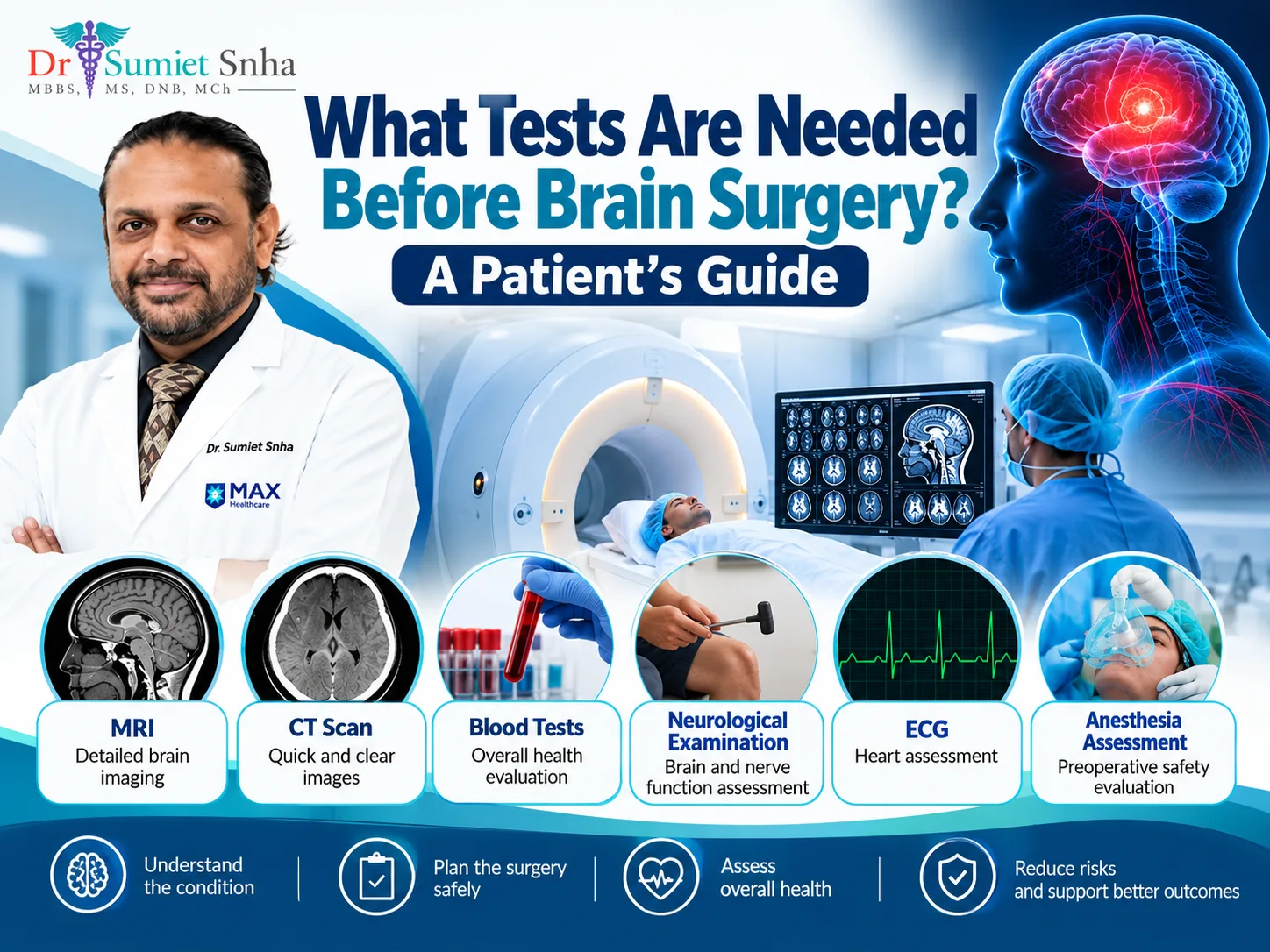
Preparing for brain surgery can bring many questions, especially about the medical examinations required beforehand. Understanding the tests before brain surgery can help patients and their families feel better informed about the process.
Doctors use these assessments to understand the brain condition, evaluate overall health, and plan the procedure carefully. From imaging scans to blood investigations, each test provides information that may influence surgical decisions.
Not every patient needs the same tests. The investigations depend on the diagnosis, planned operation, medical history, and individual health needs.
Why Are Tests Needed Before Brain Surgery?
Brain surgery involves delicate structures responsible for movement, speech, memory, and other essential functions. Therefore, preoperative tests for brain surgery help the medical team identify potential risks and prepare an appropriate surgical plan.
These assessments help doctors:
Locate abnormalities: Identify tumors, bleeding, swelling, or other structural changes.
Evaluate brain function: Understand existing neurological symptoms and possible areas of concern.
Assess general health: Identify conditions that may affect anesthesia or recovery.
Plan surgical treatment: Determine the approach most appropriate for the patient's condition.
A thorough brain surgery preoperative assessment supports informed decision-making but cannot eliminate every surgical risk.
What Tests Are Commonly Done Before Brain Surgery?
1. MRI Before Brain Surgery
Magnetic Resonance Imaging (MRI) creates detailed pictures of the brain using magnetic fields and radio waves.
An MRI before brain surgery may help doctors examine brain tumors, surrounding tissues, blood vessels, and other abnormalities.
Depending on the condition, doctors may recommend additional MRI techniques to evaluate important brain pathways or functional areas.
Important: Patients should inform the medical team about implanted devices, metal fragments, or previous reactions to contrast agents.
2. CT Scan Before Brain Surgery
A CT scan before brain surgery uses X-rays to produce detailed cross-sectional images.
CT scans can be particularly useful when doctors need to assess:
Bleeding inside the skull
Skull fractures or bone abnormalities
Hydrocephalus or enlarged fluid spaces
Certain urgent neurological conditions
CT imaging is often faster than MRI, making it valuable in emergencies. However, MRI and CT provide different information and are not always interchangeable.
3. Blood Tests Before Brain Surgery
Blood tests before brain surgery help evaluate whether a patient has medical conditions that require attention before an operation.
Common investigations may include:
Complete blood count (CBC): Checks hemoglobin, white blood cells, and platelets.
Clotting tests: Assess factors involved in blood clotting.
Kidney function tests: Help evaluate kidney health.
Blood glucose and electrolytes: Identify abnormalities that may require management.
Additional tests may be recommended depending on medical history and the planned procedure.
4. Neurological Examination Before Brain Surgery
A neurological examination before brain surgery evaluates how the brain, spinal cord, and nerves are functioning.
Doctors may assess muscle strength, sensation, reflexes, coordination, speech, vision, and balance.
These findings establish a baseline that can be compared with neurological function after surgery.
5. Anesthesia Assessment Before Brain Surgery
An anesthesia assessment before brain surgery helps the anesthesiologist evaluate the patient's medical history, medications, airway, and possible anesthesia-related risks.
The assessment may include questions about previous operations, allergies, heart or lung conditions, and current medicines.
Patients should never stop prescribed medications without medical advice. The surgical team will explain which medicines to continue, adjust, or temporarily withhold.
6. ECG and Additional Medical Tests
An electrocardiogram (ECG) records the heart's electrical activity.
An ECG before brain surgery may be recommended based on the patient's age, symptoms, medical conditions, and the nature of the operation.
Some patients may also need chest imaging, specialist consultations, or other investigations. Routine testing should be guided by individual clinical needs.
Comparison of Common Tests Before Brain Surgery
Remember: This comparison is educational. The medical team determines which investigations are necessary for each patient.
How Should Patients Prepare for Preoperative Tests?
Good brain surgery preparation involves following medical instructions and sharing accurate health information.
Before testing or surgery:
Bring previous reports: Carry MRI scans, CT scans, prescriptions, and relevant medical records.
Share your medication list: Include blood thinners, supplements, and over-the-counter medicines.
Mention existing conditions: Tell doctors about diabetes, heart disease, breathing problems, or allergies.
Follow fasting instructions: Do not assume fasting is required for every test; follow the instructions provided.
Ask questions: Understand why each investigation is needed and what the results may mean.
Patients should also report new weakness, seizures, severe headaches, or changes in consciousness promptly. Sudden neurological deterioration requires urgent medical attention.
What Happens If a Test Result Is Abnormal?
An abnormal result does not automatically mean brain surgery will be cancelled.
Doctors first determine whether the finding affects surgical planning or anesthesia safety. Some problems can be managed before the operation, while others may require additional investigations.
The decision to proceed, postpone, or modify surgery depends on the urgency of the neurological condition and the patient's overall health.
About Dr. Sumiet Snha
Dr. Sumiet Snha is an experienced neurosurgeon with over 30 years of experience in neurosurgery. His clinical work involves the assessment and management of brain and spine conditions.
He is associated with Max Super Speciality Hospital, Dwarka, New Delhi, and Max Hospital, Gurugram.
Understanding the patient's diagnosis, reviewing appropriate investigations, and explaining treatment considerations are important parts of preoperative neurosurgical care.
Frequently Asked Questions (FAQs)
1. What tests are required before brain surgery?
Common tests before brain surgery include MRI, CT scans, blood investigations, neurological examinations, and anesthesia assessments. The exact combination varies.
2. Is an MRI necessary before brain surgery?
MRI is commonly used for detailed surgical planning, but not every operation requires an MRI. The diagnosis determines the imaging needed.
3. Why are blood tests done before brain surgery?
Blood tests help identify anemia, clotting problems, electrolyte imbalances, and other medical concerns that could affect treatment.
4. Is a CT scan required before brain surgery?
A CT scan may be needed to evaluate bleeding, bone structures, or urgent abnormalities. It is not mandatory for every patient.
5. What happens during a neurological examination?
Doctors assess movement, strength, sensation, reflexes, coordination, speech, and other neurological functions.
6. Why is an anesthesia assessment important?
It helps identify anesthesia-related risks and allows the anesthesiologist to prepare an appropriate care plan.
7. Is an ECG compulsory before brain surgery?
No. ECG testing depends on the patient's health, risk factors, and planned operation.
8. How long do preoperative tests take?
Some tests take minutes, while imaging and specialist assessments may require longer. Scheduling depends on clinical urgency.
9. Can brain surgery proceed if blood tests are abnormal?
Sometimes. Doctors evaluate the abnormality and decide whether treatment, further testing, or postponement is necessary.
10. Do patients need to fast before brain surgery tests?
Fasting requirements vary. Patients should follow specific instructions for imaging, blood investigations, and anesthesia.
11. Can patients take their regular medicines before surgery?
Some medicines may need adjustment. Never stop or change medication without instructions from the treating team.
12. Are all preoperative tests performed on the same day?
Not necessarily. Tests may be scheduled over several days, depending on availability, urgency, and medical requirements.
Conclusion
Understanding the tests before brain surgery helps patients prepare for an important stage of treatment. MRI, CT scans, blood tests, neurological examinations, and anesthesia assessments each provide different information.
The most important point is that preoperative testing should be personalized. Patients should discuss recommended investigations, possible risks, and preparation instructions with their neurosurgical team.
Being informed, sharing complete medical information, and following professional guidance can support safer planning and a clearer understanding of the surgical journey.




0 Comments