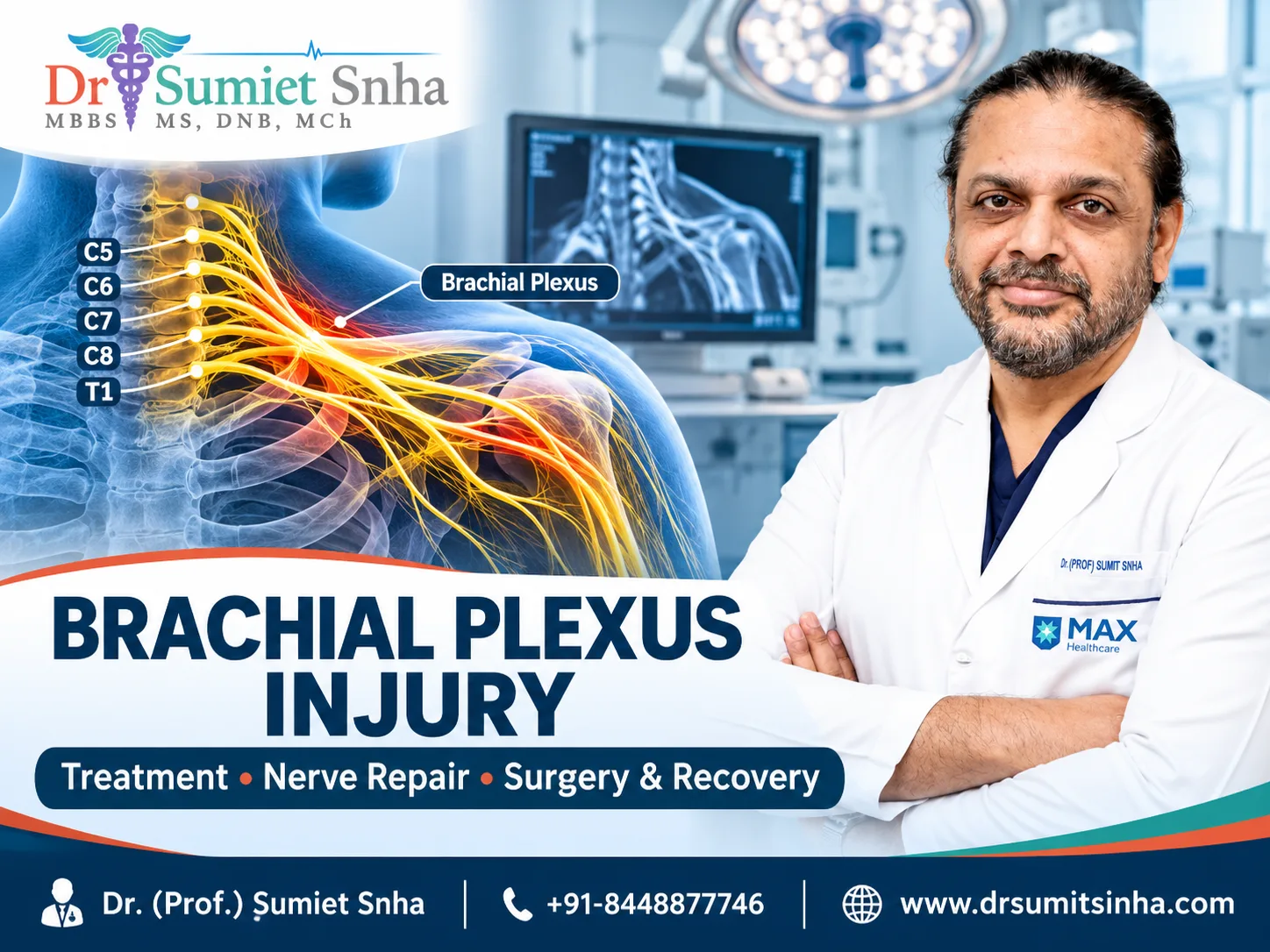
Brachial Plexus Injury Treatment & Surgery in Delhi focuses on diagnosing damage to the network of nerves that controls movement and sensation in the shoulder, arm and hand. These injuries can occur after road accidents, falls, sports injuries or difficult childbirth. Depending on the severity of the nerve damage, treatment may involve observation, physiotherapy, nerve repair, nerve grafting or nerve transfer surgery.
A brachial plexus injury can significantly affect everyday activities, including lifting the arm, bending the elbow, holding objects and performing routine tasks. Some injuries recover gradually without surgery, while severe nerve tears or nerve root avulsions may require specialised surgical reconstruction.
Early assessment is important because the type of injury and the time elapsed since the accident can influence treatment options and potential recovery. A detailed examination helps determine whether the nerves are likely to recover naturally or whether surgical intervention should be considered.
This guide explains the causes, symptoms, diagnostic process, surgical options and rehabilitation considerations for patients with brachial plexus injuries.
What Is the Brachial Plexus?
The brachial plexus is a network of nerves originating from the lower part of the neck. It is formed primarily by the nerve roots C5, C6, C7, C8 and T1, which travel through the neck and shoulder region before supplying the arm and hand.
These nerves carry signals between the spinal cord and the muscles and skin of the upper limb. They help control shoulder movement, elbow bending, wrist movement, finger coordination and sensation.
The different nerve roots contribute to different functions:
C5 and C6: Help control shoulder movement and elbow flexion.
C7: Contributes to elbow, wrist and finger extension.
C8 and T1: Contribute to finger flexion, grip and small hand movements.
An injury can affect one nerve root, several roots or most of the brachial plexus. Consequently, the symptoms vary considerably from one patient to another.
For example, a person with an upper plexus injury may struggle to lift the shoulder or bend the elbow, whereas a more extensive injury can leave the entire arm weak or paralysed.
What Causes a Brachial Plexus Injury?
Understanding how the injury occurred helps specialists assess the possible extent of nerve damage.
1. Road Traffic Accidents
Motorcycle and other road accidents are important causes of traumatic brachial plexus injuries. When the head and neck move forcefully away from the shoulder, the nerves connecting the spinal cord to the arm may stretch or tear.
Patients may also sustain shoulder dislocations, collarbone fractures, chest injuries or damage to nearby blood vessels.
2. Falls and Sports Injuries
Falls from a height and certain contact sports can produce significant traction on the shoulder and neck. Depending on the force involved, the nerves may be stretched, compressed or ruptured.
3. Workplace and Machinery Accidents
Industrial injuries can occur when the arm is pulled, trapped or subjected to substantial force. These injuries may involve damage to several nerves and surrounding tissues.
4. Birth-Related Brachial Plexus Injuries
During some difficult deliveries, stretching of the baby's neck and shoulder can damage the brachial plexus. This is known as an obstetric brachial plexus injury.
Many infants improve naturally, but some require specialist monitoring, physiotherapy or surgery if recovery is inadequate.
5. Other Nerve Conditions
The brachial plexus may also be affected by inflammatory nerve disorders, tumours, radiation-related damage or compression in the region between the collarbone and first rib.
These conditions do not all require the same treatment. Accurate diagnosis is necessary before deciding on an appropriate management plan.
Symptoms That May Indicate Brachial Plexus Damage
Symptoms depend on which nerves are affected and how severely they are injured.
Common signs include:
Weakness in the shoulder or arm: Difficulty lifting the arm, bending the elbow or moving the wrist.
Loss of sensation: Numbness or reduced feeling in parts of the arm or hand.
Severe nerve pain: Burning, shooting or electric-shock-like pain.
Reduced grip strength: Difficulty holding, lifting or manipulating objects.
Muscle wasting: A gradual reduction in muscle size when nerve supply is significantly impaired.
Limited shoulder stability: Difficulty controlling the shoulder or maintaining normal joint position.
In severe injuries, the arm may hang limply and have little or no voluntary movement.
Parents should seek early assessment if a newborn has an arm that moves noticeably less than the other arm following birth.
Sudden or severe arm weakness following an accident requires prompt medical evaluation. Associated chest trauma, a cold or pale limb, major bleeding or other serious injuries may require emergency care.
Understanding the Different Types of Nerve Injury
Not every brachial plexus injury permanently damages the nerves. The type of damage helps determine the likely recovery pattern and whether surgery may be required.
Neurapraxia
Neurapraxia is a relatively mild nerve injury in which the nerve's internal signalling is temporarily disrupted without complete disruption of its structure.
Recovery may occur over days or weeks, depending on the injury.
Axonotmesis
In axonotmesis, the nerve fibres are damaged, although some of the supporting structures may remain intact. Recovery depends on the severity of the damage, the distance the regenerating fibres must travel and whether they reach the correct target tissues.
Neurotmesis
Neurotmesis involves severe disruption of the nerve itself. A completely divided nerve generally cannot restore normal function without appropriate repair or reconstruction.
Nerve Root Avulsion
In a root avulsion, a nerve root is torn away from its attachment to the spinal cord. This is a particularly severe injury because the affected root cannot simply be reattached in the usual manner.
Specialised reconstruction, often involving nerve transfers, may be considered to restore selected functions.
Because different types of damage can occur within the same brachial plexus, clinical examination and investigations are essential for treatment planning.
How Is a Brachial Plexus Injury Diagnosed?
Diagnosis involves identifying the affected nerves, assessing the severity of the injury and looking for associated damage.
Clinical and Neurological Examination
The specialist evaluates muscle strength, sensation, reflexes and the movement of the shoulder, elbow, wrist and fingers.
The examination helps identify which parts of the brachial plexus may be affected. Repeated assessments can also reveal whether meaningful recovery is occurring.
MRI and Other Imaging
MRI can help visualise the brachial plexus and surrounding structures. In selected cases, MR neurography or CT myelography may be recommended to investigate the location and extent of nerve damage.
X-rays or CT scans may be required to assess fractures and other injuries associated with an accident.
Nerve Conduction Studies and EMG
Nerve conduction studies and electromyography (EMG) help assess how nerves transmit signals and how muscles respond.
The timing of these tests matters. They may need to be performed or repeated at intervals to provide useful information about the injury and signs of recovery.
Assessment of Associated Injuries
Traumatic injuries can affect blood vessels, bones, the shoulder joint, the chest or the cervical spine as well as the brachial plexus.
The medical team must identify and address urgent associated injuries before planning nerve reconstruction.
Brachial Plexus Injury Treatment in Delhi: What Are the Options?
Brachial Plexus Injury Treatment in Delhi depends on the severity of the injury, the nerves involved, the patient's age, the time since the injury and evidence of natural recovery.
Treatment may be non-surgical or surgical.
1. Observation and Physiotherapy
Milder stretch injuries may recover without an operation. During this period, the medical team monitors muscle strength, sensation and the return of movement.
Physiotherapy may help maintain joint mobility and reduce the risk of stiffness and contractures.
Patients should follow a supervised exercise programme rather than forcing weak or painful joints to move. When sensation is reduced, protecting the affected arm from burns, cuts and pressure injuries is also important.
Observation should include appropriate follow-up. It should not mean waiting indefinitely when significant weakness or paralysis persists.
2. Nerve Exploration and Neurolysis
In selected cases, surgery may be used to inspect the injured nerves and release scar tissue that is restricting them.
This procedure, known as neurolysis, may be considered when the nerve remains in continuity but surrounding scar tissue or compression interferes with its function.
The decision depends on the injury pattern and the findings during assessment.
3. Nerve Repair and Nerve Grafting
If a nerve is ruptured but the relevant nerve root remains connected to the spinal cord, the surgeon may consider direct repair or nerve grafting.
When a damaged section leaves a gap, a graft can be used to bridge it. The goal is to provide a pathway for regenerating nerve fibres.
Recovery depends on the extent of the injury, the distance to the target muscle and whether useful nerve regeneration occurs.
4. Nerve Transfer Surgery
Nerve transfer surgery is an important option for selected severe brachial plexus injuries.
During this procedure, a functioning nerve or part of a nerve is connected to a nerve supplying a muscle that has lost its normal input. The donor nerve is selected carefully to preserve as much useful function as possible.
Because the new connection can be made closer to the target muscle, nerve transfers may reduce the distance that regenerating fibres must travel.
Depending on the injury, transfers may aim to restore elbow bending, shoulder movement or other selected functions.
However, the results vary, and nerve transfer surgery cannot guarantee complete restoration of normal arm or hand function.
5. Secondary Reconstructive Procedures
When patients present late or nerve reconstruction does not restore sufficient movement, other procedures may be considered.
These can include tendon transfers, free functional muscle transfers or selected joint procedures to improve stability and function.
The choice depends on which muscles remain functional, the condition of the joints and the patient's rehabilitation potential.
Brachial Plexus Injury Surgery in Delhi: Why Timing Matters
Brachial Plexus Injury Surgery in Delhi may be considered when the injury is unlikely to recover adequately without reconstruction.
Timing is an important part of surgical planning because nerve regeneration is slow. Regenerating fibres must travel from the repair or transfer site to the muscles they are intended to activate.
For many closed traction injuries, specialist assessment during the first few weeks and months helps determine whether surgery is required. Reconstruction is often considered within approximately 3–6 months when indicated, although the appropriate timing varies by injury.
Open nerve injuries, clear nerve root avulsions and other severe patterns may require earlier specialist intervention.
Waiting too long can reduce the potential for muscle recovery. Nevertheless, patients presenting later should still be assessed because tendon transfers, muscle transfers and other reconstructive procedures may remain possible.
There is no single deadline that applies to every injury. The surgeon considers the injury pattern, examination findings, investigations and evidence of recovery before recommending a procedure.
Recovery After Brachial Plexus Surgery
Recovery is gradual and may continue for many months. The timeline depends on the procedure, the severity of the injury and the distance between the reconstruction site and the target muscles.
Early Postoperative Care
After surgery, the arm and shoulder may need protection with a sling or splint for a period specified by the surgical team.
Patients should follow instructions regarding wound care, movement restrictions, medication and follow-up appointments.
Physiotherapy and Joint Mobility
Rehabilitation helps maintain joint movement and prevent stiffness while the nerves recover.
The physiotherapist may introduce gentle range-of-motion exercises and modify the programme as strength and movement change.
Nerve Recovery and Motor Re-Education
Following nerve transfers, the brain and muscles must adapt to the new nerve connections. Patients may need to practise specific movements repeatedly as the transferred nerve begins to activate the target muscle.
The first visible signs of movement may take several months, and continued improvement can occur over one to two years or longer.
Monitoring Progress
Follow-up assessments help track muscle strength, sensation, joint mobility and functional improvement.
Rehabilitation should be adjusted according to progress rather than based on a fixed timetable. Patients should understand that nerve recovery is slow and outcomes differ considerably.
What Results Can Patients Realistically Expect?
The outcome depends on the extent of nerve damage, the timing of treatment, the patient's age, the reconstruction method and participation in rehabilitation.
Some patients regain useful shoulder movement or elbow flexion, while others may experience more limited recovery.
In extensive injuries, the priority may be to restore selected functions that improve independence, such as bending the elbow, stabilising the shoulder or protecting the hand from injury.
Even when normal function cannot be restored, reconstructive procedures and rehabilitation may improve the usefulness of the affected limb.
Before surgery, patients should discuss realistic goals, potential complications and the possibility that additional treatment may be needed.
Why Choose an Experienced Peripheral Nerve Specialist?
Brachial plexus injuries can be complex because several nerves may be damaged at different levels. Treatment planning requires an understanding of nerve anatomy, microsurgical techniques and functional rehabilitation.
Dr. (Prof.) Sumiet Snha has a professional background in neurosurgery and peripheral nerve surgery, including experience with nerve grafting, nerve transfers and the management of brachial plexus injuries.
He previously served as a Professor of Neurosurgery at AIIMS, New Delhi. Patients can review his qualifications and professional background on the official profile of Dr. (Prof.) Sumiet Snha.
A specialist consultation should include a review of the injury history, neurological examination, imaging and nerve study results. Patients should also have an opportunity to discuss non-surgical care, the potential benefits and risks of reconstruction, and the rehabilitation required after treatment.
Frequently Asked Questions
1. Can a brachial plexus injury heal without surgery?
Yes. Some mild stretch injuries recover naturally. Severe nerve ruptures and root avulsions may require surgery. Regular specialist assessment helps determine whether recovery is progressing adequately.
2. When should I consult a specialist after a brachial plexus injury?
Seek prompt assessment after an accident that causes significant arm weakness, numbness or paralysis. Early evaluation helps identify severe injuries and determine whether time-sensitive treatment is needed.
3. What is nerve transfer surgery?
Nerve transfer surgery connects a functioning donor nerve, or part of it, to a nerve supplying a muscle that has lost its normal nerve input. It may help restore selected movements in suitable patients.
4. How long does recovery take after brachial plexus surgery?
Recovery varies. The first signs of movement may take several months, and improvement can continue for one to two years or longer. Physiotherapy and follow-up are important parts of the process.
5. Can surgery restore complete arm movement?
Complete recovery cannot be guaranteed. The outcome depends on the severity and location of the injury, the timing of treatment, the procedure performed and the patient's response to rehabilitation.
6. Can babies recover from birth-related brachial plexus injuries?
Many babies improve naturally, but some have persistent weakness and need specialist treatment. Early assessment and monitoring help identify children who may benefit from further intervention.
7. Is treatment possible if the injury occurred a long time ago?
Yes, some treatment options may remain available. Although delayed nerve reconstruction may have limitations, tendon transfers, functional muscle transfers and other procedures can sometimes improve movement or stability.
Conclusion
Brachial Plexus Injury Treatment & Surgery in Delhi involves identifying the extent of nerve damage and choosing an appropriate treatment strategy. While mild injuries may recover with observation and rehabilitation, severe nerve tears or root avulsions may require specialised procedures such as nerve grafting or nerve transfer surgery.
Early specialist assessment is important because the timing of treatment can influence the potential for functional recovery. MRI, nerve studies and clinical examination help guide decisions about whether surgery is necessary and which functions may be restored.
Recovery requires patience, structured rehabilitation and realistic expectations. With an individualised treatment plan, suitable patients may regain useful movement or improve the function of the affected arm.


0 Comments