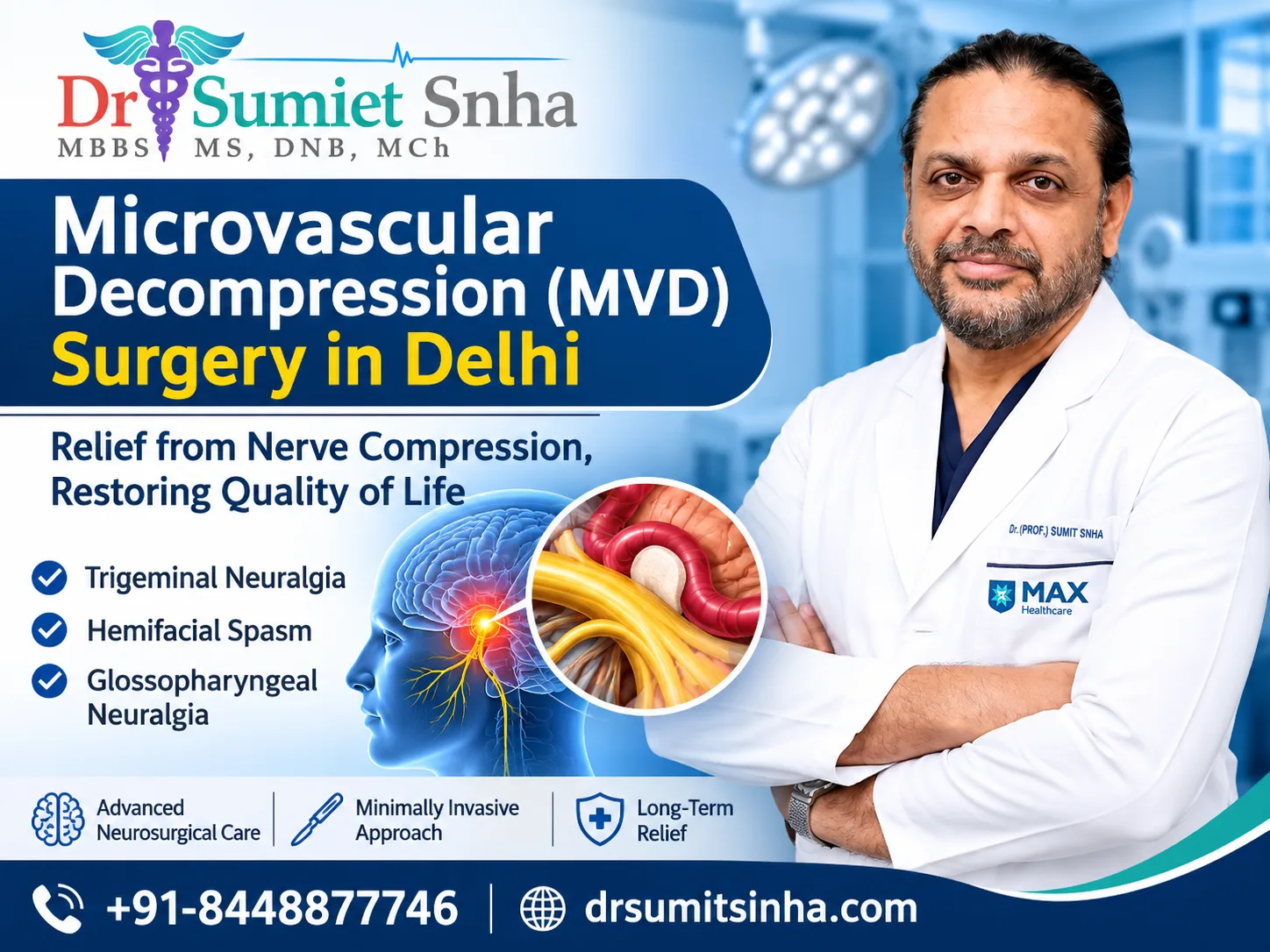
Microvascular Decompression (MVD) Surgery in Delhi is an advanced neurosurgical procedure designed to relieve severe nerve-related pain and involuntary facial movements caused by blood vessels compressing cranial nerves near the brainstem. This procedure is particularly useful for patients suffering from trigeminal neuralgia, hemifacial spasm and glossopharyngeal neuralgia when conservative treatments do not provide adequate relief.
Persistent facial pain, sudden electric-shock-like sensations and involuntary muscle contractions can significantly affect everyday activities. Simple actions such as eating, brushing teeth, speaking or smiling may become uncomfortable or painful. In many cases, these symptoms develop because a nearby artery or vein continuously presses against a cranial nerve.
Microvascular Decompression (MVD) addresses this underlying problem by carefully separating the blood vessel from the affected nerve. Unlike procedures that intentionally damage nerve fibres, MVD aims to preserve normal nerve function while reducing abnormal irritation and pain signals.
What Is Microvascular Decompression (MVD) Surgery?
Microvascular Decompression (MVD) Surgery is a specialised brain surgery performed to relieve pressure on cranial nerves caused by nearby blood vessels. It is commonly recommended for selected patients with trigeminal neuralgia, hemifacial spasm and glossopharyngeal neuralgia.
Cranial nerves originate from the brain and control several important functions, including facial sensation, facial movements, swallowing and hearing. When a blood vessel repeatedly presses against one of these nerves, it may interfere with normal nerve signals.
During MVD surgery, a neurosurgeon accesses the affected nerve through a small opening in the skull, generally behind the ear. Using an operating microscope and specialised surgical instruments, the surgeon identifies the compressing blood vessel and gently moves it away from the nerve.
A small piece of medical-grade cushioning material, commonly Teflon felt, may be placed between the vessel and nerve to prevent further contact.
The main objectives of the procedure include:
Relieving abnormal pressure on the affected cranial nerve.
Reducing nerve irritation and abnormal electrical signalling.
Providing long-term relief from facial pain or muscle spasms.
Preserving normal facial sensation and nerve function.
Reducing dependence on long-term pain medications in suitable patients.
Conditions Treated with Microvascular Decompression Surgery
Microvascular decompression is primarily used for neurological conditions associated with vascular compression of cranial nerves.
1. Trigeminal Neuralgia
Trigeminal neuralgia is a neurological condition characterised by sudden, severe facial pain that may feel like an electric shock, stabbing sensation or intense burning pain.
The condition affects the trigeminal nerve, which carries sensory information from the face to the brain.
Common symptoms include:
Sudden episodes of severe facial pain.
Pain affecting the forehead, cheek or jaw.
Discomfort while chewing, speaking or brushing teeth.
Pain triggered by touching the face or exposure to cold air.
Repeated episodes lasting from a few seconds to several minutes.
When trigeminal neuralgia develops because of vascular compression, MVD may provide significant and long-lasting relief in appropriately selected patients.
2. Hemifacial Spasm
Hemifacial spasm is a neurological condition involving involuntary contractions of muscles on one side of the face.
It commonly develops when a blood vessel compresses the facial nerve near the brainstem.
Symptoms may include:
Repeated twitching around one eye.
Involuntary closing of the eyelid.
Twitching of the cheek and mouth.
Facial muscle contractions that become more frequent over time.
Difficulty maintaining normal facial expressions.
In suitable patients, MVD can relieve the pressure responsible for abnormal facial nerve activity.
3. Glossopharyngeal Neuralgia
Glossopharyngeal neuralgia is a relatively uncommon condition that causes sudden, severe pain involving the throat, tonsil region, back of the tongue or ear.
The pain may be triggered by swallowing, talking, coughing or chewing.
When vascular compression is identified as the underlying cause, microvascular decompression may be considered as a treatment option.
What Causes Nerve Compression?
The brain contains several arteries and veins that supply oxygen and nutrients to different regions. These blood vessels pass close to cranial nerves as they emerge from the brainstem.
In certain individuals, a blood vessel may come into direct contact with a nerve near its root entry or exit zone.
Continuous vascular pulsations can gradually affect the protective covering of the nerve, known as the myelin sheath. This may lead to abnormal communication between nerve fibres and trigger painful sensations or involuntary muscle contractions.
Common contributing factors include:
Age-related changes in blood vessel structure.
Abnormal positioning or looping of arteries.
Vascular contact near the cranial nerve root.
Changes in the protective covering of nerve fibres.
Anatomical variations around the brainstem.
Not every case of facial pain or muscle twitching is caused by vascular compression. A detailed neurological examination and appropriate imaging are important for identifying the actual cause.
How Is Microvascular Decompression Surgery Diagnosed and Planned?
Before recommending Microvascular Decompression Surgery in Delhi, a neurosurgeon carefully evaluates the patient's symptoms, medical history and diagnostic imaging.
The purpose of this evaluation is to determine whether vascular compression is responsible for the neurological symptoms and whether surgery is appropriate.
1. Neurological Examination
The doctor evaluates facial sensation, muscle movements, pain patterns and other neurological functions. The history of symptoms helps distinguish trigeminal neuralgia, hemifacial spasm and other neurological conditions.
2. MRI Brain
A high-resolution MRI brain scan helps identify the relationship between cranial nerves and surrounding blood vessels.
Specialised imaging sequences, including thin-section T2-weighted imaging and MR angiography when indicated, may help identify vascular compression.
3. Medical History and Medication Review
The doctor reviews previous treatments, medications, associated medical conditions and the patient's overall health.
For patients with trigeminal neuralgia, the response to medications such as carbamazepine or oxcarbazepine may also help guide treatment decisions.
4. Surgical Fitness Assessment
Before surgery, patients may undergo blood investigations, ECG and anaesthesia evaluation. Additional tests may be recommended depending on their medical history.
A complete assessment helps determine the safest and most appropriate treatment approach.
How Is Microvascular Decompression Surgery Performed?
MVD surgery is performed under general anaesthesia by an experienced neurosurgical team. The procedure requires careful handling of delicate cranial nerves and nearby blood vessels.
The major surgical steps include:
Step 1: Anaesthesia and Positioning
The patient receives general anaesthesia and is positioned to allow safe access to the affected cranial nerve.
Step 2: Small Surgical Incision
A small incision is made behind the ear on the affected side. A limited opening in the skull, known as a retrosigmoid craniotomy, is created to access the surgical area.
Step 3: Identifying the Affected Nerve
The neurosurgeon carefully accesses the area around the brainstem and identifies the affected cranial nerve using an operating microscope.
Step 4: Locating the Compressing Blood Vessel
The surgeon examines the nerve to identify the artery or vein responsible for abnormal compression. Endoscopic assistance may be used to inspect areas that are difficult to visualise through the microscope alone.
Step 5: Decompression of the Nerve
The compressing blood vessel is gently moved away from the nerve. A small piece of Teflon felt may be positioned between the structures, or the vessel may be transposed and secured away from the nerve.
Step 6: Monitoring and Closure
Appropriate intraoperative monitoring may be used to help protect important neurological functions, including hearing and facial nerve activity.
After confirming the decompression, the surgical opening is carefully closed.
The duration of surgery varies according to the condition, anatomy and complexity of the case.
Benefits of Microvascular Decompression Surgery
For appropriately selected patients, Microvascular Decompression Surgery offers several important advantages.
1. Addresses the Underlying Cause
Unlike treatments that primarily control pain signals, MVD directly addresses the vascular compression responsible for symptoms.
2. Long-Term Pain Relief
Many patients with classical trigeminal neuralgia experience substantial and lasting pain relief following successful surgery.
3. Preserves Facial Sensation
The procedure aims to relieve pressure without intentionally damaging the trigeminal nerve, helping preserve normal facial sensation.
4. Improvement in Facial Spasms
Patients with vascular compression-related hemifacial spasm may experience significant improvement or complete resolution of involuntary muscle contractions.
5. Reduced Dependence on Medication
Patients who respond well to surgery may gradually reduce their neurological medications under medical supervision.
6. Improvement in Daily Activities
Relief from severe facial pain or involuntary muscle movements can help patients return to normal activities and improve their quality of life.
However, treatment outcomes differ between individuals, and no surgical procedure can guarantee permanent relief.
Risks and Possible Complications of MVD Surgery
Although microvascular decompression is an established neurosurgical procedure, it involves operating near important cranial nerves and blood vessels.
Potential risks and complications include:
Hearing changes or hearing loss.
Facial weakness or numbness.
Cerebrospinal fluid leakage.
Infection or bleeding.
Dizziness or balance difficulties.
Cerebellar or brainstem-related complications.
Anaesthesia-related complications.
Recurrence of symptoms over time.
The likelihood of complications depends on individual anatomy, medical conditions and surgical complexity.
A detailed discussion with the neurosurgeon helps patients understand the expected benefits, limitations and potential risks before making a treatment decision.
Recovery After Microvascular Decompression Surgery
Recovery following MVD surgery depends on the patient's general health, the underlying neurological condition and the complexity of the procedure.
Patients are generally monitored in the hospital after surgery to assess neurological function and identify any early complications.
Initial Recovery
During the first few days, the medical team monitors:
Facial sensation and muscle movements.
Hearing and balance.
Headache and surgical wound healing.
Neurological status and general health.
Hospital stay varies, but many patients require approximately 3–5 days, depending on their recovery and medical condition.
Returning to Daily Activities
After discharge, patients receive instructions regarding wound care, medication and physical activity.
Strenuous activities and heavy lifting should generally be avoided until the treating surgeon gives clearance.
Long-Term Follow-Up
Regular follow-up appointments help evaluate symptom improvement, medication requirements and overall recovery.
In patients with trigeminal neuralgia, pain relief may occur immediately or improve over time. Similarly, hemifacial spasm may resolve immediately or gradually reduce over several weeks or months.
Patients should never stop prescribed medication without consulting their treating doctor.
Microvascular Decompression vs Other Treatment Options
Not every patient with facial pain or involuntary facial movements requires surgery. Treatment depends on the underlying diagnosis, severity of symptoms, MRI findings and overall health.
| Treatment | Main Approach |
|---|---|
| Medications | Control abnormal nerve activity and pain |
| Radiofrequency Rhizotomy | Uses controlled heat to interrupt pain signals |
| Balloon Compression | Applies controlled pressure to trigeminal nerve fibres |
| Stereotactic Radiosurgery | Uses focused radiation to target the nerve |
| Microvascular Decompression | Separates the compressing blood vessel from the nerve |
Microvascular decompression is often considered for medically fit patients with classical trigeminal neuralgia and convincing neurovascular compression, particularly when medications are ineffective or poorly tolerated.
Other treatment options may be more appropriate for patients with significant medical risks, multiple sclerosis-related trigeminal neuralgia or no clear evidence of vascular compression.
The final decision should always be made after an individual medical assessment.
Why Choose Dr. (Prof.) Sumiet Snha for Microvascular Decompression Surgery in Delhi?
Choosing an experienced neurosurgeon is an important part of planning treatment for complex cranial nerve disorders.
Dr. (Prof.) Sumiet Snha is an AIIMS-trained neurosurgeon with qualifications including MBBS, MS, DNB, MCh (AIIMS, New Delhi) and FACS. He previously served as Professor of Neurosurgery at AIIMS, New Delhi, and has extensive experience in complex brain, spine and peripheral nerve surgery.
He currently serves as Principal Director – Neurosurgery & Spine Surgery at Max Hospital, Dwarka, New Delhi.
His professional experience and areas of expertise include:
Extensive experience in complex neurosurgical procedures.
Specialised training in microsurgical and minimally invasive techniques.
Experience in cranial nerve and peripheral nerve surgery.
Expertise in endoscopic and microscope-assisted neurosurgical approaches.
Comprehensive evaluation and individualised treatment planning.
Patients interested in learning more about his qualifications, professional background and areas of expertise can visit the official profile of Dr. (Prof.) Sumiet Snha.
For patients considering Microvascular Decompression (MVD) Surgery in Delhi, an individual consultation helps determine whether the procedure is suitable and which treatment approach may offer the most appropriate outcome.
Frequently Asked Questions (FAQs)
1. What is the success rate of Microvascular Decompression Surgery?
MVD has favourable outcomes in appropriately selected patients, particularly those with classical trigeminal neuralgia and identifiable vascular compression. Success rates vary according to the underlying condition, patient characteristics and duration of follow-up.
2. Is Microvascular Decompression Surgery permanent?
MVD can provide long-term relief, and many patients remain free from their original symptoms for years. However, recurrence is possible in some cases.
3. Is MVD surgery painful?
The procedure is performed under general anaesthesia, so patients do not experience pain during surgery. Some headache, incision discomfort or temporary soreness may occur during recovery.
4. How long does recovery take after MVD surgery?
Initial hospital recovery generally takes several days. Returning to normal activities may require a few weeks, depending on the patient's condition and the surgeon's recommendations.
5. Can Microvascular Decompression treat trigeminal neuralgia?
Yes. MVD is an established surgical treatment for selected patients with trigeminal neuralgia caused by vascular compression of the trigeminal nerve.
6. Can MVD surgery treat hemifacial spasm?
Yes. MVD can relieve vascular compression of the facial nerve and provide significant improvement or resolution of hemifacial spasm in many appropriately selected patients.
7. Does MVD surgery cause facial numbness?
MVD aims to preserve the normal structure and function of the affected nerve. Facial numbness is possible but is generally less common than with procedures that deliberately damage trigeminal nerve fibres.
8. Who is a suitable candidate for MVD surgery?
Patients with severe or persistent symptoms, inadequate response to medication and clear evidence of neurovascular compression may be considered. Overall health and surgical fitness are also important factors.
9. Is MRI necessary before Microvascular Decompression Surgery?
High-resolution MRI is an important part of preoperative assessment. It helps evaluate the relationship between cranial nerves and surrounding blood vessels and identify other possible causes of symptoms.
10. Where can I consult for Microvascular Decompression Surgery in Delhi?
Patients can consult Dr. (Prof.) Sumiet Snha at Max Super Speciality Hospital, Dwarka, New Delhi, for neurological evaluation and discussion of appropriate treatment options.
Conclusion
Persistent facial pain, trigeminal neuralgia and hemifacial spasm can significantly affect physical comfort, emotional well-being and everyday life. When these conditions develop due to vascular compression of cranial nerves, Microvascular Decompression Surgery may offer an effective treatment option.
With detailed neurological assessment, appropriate imaging and careful surgical planning, patients can understand whether MVD is suitable for their condition.
For professional evaluation and treatment guidance, consult Dr. (Prof.) Sumiet Snha, an experienced neurosurgeon at Max Hospital, Dwarka, New Delhi.



0 Comments