
Sciatica pain can make everyday activities such as walking, sitting, bending, or sleeping unexpectedly difficult. It occurs when the sciatic nerve, the large nerve extending from the lower back through the buttocks and into the legs, becomes irritated, inflamed, or compressed. A herniated disc, lumbar spinal stenosis, bone changes, or other lower-spine conditions can contribute to these symptoms. The right Sciatica treatment depends on what is causing the nerve irritation, how severe the symptoms are, and whether weakness or numbness is present. Early medical assessment can help identify the underlying spinal problem and guide appropriate treatment before persistent pain or nerve-related problems affect daily life.
What Is Sciatica Pain?
Sciatica is a type of nerve-related pain that develops when the sciatic nerve is irritated, inflamed, or compressed in the lower spine. This large nerve begins in the lower back, passes through the buttocks and hip area, and extends down each leg. Unlike ordinary lower back pain, sciatica often follows a specific path and may travel from the lower back or buttock into the thigh, calf, or foot. Sciatic nerve pain commonly affects one side of the body and may cause burning, tingling, numbness, or weakness. Nerve compression from a spinal disc or other lower-back condition is a frequent underlying cause of associated leg pain.
What Causes Sciatica Pain?
Understanding the sciatica pain causes is important because the right treatment depends on what is irritating or compressing the sciatic nerve. Sciatica often begins with a problem in the lumbar spine, where nerve roots that form the sciatic nerve can become pressured or inflamed.
Common Causes of Sciatica
Some of the most frequent causes include:
- Herniated or slipped disc: A damaged disc can bulge outward and press against a nearby nerve root, resulting in herniated disc and sciatica.
- Lumbar spinal stenosis: Narrowing within the spinal canal can reduce space around the nerves and lead to nerve compression.
- Degenerative disc changes: Age-related wear in spinal discs may contribute to nerve irritation.
- Bone spurs: Extra bone growth caused by arthritis can narrow the space around spinal nerves.
- Spondylolisthesis: One vertebra may shift forward relative to another, potentially reducing available space for nerves.
- Injury or other spinal conditions: Trauma, inflammation, or less common structural problems can occasionally trigger sciatic symptoms.
Risk Factors
The likelihood of developing sciatica may increase with:
- Getting older and experiencing natural spinal changes
- Sitting for long periods without movement
- Poor posture or improper body mechanics
- Physically demanding jobs
- Excess body weight
- Repeated lifting, bending, or twisting
Identifying the specific cause helps a spine specialist determine whether conservative care, targeted procedures, or another form of sciatica treatment is appropriate.
Common Symptoms of Sciatica
Sciatica symptoms can vary depending on how strongly a spinal nerve is irritated or compressed. The discomfort often follows the path of the sciatic nerve rather than remaining limited to the lower back. Common symptoms include:
- Pain that travels from the lower back or buttock into the thigh, calf, or foot
- Burning, shooting, or electric-shock-like pain
- Numbness or reduced sensation in the leg or foot
- Tingling or a “pins and needles” feeling
- Muscle weakness that may affect walking or leg movement
- Pain that becomes worse after prolonged sitting, coughing, sneezing, bending, or certain movements
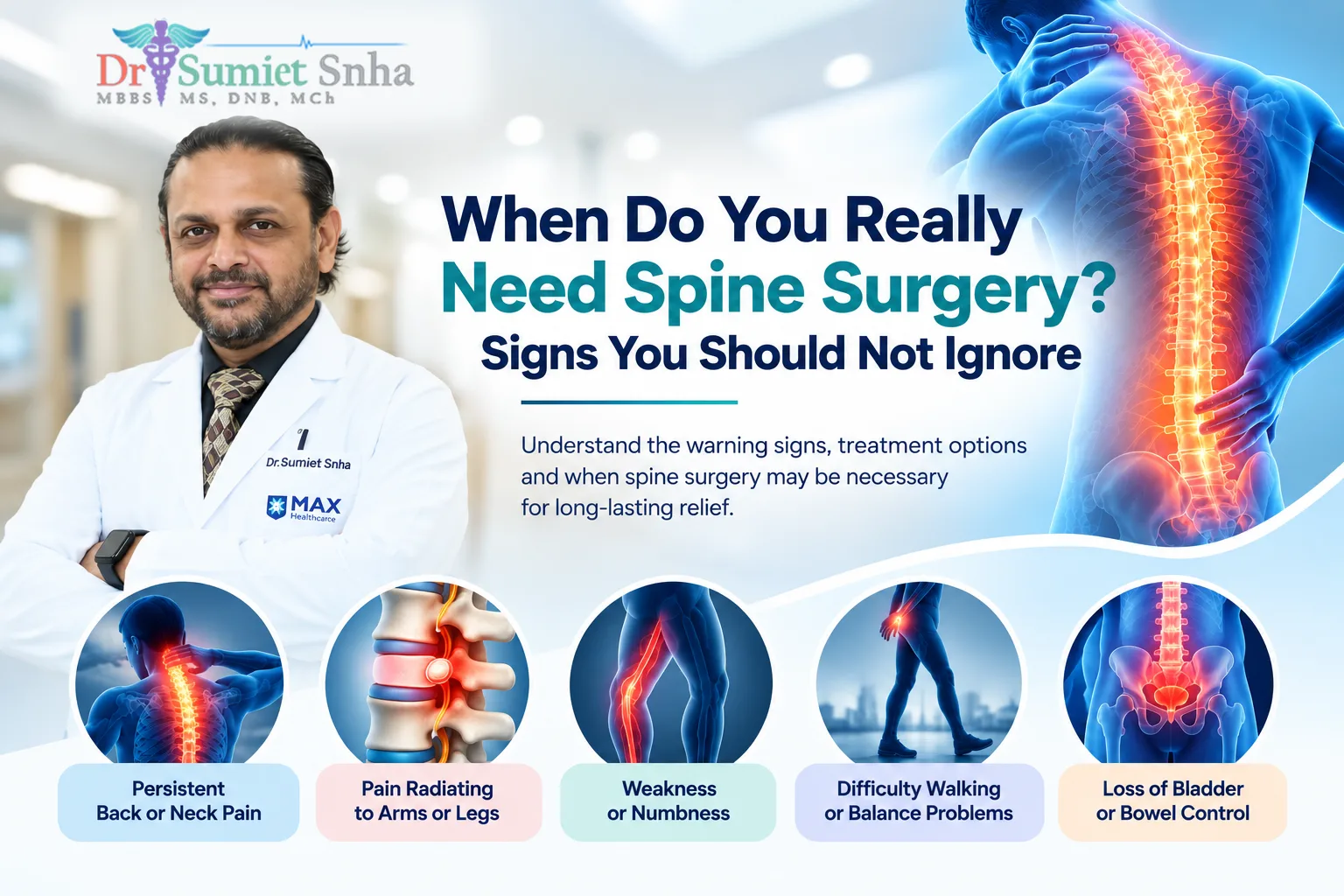
When Are Sciatica Symptoms an Emergency?
Some symptoms require urgent medical evaluation, particularly:
- New or progressively worsening weakness in a leg
- Loss of bladder or bowel control
- Numbness around the inner thighs, buttocks, or genital area (saddle region)
- Severe back or leg symptoms following significant trauma
These warning signs can indicate serious nerve compression and should not be ignored. Prompt assessment can help reduce the risk of permanent neurological problems.
How Is Sciatica Diagnosed?
Diagnosing sciatica begins with understanding the patient’s symptoms, medical history, and how the pain travels through the lower back, buttock, and leg. A doctor may perform a physical and neurological examination, including a straight-leg raise test, to check nerve irritation, sensation, reflexes, and muscle strength. Imaging such as an MRI may be recommended when symptoms persist or significant nerve compression is suspected. X-rays or CT scans may be useful in selected cases, while electromyography (EMG) or nerve-conduction studies can help assess nerve function when clinically indicated. Imaging is not routinely required for uncomplicated acute sciatica unless persistent symptoms, neurological deficits, or another serious condition warrant further investigation.
Best Sciatica Treatment Options in 2026
The right Sciatica treatment depends on the underlying cause, intensity and duration of symptoms, overall health, and whether neurological changes such as numbness or weakness are present. A personalized approach can help address both pain and the spinal problem responsible for nerve irritation.
Non-Surgical Treatment
For many patients, initial care may include:
- Activity modification: Avoiding movements that aggravate symptoms while maintaining appropriate daily activity.
- Physical therapy: Guided exercises can improve mobility, strength, flexibility, and spinal support.
- Targeted sciatica exercises: Specific movements may help reduce nerve irritation and improve function.
- Pain-relieving medicines: Medicines may be recommended when medically appropriate.
- Heat or cold therapy: These may provide short-term symptom relief for some people.
- Posture and lifestyle changes: Improving sitting habits, lifting techniques, and general activity levels may support recovery.
Interventional Treatment
For selected patients with persistent radiating pain, an epidural steroid injection may be considered. It can reduce inflammation around an irritated nerve and provide temporary relief, but it does not remove the underlying structural cause.
Surgical Treatment
Surgery may be considered when significant nerve compression is confirmed, symptoms continue despite appropriate conservative care, or progressive weakness develops. Endoscopic spine surgery is a minimally invasive option for selected spinal conditions where the source of nerve compression can be safely treated.
Sciatica Treatment Without Surgery vs Surgery
The choice between non-surgical care and surgery depends on the cause of sciatica, symptom severity, duration, neurological findings, and response to initial treatment. The following comparison provides a simple overview of common approaches:
|
Treatment Approach |
Commonly Used For |
Main Benefit |
Limitations |
|
Activity modification |
Mild or early symptoms |
Reduces activities that may aggravate nerve irritation |
May not resolve significant nerve compression |
|
Physical therapy |
Many uncomplicated sciatica cases |
Supports mobility, flexibility, and muscle strength |
Results depend on regular participation |
|
Medicines |
Pain or inflammation |
Can provide short-term symptom control |
May not be suitable for every patient |
|
Epidural injection |
Selected nerve-root inflammation |
May reduce radiating leg pain for a period of time |
Relief can be temporary and does not correct the underlying cause |
|
Endoscopic spine surgery |
Selected structural nerve compression |
Uses a minimally invasive approach in appropriate cases |
Not suitable for every spinal condition |
|
Conventional spine surgery |
Significant structural compression |
Can directly address certain causes of nerve compression |
Recovery varies and may be longer depending on the procedure |
Which Treatment Is Right for You?
There is no single best Sciatica treatment for everyone. A treatment that works well for one patient may not be appropriate for another. The underlying cause, severity of nerve compression, duration of symptoms, and neurological status should be evaluated before deciding between conservative care, injections, or surgery. A qualified spine specialist can help determine the most appropriate treatment pathway based on individual findings.
How to Get Long-Term Sciatica Pain Relief
Long-term sciatica pain relief depends on addressing the cause while gradually restoring normal movement and strength. Patients can support recovery by following a personalized physiotherapy plan and performing appropriate sciatica exercises recommended by a qualified professional. Good sitting and standing posture can reduce unnecessary strain on the lower back. Avoid prolonged inactivity, but also increase activity gradually rather than suddenly. Use safe lifting techniques and maintain a healthy body weight to reduce stress on the spine. For suitable patients, sciatica treatment without surgery may provide effective symptom management. Always follow your doctor’s advice regarding medicines, exercises, activity levels, and follow-up care to reduce the risk of recurring symptoms.
When Should You See a Spine Specialist for Sciatica?
A spine specialist evaluation may be appropriate when sciatica pain persists, repeatedly returns, disrupts sleep or daily activities, or is accompanied by numbness or weakness. Medical assessment is also important when symptoms do not improve with appropriate conservative care or imaging shows significant nerve compression. Emergency warning signs require prompt evaluation. A spine specialist can review your symptoms and investigations to determine whether continued non-surgical care, an injection, or surgery is appropriate for your condition.
About Dr. (Prof.) Sumiet Snha
Dr. (Prof.) Sumiet Snha is Vice Chairman – Neurosciences (Neurology & Spine) and has more than 25 years of experience in neurosurgery. He completed his advanced neurosurgical training at All India Institute of Medical Sciences (AIIMS), New Delhi, and has received further training and professional exposure internationally.
His areas of experience include neurosurgery, spine surgery, minimally invasive spine procedures, spinal injuries, brachial plexus surgery, and peripheral nerve surgery. He has also received spinal training through AO Spine and has been involved in teaching and research activities.
Professional Background
- Principal Director – Neuro & Spine Surgery, MAX Hospital, Dwarka, New Delhi
- Ex-Director – Neuro & Spine Surgery, Paras Health, Gurugram
- Ex-Professor, Department of Neurosurgery, AIIMS, New Delhi
- Secretary, Neurotrauma Society of India
- Founder Secretary, Indian Society of Peripheral Nerve Surgery
- Former faculty member at AIIMS, New Delhi
- Involved in cadaver-based training and neurosurgical education
Dr. (Prof.) Sumiet Snha has a particular interest in minimally invasive spine surgery, which may help selected patients undergo treatment through smaller surgical approaches. However, suitability for any procedure depends on the individual's diagnosis, imaging findings, symptoms, overall health, and neurological condition.
Frequently Asked Questions About Sciatica Pain
1. What is sciatica pain?
Sciatica pain occurs when the sciatic nerve or one of its contributing nerve roots becomes irritated or compressed, often causing pain that travels from the lower back or buttock into the leg.
2. What causes sciatica?
Common causes include a herniated disc, lumbar spinal stenosis, degenerative spinal changes, bone spurs, and sometimes vertebral conditions that place pressure on a nerve.
3. What are the most common sciatica symptoms?
Typical symptoms include pain radiating into the buttock or leg, burning or shooting sensations, numbness, tingling, and, in some cases, muscle weakness.
4. Can sciatica go away on its own?
Many cases improve with time and appropriate conservative care. However, symptoms that persist, worsen, or become associated with weakness or significant numbness should be medically assessed.
5. What is the best treatment for sciatica?
There is no single treatment that is best for everyone. Sciatica treatment depends on the underlying cause, symptom severity, duration, and whether there is significant nerve compression or neurological impairment.
6. Can sciatica be treated without surgery?
Yes. Depending on the cause, treatment may include activity modification, physiotherapy, appropriate exercises, medicines, and selected injections. A healthcare professional can determine which options are suitable.
7. Which exercises are good for sciatica?
The most appropriate exercises depend on the cause of the symptoms. A physiotherapist or spine specialist can recommend movements that match the patient's condition rather than relying on a generic exercise routine.
8. When does sciatica require surgery?
Surgery may be considered when significant nerve compression causes persistent disabling symptoms despite appropriate non-surgical treatment, or when progressive neurological weakness develops.
9. Can a slipped disc cause sciatica?
Yes. A herniated or slipped disc can press against a nearby nerve root in the lower spine. This nerve compression may produce pain, numbness, tingling, or weakness along the sciatic nerve pathway.
10. How long does sciatica usually last?
The duration varies considerably. Some cases improve within weeks, while symptoms caused by persistent structural problems may last longer. Recovery depends on the underlying cause and response to treatment.
11. Is sciatica a serious condition?
Many cases can be managed successfully, but sciatica should not always be dismissed as routine back pain. New or worsening weakness, bladder or bowel problems, or numbness around the saddle region requires prompt medical evaluation.
12. When should I see a doctor for sciatica?
Consider medical evaluation when pain persists or repeatedly returns, affects normal activities, or is accompanied by numbness or weakness. Seek urgent assessment for bladder or bowel control problems, saddle-area numbness, or rapidly worsening neurological symptoms.
Conclusion
Sciatica commonly develops when a nerve in the lower spine becomes irritated or compressed, causing symptoms that can extend from the back into the leg. Identifying the underlying cause is essential for choosing appropriate Sciatica treatment. Many patients improve with non-surgical care, while selected cases may require injections or surgery. If pain is persistent, severe, or accompanied by neurological changes, professional evaluation is important. An individualized treatment plan can help address the cause, manage symptoms, and support a safer return to daily activities.

0 Comments