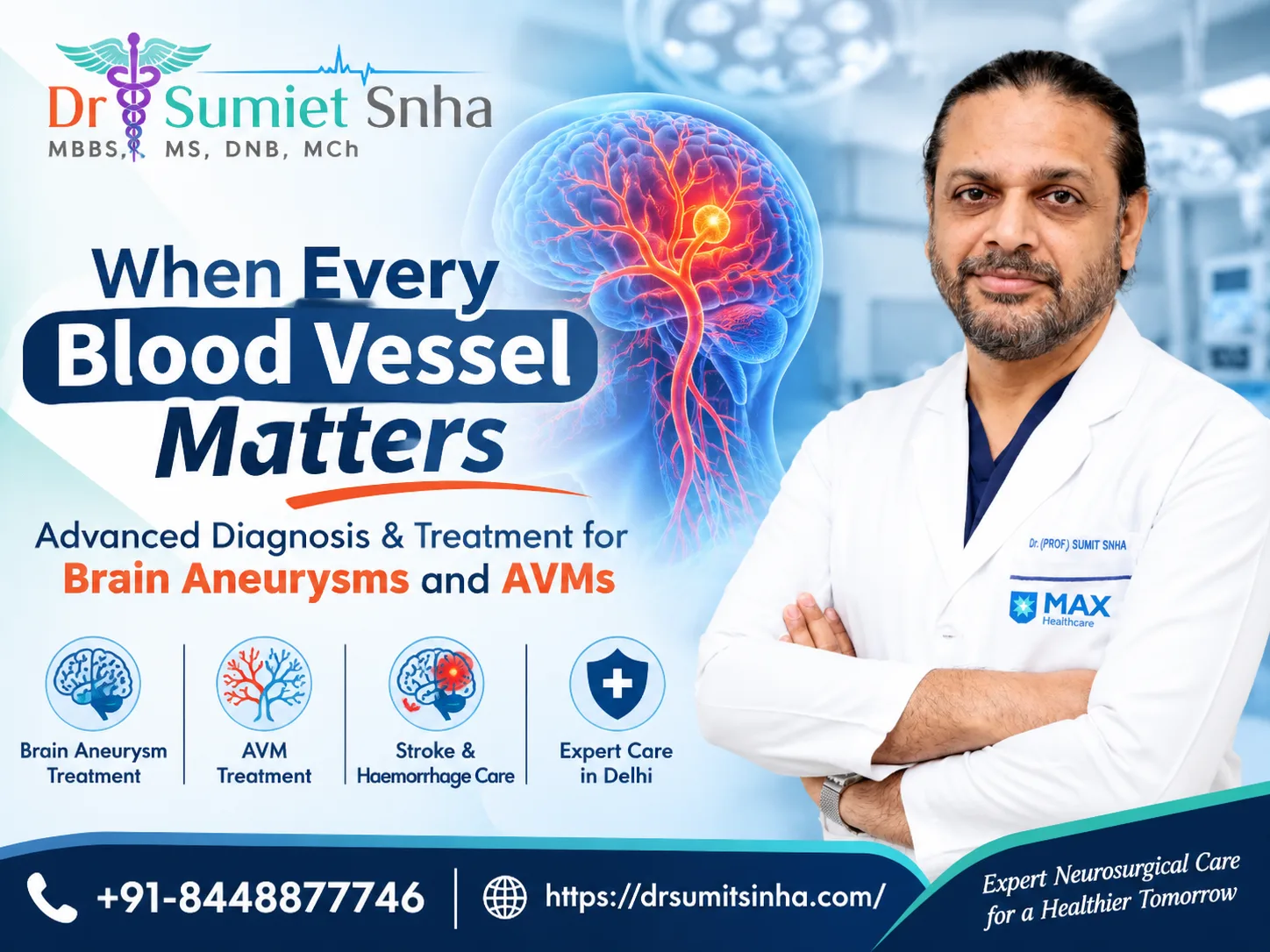
Vascular Neurosurgery in Delhi is an important specialised field of neurosurgery that focuses on diagnosing and treating abnormalities of the blood vessels in the brain and spinal cord. Conditions such as brain aneurysms, arteriovenous malformations (AVMs), and brain haemorrhages require accurate diagnosis and carefully planned treatment to reduce the risk of serious neurological complications.
Dr. (Prof.) Sumiet Snha, former Professor of Neurosurgery at AIIMS, New Delhi, has a special interest in cerebrovascular surgery and the management of complex brain vascular conditions. He provides specialised neurosurgical consultation at Max Hospital, Dwarka, New Delhi, for patients requiring evaluation and treatment of these conditions.
What Is Vascular Neurosurgery?
Vascular neurosurgery, also known as cerebrovascular neurosurgery, is a specialised branch of medical science that deals with disorders affecting the blood vessels supplying the brain and spinal cord.
The brain receives oxygen and nutrients through a complex network of arteries and veins. Any abnormality in this network can interfere with normal blood circulation and potentially lead to bleeding, stroke, seizures or other neurological problems.
Modern Vascular Neurosurgery in Delhi involves advanced diagnostic techniques, microsurgical procedures and endovascular treatment approaches. The appropriate treatment depends on the type of vascular abnormality, its location, severity and the patient's overall health.
The primary objectives of cerebrovascular treatment include:
Managing abnormal blood vessels.
Preventing or controlling bleeding in the brain.
Maintaining healthy blood circulation.
Reducing the risk of stroke and neurological complications.
Protecting surrounding brain tissue and neurological functions.
Common Conditions Treated Through Vascular Neurosurgery
Several neurological conditions can affect the blood vessels of the brain and spinal cord. Some may remain asymptomatic, while others can cause sudden and serious complications.
1. Brain Aneurysm
A brain aneurysm develops when a weak area in an artery wall becomes enlarged and forms a balloon-like bulge. Although some aneurysms remain stable, a ruptured aneurysm can cause subarachnoid haemorrhage, which requires immediate medical attention.
Common symptoms of a ruptured brain aneurysm include:
Sudden and extremely severe headache.
Nausea and vomiting.
Neck stiffness.
Sensitivity to light.
Seizures or loss of consciousness.
Depending on the patient's condition, Brain Aneurysm Treatment in Delhi may involve microsurgical clipping, endovascular coiling or flow diversion. Some unruptured aneurysms may require regular monitoring instead of immediate intervention.
2. Arteriovenous Malformation (AVM)
An Arteriovenous Malformation (AVM) is an abnormal connection between arteries and veins that bypasses the normal capillary network. These abnormal blood vessels can create pressure-related complications and may carry a risk of bleeding.
Symptoms may include:
Seizures.
Persistent or recurring headaches.
Sudden neurological weakness.
Difficulty speaking or maintaining balance.
Brain haemorrhage in cases of rupture.
AVM Treatment in Delhi may involve microsurgical removal, endovascular embolisation, stereotactic radiosurgery or observation in selected cases. Treatment planning depends on the AVM's size, location and Spetzler-Martin grade.
3. Cavernous Malformations
Cavernous malformations, also called cavernomas, are clusters of abnormal blood vessels with thin walls. They can develop in different areas of the brain and may cause seizures, headaches or repeated small haemorrhages.
MRI is particularly useful for identifying these abnormalities. Surgery may be considered when a cavernoma causes significant symptoms or repeated bleeding, depending on its location and surgical accessibility.
4. Brain Haemorrhage and Stroke
A brain haemorrhage occurs when a blood vessel ruptures and causes bleeding within or around the brain. High blood pressure is an important risk factor for certain types of intracerebral haemorrhage.
A stroke can also occur when blood flow to a part of the brain becomes blocked. Depending on the underlying cause, patients may require emergency medical treatment, surgical intervention or endovascular procedures.
Sudden facial weakness, arm weakness, speech difficulties or loss of balance should never be ignored. Immediate emergency medical attention is essential.
5. Dural Arteriovenous Fistulas and Spinal Vascular Malformations
A dural arteriovenous fistula is an abnormal connection between arteries and veins within the protective covering of the brain. It can interfere with normal venous drainage and may cause bleeding or other neurological complications.
Similarly, spinal vascular malformations affect the blood vessels surrounding the spinal cord. Symptoms may include progressive leg weakness, numbness and bladder-related difficulties.
Specialised imaging and angiography help determine the appropriate treatment strategy.
Advanced Treatment Options in Vascular Neurosurgery
Treatment approaches vary according to the patient's diagnosis and the characteristics of the vascular abnormality. Vascular Neurosurgery in Delhi may involve different microsurgical and minimally invasive techniques.
Microsurgical Clipping
Microsurgical clipping is an established treatment for selected brain aneurysms. During the procedure, a neurosurgeon places a small titanium clip across the neck of the aneurysm to prevent blood from entering it.
The procedure is performed using specialised surgical microscopes and requires careful preservation of surrounding blood vessels.
Endovascular Coiling
Endovascular coiling is a minimally invasive technique used to treat selected brain aneurysms. A catheter is guided through the blood vessels, and small coils are placed inside the aneurysm to promote clot formation.
The technique avoids the need for a traditional open surgical approach in suitable cases.
AVM Embolisation
Endovascular embolisation involves introducing specialised materials through a catheter to block abnormal blood vessels supplying an AVM.
It may be performed as part of a combined treatment strategy or in selected cases as an individual treatment.
Stereotactic Radiosurgery
Stereotactic radiosurgery uses highly focused radiation to treat selected brain AVMs. The treatment gradually causes the abnormal vessels to close over time, rather than removing them immediately.
Microsurgical AVM Removal
In selected cases, a neurosurgeon may recommend microsurgical removal of an AVM. The procedure involves carefully separating and removing the abnormal blood vessel network while protecting healthy brain tissue.
The final treatment decision requires detailed clinical assessment and imaging.
Why Choose Dr. (Prof.) Sumiet Snha for Vascular Neurosurgery in Delhi?
Selecting an experienced neurosurgeon is an important step when dealing with complex cerebrovascular conditions. Patients should consider the surgeon's qualifications, specialised training, clinical experience and available treatment facilities.
Dr. (Prof.) Sumiet Snha has extensive academic and professional experience in the field of neurosurgery.
His professional background includes:
MBBS, MS, DNB and MCh Neurosurgery from AIIMS, New Delhi.
Former Professor of Neurosurgery at AIIMS, New Delhi.
Fellow of the American College of Surgeons (FACS).
International training with renowned neurosurgical experts, including Prof. Hiroshi Sano of Japan.
Recipient of the Young Neurosurgeon Award associated with the 9th International Conference on Cerebrovascular Surgery in Nagoya, Japan.
Special interest in the management of complex brain aneurysms and arteriovenous malformations.
At Max Hospital, Dwarka, New Delhi, he provides neurosurgical consultation for patients with complex brain and spinal conditions.
Patients looking for Vascular Neurosurgery in Delhi can explore his professional qualifications and experience to understand his academic background and neurosurgical expertise.
Diagnosis Before Vascular Neurosurgery
Accurate diagnosis is essential before selecting a treatment approach. Neurosurgeons may recommend different investigations depending on the suspected vascular condition.
Important diagnostic investigations include:
CT Scan: Helps identify brain haemorrhage and other acute neurological abnormalities.
CT Angiography (CTA): Provides detailed images of brain blood vessels and helps identify aneurysms and vascular abnormalities.
MRI Brain: Helps examine brain tissue and detect certain vascular lesions, including cavernous malformations.
MR Angiography (MRA): Provides information about blood vessels and can be useful for screening and follow-up.
Digital Subtraction Angiography (DSA): A specialised investigation that provides detailed images of cerebral blood vessels and helps plan selected vascular procedures.
The choice of diagnostic investigation depends on the patient's symptoms, clinical examination and medical history.
Recovery After Vascular Neurosurgery
Recovery following a cerebrovascular procedure varies depending on the underlying condition, treatment method and patient's neurological health.
Post-treatment care may include:
Regular neurological examinations.
Blood pressure monitoring.
Medication as prescribed by the treating doctor.
Follow-up CT scans, MRI or angiography when required.
Physiotherapy and neurological rehabilitation.
Monitoring for seizures and other complications.
Patients should follow their neurosurgeon's instructions regarding medication, physical activities and follow-up appointments.
Frequently Asked Questions (FAQs)
1. What does a vascular neurosurgeon treat?
A vascular neurosurgeon evaluates and treats disorders affecting blood vessels in the brain and spinal cord, including brain aneurysms, AVMs, cavernous malformations and certain types of brain haemorrhage.
2. When should I consult a vascular neurosurgeon in Delhi?
You should consult a qualified neurosurgeon if you have been diagnosed with a brain aneurysm, AVM, cavernoma or another cerebrovascular abnormality. Sudden severe headaches, seizures, weakness or speech difficulties require urgent medical evaluation.
3. What are the treatment options for brain aneurysms?
Common treatment options include microsurgical clipping, endovascular coiling and flow diversion. Some unruptured aneurysms may be monitored through regular imaging, depending on their characteristics and associated risks.
4. Can an AVM be treated without open brain surgery?
Yes. Selected AVMs may be managed through endovascular embolisation or stereotactic radiosurgery. However, some cases require microsurgical removal, while others may be suitable for observation.
5. Is vascular neurosurgery a major procedure?
The complexity depends on the condition and treatment method. Some procedures are minimally invasive, while others involve complex microsurgery. The neurosurgeon evaluates the potential risks and benefits before recommending treatment.
6. Who provides consultation for vascular neurosurgery in Delhi?
Dr. (Prof.) Sumiet Snha, former Professor of Neurosurgery at AIIMS, New Delhi, provides specialised neurosurgical consultation at Max Hospital, Dwarka, New Delhi.
Conclusion
Cerebrovascular disorders require timely diagnosis, specialised medical evaluation and an appropriate treatment plan. Conditions such as brain aneurysms, AVMs and other vascular abnormalities should be assessed carefully to understand the available treatment options and associated risks.
For patients seeking Vascular Neurosurgery in Delhi, Dr. (Prof.) Sumiet Snha offers specialised neurosurgical consultation backed by his academic experience at AIIMS, New Delhi, international training and clinical expertise in complex brain and spine conditions.
To learn more about available treatment approaches or schedule a consultation, visit the Vascular Neurosurgery in Delhi page or contact the appointment team.
0 Comments