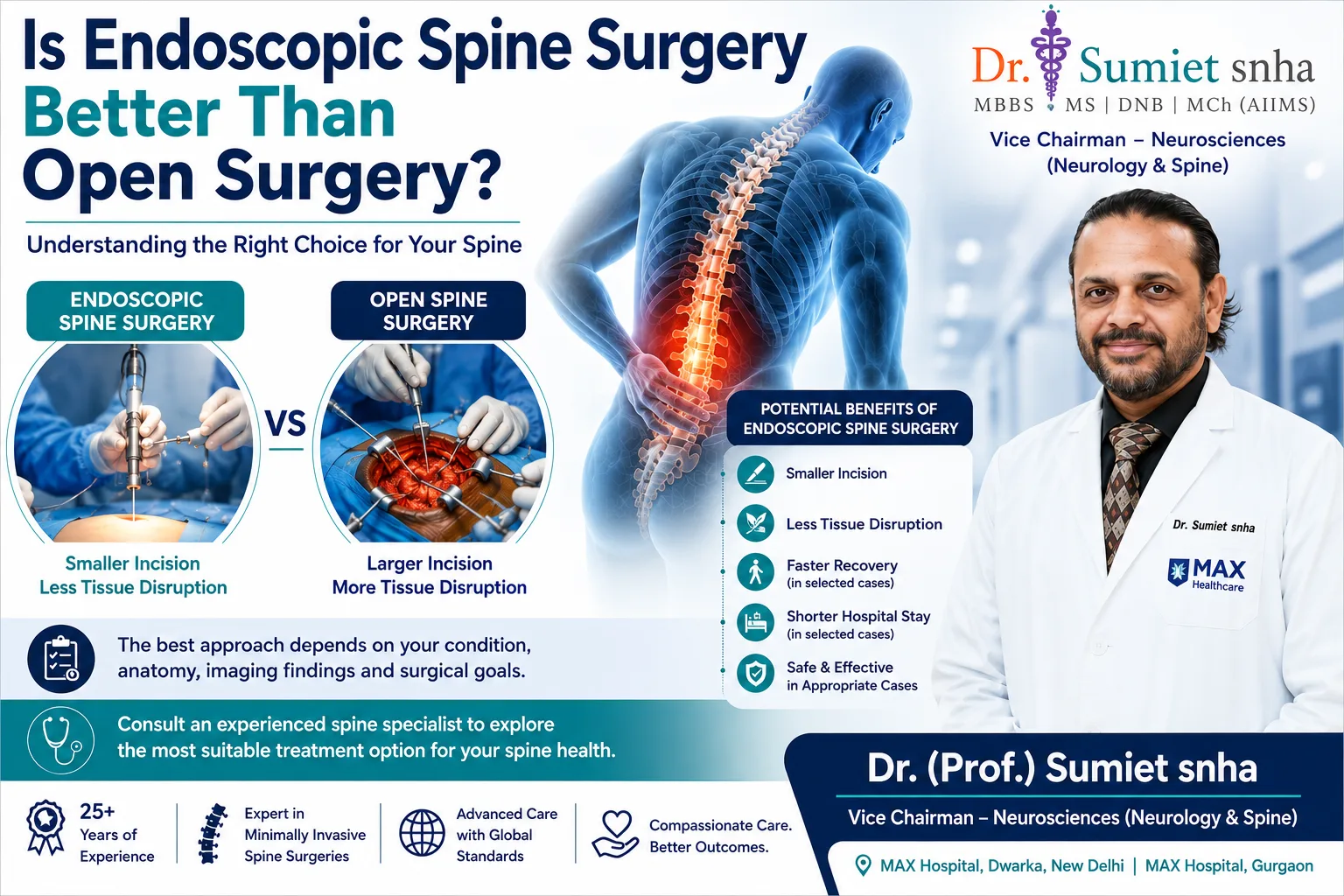
Advances in modern spine care have introduced less invasive techniques that can help selected patients undergo surgery through smaller access points. Minimally invasive spine surgery in Delhi includes advanced approaches such as endoscopic spine surgery, which uses specialized instruments and a small incision to reach the affected area of the spine. Unlike conventional open surgery, endoscopic procedures may reduce disruption to surrounding tissues in suitable cases. However, endoscopic surgery is not automatically better for every patient. The appropriate approach depends on the spinal condition, affected level, symptoms, imaging findings, overall health, and the surgeon’s clinical assessment. This article compares both techniques to help readers understand when each may be appropriate.
What Is Endoscopic Spine Surgery?
Endoscopic spine surgery is a modern surgical technique that uses a small incision, a narrow endoscope, and specialized instruments to reach and treat certain spinal conditions with limited tissue disruption. Instead of creating a wide surgical opening, the surgeon guides the endoscope toward the targeted area while viewing the anatomy through a camera system. Depending on the diagnosis, this approach may be considered for selected disc problems, nerve compression, or other conditions that can be safely accessed through an endoscopic route. Minimally invasive spine surgery in Delhi can provide eligible patients with an alternative among available spine surgery options. The final procedure is selected by a qualified spine surgeon in Delhi after reviewing symptoms, imaging, spinal anatomy, and overall health.
What Is Open Spine Surgery?
Open spine surgery is a conventional surgical approach in which the surgeon creates a larger access point to reach the affected structures of the spine. Compared with endoscopic spine surgery, it can provide broader visibility and access when a condition requires more extensive treatment. Greater exposure may be necessary for complex spinal problems, significant nerve compression, spinal instability, deformities, or procedures involving reconstruction or fusion. Although minimally invasive spine surgery has become an important option for selected patients, open surgery remains a valuable part of modern spine surgery treatment in Delhi. It should not be considered outdated or inferior; the appropriate technique depends on the patient’s condition, anatomy, surgical goals, and clinical assessment.
Endoscopic Spine Surgery vs Open Spine Surgery
Endoscopic and open spine surgery use different surgical approaches, and each may have a role depending on the patient's specific spinal problem. The comparison below highlights general differences, but it should not be interpreted as a recommendation for one technique over another.
|
Feature |
Endoscopic Spine Surgery |
Open Spine Surgery |
|
Surgical access |
Uses a small access point with an endoscope and specialized instruments |
Uses a larger surgical opening to expose the required spinal structures |
|
Incision size |
Typically smaller |
Generally larger, depending on the procedure |
|
Tissue exposure |
Designed to limit unnecessary tissue exposure in suitable cases |
Provides wider access when extensive treatment is required |
|
Visualization |
Camera-assisted visualization through an endoscope |
Direct visualization of the surgical area |
|
Recovery |
May be shorter for appropriately selected procedures |
Recovery varies and may be longer after more extensive procedures |
|
Hospital stay |
May be suitable for shorter hospital stays in selected cases |
Depends on the complexity of surgery and patient's recovery |
|
Scarring |
Usually involves a smaller incision |
May result in a larger surgical scar |
|
Suitability |
Depends on spinal condition, anatomy and surgical objective |
Can be appropriate for complex or extensive spinal conditions |
|
Surgical scope |
Useful for selected minimally invasive procedures |
Allows broader access for procedures requiring greater exposure |
|
Treatment choice |
Determined after clinical and imaging assessment |
Determined according to diagnosis and surgical requirements |
Which Approach Is More Suitable?
The size of the incision alone does not determine which spine surgery is better. Treatment decisions depend on the spinal condition, type of procedure, location of the problem, imaging findings, surgeon expertise, overall health and individual patient factors. While minimally invasive spine surgery and endoscopic spinal surgery may offer advantages for carefully selected patients, open surgery can be the more appropriate option when extensive decompression, stabilization, fusion or reconstruction is required.
Patients considering minimally invasive spine surgery in Delhi should discuss both spine surgery options with an experienced spine surgeon in Delhi rather than choosing a procedure based only on the promise of a smaller incision or faster recovery.
Potential Benefits of Endoscopic Spine Surgery
Minimally invasive spine surgery uses specialized techniques designed to reach the affected spinal area while limiting unnecessary disruption to surrounding tissues. Endoscopic procedures may provide several potential benefits for appropriately selected patients, although results can vary according to the diagnosis and type of surgery.
- Smaller incision: The surgical opening is generally smaller than that used for many traditional procedures.
- Less tissue disruption: The technique may reduce disturbance to nearby muscles and soft tissues.
- Potentially less postoperative discomfort: Some patients may experience less pain after suitable procedures.
- Shorter hospital stay: Certain endoscopic procedures may allow earlier discharge.
- Earlier activity: Selected patients may return to routine activities sooner, depending on recovery.
- Smaller scar: A smaller access point may result in less visible scarring.
- Targeted treatment: Specialized instruments can provide focused access to the affected spinal structure.
When Can Open Spine Surgery Be More Appropriate?
Open spine surgery may be recommended when a spinal problem requires broader access or more extensive surgical correction than an endoscopic approach can safely provide. It may be considered when the condition is complex, substantial nerve decompression is required, spinal instability is present, or spinal fusion or reconstruction is necessary. In some patients, the location or anatomy of the affected area may also make endoscopic spine surgery unsuitable. A wider surgical field can help the surgeon address complicated structural problems effectively. The decision should always follow a detailed medical evaluation rather than the assumption that minimally invasive spine surgery is automatically the better choice for every patient.
Is Endoscopic Spine Surgery Better Than Open Surgery?
Endoscopic spine surgery can offer important advantages for appropriately selected patients, but it is not automatically better than open surgery for every spinal condition. The most suitable approach depends on the patient's diagnosis, anatomy, treatment goals and overall clinical situation. Before recommending a procedure, a spine specialist may consider:
- Patient selection: Not every spinal condition is suitable for an endoscopic approach.
- Type and location of the problem: Disc disorders, nerve compression and other conditions may require different surgical techniques.
- Surgical objective: Decompression, stabilization, fusion or reconstruction can influence the choice.
- Surgeon experience: Appropriate training and experience with the selected technique are important.
- Imaging findings: MRI or CT findings help determine whether the affected area can be safely accessed.
- Overall health and previous surgeries: Medical history can influence surgical planning and recovery.
- Expected recovery and risks: Potential benefits, limitations and complications should be discussed before treatment.
For patients exploring minimally invasive spine surgery in Delhi, an experienced spine specialist can compare available treatment options and recommend an approach based on individual clinical needs rather than incision size alone.
How Doctors Decide Between Endoscopic and Open Surgery
Choosing between endoscopic and open spine surgery requires an individualized clinical assessment rather than a one-size-fits-all approach. A spine specialist reviews the patient's symptoms, medical history and diagnostic results before recommending a surgical technique.
Factors Considered
- Medical history: Previous illnesses, treatments and spine-related concerns.
- Neurological examination: Muscle strength, sensation, reflexes and nerve function.
- MRI or CT findings: Location and extent of spinal compression or structural changes.
- Symptoms: Severity, duration and impact on daily activities.
- Spinal stability: Whether additional stabilization or fusion may be required.
- Previous spine procedures: Earlier surgery can influence the available approach.
- Age and general health: Overall fitness and medical conditions are considered.
- Treatment goals: Expected benefits, recovery requirements and potential risks.
This individualized evaluation helps determine whether minimally invasive spine surgery or an open approach is more appropriate for the patient's specific condition.
Recovery Comparison
Recovery after spine surgery is influenced by the type of procedure, the underlying spinal condition, the patient's general health and the extent of treatment required. Endoscopic techniques may allow a smoother recovery for selected patients, while more extensive open procedures can require additional healing and rehabilitation.
Recovery After Endoscopic Spine Surgery
- Potentially quicker recovery: Selected patients may resume routine activities sooner when the procedure is less extensive.
- Activity restrictions: Returning to exercise, lifting or work should follow the surgeon's specific advice.
- Follow-up care: Regular follow-up remains important even when the procedure involves a small incision.
- Individual variation: Recovery can differ considerably depending on the condition and surgical objective.
Recovery After Open Spine Surgery
- Longer healing: More extensive procedures may require additional time for tissues to heal.
- Rehabilitation: Physiotherapy or structured rehabilitation may be recommended when appropriate.
- Gradual activity: Normal activities are usually resumed according to the surgeon's recovery plan.
- Procedure-specific recovery: Recovery differs significantly between decompression, fusion, reconstruction and other procedures.
Mini Comparison
|
Recovery Factor |
Endoscopic Surgery |
Open Spine Surgery |
|
Incision healing |
Generally involves a smaller access point |
Usually involves a larger surgical opening |
|
Tissue disruption |
May involve less surrounding tissue disruption |
May involve greater tissue exposure |
|
Return to activities |
Depends on the specific procedure and recovery |
Depends on surgical complexity and recovery |
|
Rehabilitation |
May be recommended when appropriate |
May be an important part of recovery |
|
Follow-up |
Required to monitor healing and symptoms |
Required to assess healing and treatment progress |
There is no single recovery timeline that applies to every patient. Even with minimally invasive spine surgery, recovery should be guided by the treating specialist. Patients should follow individualized instructions regarding movement, work, exercise, medication and rehabilitation.
Risks and Limitations of Endoscopic Spine Surgery
Although endoscopic spine surgery can be an effective option for appropriately selected patients, it is not suitable for every spinal condition. Complex disorders may require conventional open surgery, while certain anatomical locations can create technical limitations for an endoscopic approach. Like other surgical procedures, it can involve potential complications, and symptoms may persist or recur depending on the underlying condition. Proper diagnosis, detailed imaging and careful patient selection are essential when considering minimally invasive spine surgery. A qualified spine specialist should assess whether the expected benefits and risks make the procedure appropriate for an individual patient.
Choosing the Right Spine Surgeon in Delhi
Choosing an experienced minimally invasive spine surgeon in Delhi is an important step when considering surgical treatment. Patients researching minimally invasive spine surgery in Delhi or endoscopic spine surgery in Delhi should consider the surgeon's relevant training, credentials and experience with both minimally invasive and open procedures. A proper diagnostic assessment, clear explanation of potential benefits and risks, and discussion of alternative treatments are equally important. The right spine surgeon in Delhi should develop an individualized treatment plan based on the patient's diagnosis, imaging findings, overall health and specific surgical needs.
About Dr. (Prof.) Sumiet Snha
Vice Chairman – Neurosciences (Neurology & Spine)
Dr. (Prof.) Sumiet Snha is a neurosurgeon with more than 25 years of experience in neurosurgery and advanced spine care. He completed his neurosurgical training at AIIMS, New Delhi, and has further enhanced his expertise through international training and professional collaborations with renowned neurosurgical specialists. His areas of expertise include minimally invasive spine surgery, spinal injuries, peripheral nerve surgery and complex neurosurgical procedures. He has also contributed to teaching, research and professional training in India and abroad and is associated with advanced spine and neurosurgical care.
Frequently Asked Questions
FAQ 1. Is endoscopic spine surgery better than open surgery?
Endoscopic spine surgery can offer benefits such as smaller access points and potentially less tissue disruption in carefully selected cases. However, it is not universally better than open surgery. The appropriate technique depends on the spinal condition, anatomy, surgical objective, imaging findings and overall health.
FAQ 2. What is minimally invasive spine surgery?
Minimally invasive spine surgery uses specialized instruments and smaller surgical access points to treat certain spinal conditions while aiming to limit unnecessary disruption to surrounding tissues. It may be appropriate for selected patients after a detailed clinical and imaging assessment.
FAQ 3. Is endoscopic spine surgery safe?
Endoscopic spine surgery is an established surgical approach for selected spinal conditions. However, like any surgical procedure, it can involve potential risks or complications. A specialist should assess the patient's condition and explain the expected benefits, limitations and risks before treatment.
FAQ 4. Who may be a candidate for endoscopic spine surgery?
Eligibility depends on several factors, including the diagnosis, location of the spinal problem, anatomy, MRI or CT findings, symptoms, previous procedures and overall health. Not every patient or spinal condition is suitable for an endoscopic approach.
FAQ 5. Is recovery faster after endoscopic spine surgery?
Some appropriately selected patients may experience a relatively quicker recovery after certain endoscopic procedures. However, recovery varies according to the type of surgery, underlying condition, general health and individual healing. Activity should be resumed according to the treating surgeon's advice.
FAQ 6. Does endoscopic spine surgery leave a large scar?
Endoscopic procedures generally use a smaller surgical access point than many conventional open procedures. As a result, the resulting scar may be smaller. The appearance of a scar can still vary depending on the procedure, healing process and individual patient factors.
FAQ 7. Can a slipped disc be treated with endoscopic surgery?
Certain slipped or herniated discs may be suitable for an endoscopic procedure. However, suitability depends on the disc's location, size, nerve compression, spinal anatomy and other imaging findings. A spine specialist should determine whether an endoscopic approach is appropriate.
FAQ 8. When is open spine surgery necessary?
Open surgery may be considered when a spinal condition requires wider surgical access. Complex cases, extensive decompression, significant instability, spinal fusion, deformity correction or reconstruction may require an open approach. The decision depends on the specific surgical requirements of the patient.
FAQ 9. How do doctors choose between endoscopic and open spine surgery?
Doctors consider the patient's symptoms, medical history, neurological examination, MRI or CT findings, spinal anatomy, stability, previous surgery and treatment goals. The surgeon then weighs the potential benefits and limitations of each approach before recommending an individualized treatment plan.
FAQ 10. How much does minimally invasive spine surgery cost in Delhi?
The cost of minimally invasive spine surgery in Delhi varies according to the diagnosis, surgical technique, hospital, surgeon, investigations, anesthesia, medical requirements and postoperative care. Because treatment needs differ between patients, it is advisable to obtain an individualized cost estimate after clinical evaluation.
FAQ 11. How do I find a minimally invasive spine surgeon in Delhi?
Look for a specialist with relevant neurosurgical or spine-surgery training and experience in both minimally invasive and conventional procedures. Patients should also consider the quality of diagnostic evaluation, communication about treatment alternatives, potential risks and the surgeon's approach to individualized care.
FAQ 12. Should I consult a spine specialist before choosing surgery?
Yes. A spine specialist can evaluate the underlying condition, review diagnostic imaging and determine whether surgery is appropriate. If surgery is recommended, the specialist can explain whether minimally invasive spine surgery, endoscopic surgery or an open procedure is better suited to the patient's specific needs.
13. Conclusion
Endoscopic spine surgery can be a valuable treatment option for appropriately selected patients, particularly when a spinal condition can be safely addressed through a minimally invasive approach. However, open spine surgery continues to play an important role in complex conditions requiring wider access, extensive decompression, stabilization or reconstruction. Therefore, one technique cannot be considered universally better than the other. For patients exploring minimally invasive spine surgery in Delhi, the most appropriate choice should be based on an accurate diagnosis, imaging assessment, surgical requirements and specialist expertise. Discussing the available options with an experienced spine specialist can support a more informed treatment decision.

0 Comments