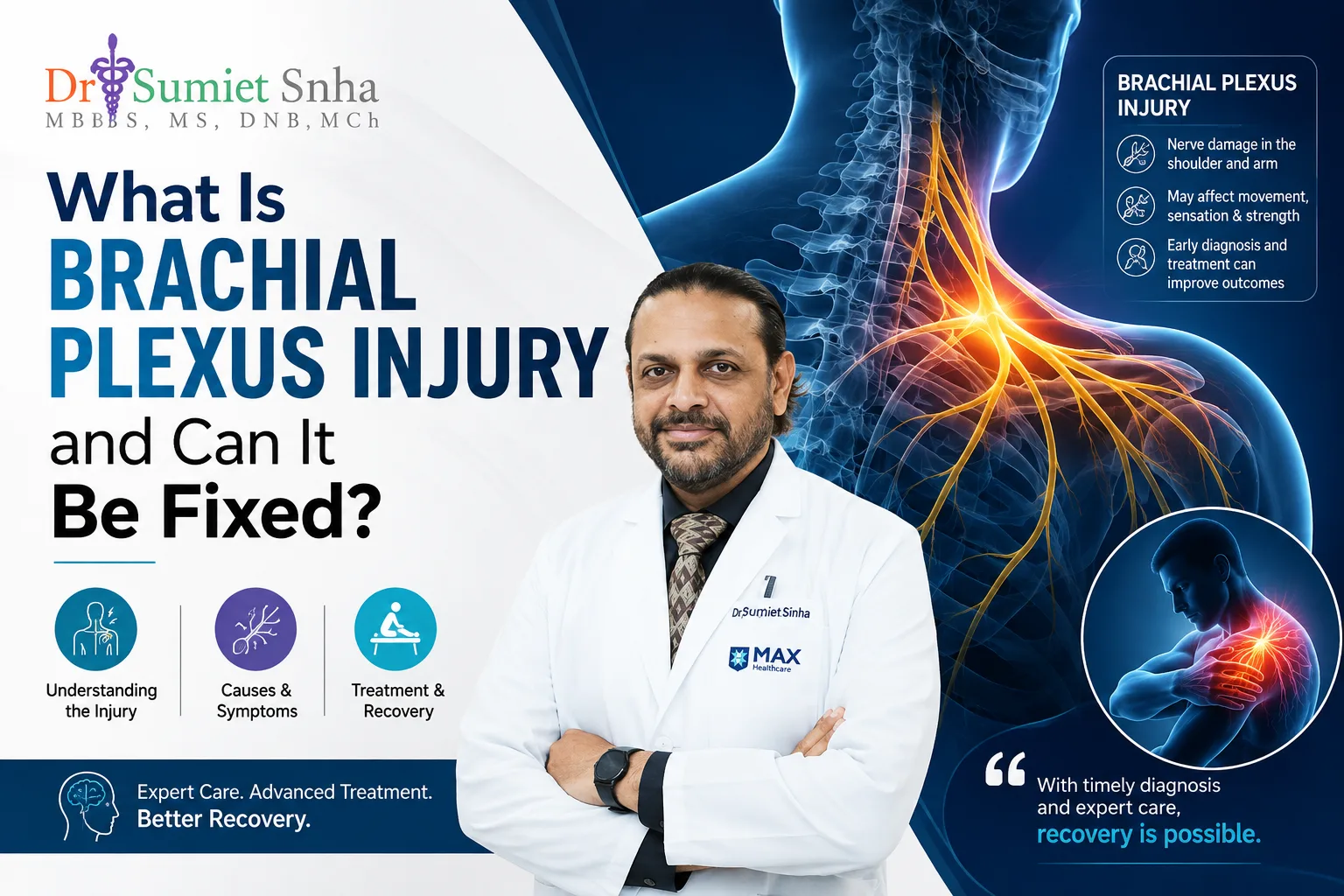
The brachial plexus is a group of nerves that connects the spinal cord with the shoulder, arm, and hand, helping control movement and sensation. When these nerves are stretched, compressed, or damaged, a person may experience pain, tingling, numbness, weakness, or difficulty moving the affected arm. Brachial plexus injury treatment depends on factors such as the type, severity, location, and cause of the nerve damage. While some injuries may improve with monitoring, physiotherapy, and rehabilitation, serious nerve damage may require surgical treatment. Early assessment by an experienced neurosurgeon or peripheral nerve specialist can help determine the appropriate treatment approach.
What Is a Brachial Plexus Injury?
What Is the Brachial Plexus?
The brachial plexus is a complex network of nerves that begins near the lower neck and extends toward the shoulder before branching into the arm and hand. These nerves carry signals between the spinal cord and the upper limb, allowing the muscles to move and enabling the brain to receive sensations such as touch, temperature, and pain. Because this nerve network influences several parts of the upper limb, damage to it can affect everyday activities such as lifting, gripping, reaching, or moving the fingers.
What Happens During an Injury?
A brachial plexus injury can occur when the nerves are overstretched, compressed, bruised, partially damaged, or completely disrupted. Serious brachial plexus nerve damage may interfere with both movement and sensation. Common causes include road traffic accidents, sports-related trauma, falls, shoulder injuries, and certain birth-related injuries. The severity of an arm nerve injury varies considerably, so proper neurological assessment is important. As a type of peripheral nerve injury, brachial plexus damage may require observation, rehabilitation, or specialist treatment depending on the individual findings.
What Are the Symptoms of Brachial Plexus Injury?
The brachial plexus injury symptoms can differ depending on which nerves are affected and how severe the damage is. Some people develop mild tingling or discomfort, while more serious injuries can interfere with normal arm movement and sensation. Common signs may include:
- Persistent or sharp pain around the shoulder, arm, or hand
- Tingling, pins and needles, or hand numbness
- Reduced strength or noticeable arm weakness
- Decreased or complete loss of sensation in part of the upper limb
- Difficulty moving the shoulder, elbow, wrist, or fingers
- Muscle thinning or wasting when nerve damage is severe or prolonged
- Partial or complete inability to use the affected arm normally
Because nerve damage in the arm can have different causes, persistent or significant symptoms should be evaluated by an appropriate neurological or peripheral nerve specialist.
What Causes Brachial Plexus Injuries?
A brachial plexus injury can develop when the nerves are stretched, compressed, or damaged by sudden force or an underlying medical condition. A traumatic brachial plexus injury commonly occurs during motor vehicle or motorcycle accidents, sports injuries, falls, direct shoulder trauma, or shoulder dislocation. In some cases, tumors or abnormal tissue growth can place pressure on these nerves. Radiation treatment may also affect the brachial plexus in certain patients. Newborns can develop brachial plexus injuries during difficult deliveries. The nature and severity of brachial plexus trauma determine the symptoms and treatment approach.
How Is Brachial Plexus Injury Diagnosed?
Accurate brachial plexus injury diagnosis begins with a detailed medical history and neurological examination. A specialist may assess muscle strength, reflexes, sensation, range of motion, and the pattern of symptoms to understand which nerves may be affected. The timing and cause of the injury are also important when planning further evaluation.
Diagnostic Tests
Depending on the suspected injury, doctors may recommend:
- Brachial plexus MRI: Helps visualize nerve structures and identify swelling, compression, or structural damage.
- MRI of the cervical spine: May be advised when a neck-related nerve problem is suspected.
- EMG nerve test: Evaluates electrical activity in muscles and helps assess nerve function.
- Nerve conduction study: Measures how effectively electrical signals travel through the nerves.
- CT or CT myelography: May provide additional information about complex nerve-root injuries.
- X-rays: Can help identify associated fractures, dislocations, or other bone and joint injuries.
The results are interpreted together rather than relying on a single test.
Brachial Plexus Injury Treatment Options
The right brachial plexus injury treatment depends on the extent and location of nerve damage, the cause of injury, symptoms, and evidence of natural recovery. A specialist may recommend non-surgical care when the nerve appears capable of healing without reconstruction.
Non-Surgical Treatment
For selected injuries, observation may be combined with pain management, physiotherapy, occupational therapy, and structured rehabilitation. These approaches can help maintain joint flexibility, support muscle function, manage discomfort, and improve the use of the affected arm while nerve recovery is monitored. The treatment for brachial plexus injury is usually adjusted according to clinical progress and follow-up findings.
Surgical Treatment
When nerves are severely damaged, completely disrupted, or fail to show appropriate recovery, brachial plexus surgery may be considered. Depending on the injury, options can include:
- Nerve repair surgery to reconnect suitable damaged nerve ends
- Nerve grafting to bridge a gap between nerve segments
- Nerve transfer surgery to redirect signals from a functioning nerve
- Neurolysis to release a nerve affected by surrounding scar tissue
- Brachial plexus reconstruction, including selected tendon or muscle transfers for longstanding injuries
Treatment decisions should be individualized after specialist assessment.
Can a Brachial Plexus Injury Be Fixed?
Whether a brachial plexus injury can be repaired depends on the type, location, and severity of nerve damage. Mild injuries, particularly those involving temporary stretching or compression, may improve naturally with appropriate monitoring and rehabilitation. More extensive injuries may require surgical intervention to restore nerve continuity or function. Complete nerve disruption needs careful assessment by a specialist and may require nerve repair, grafting, or reconstruction. Recovery is often gradual because damaged nerves regenerate slowly and may take months or longer to show meaningful improvement. Early diagnosis and timely treatment can help protect remaining nerve function and guide an appropriate recovery plan.
Treatment Options for Brachial Plexus Injury
|
Treatment Approach |
When It May Be Considered |
Primary Purpose |
|
Observation and Monitoring |
Mild nerve stretching or cases showing signs of spontaneous recovery |
Monitor nerve healing and avoid unnecessary intervention |
|
Physiotherapy and Rehabilitation |
Reduced strength, stiffness, or limited arm movement |
Preserve flexibility, mobility, and muscle function |
|
Nerve Repair |
Certain injuries where damaged nerve ends can be directly reconnected |
Restore continuity between the injured nerve ends |
|
Nerve Grafting |
When a section of the nerve is damaged and a gap remains |
Bridge the damaged area using a suitable nerve graft |
|
Nerve Transfer |
Severe injuries where direct nerve repair is not feasible |
Provide a new source of nerve signals to affected muscles |
|
Tendon or Muscle Transfer |
Selected long-standing injuries with limited nerve recovery |
Improve useful movement and functional ability |
Important: The appropriate treatment depends on the pattern and severity of nerve damage. A specialist evaluates the clinical findings, imaging, and nerve-function tests before recommending a treatment plan.
Recovery After Brachial Plexus Injury Treatment
Brachial plexus injuryrecovery varies according to the location, severity, and type of nerve damage. Because nerves regenerate gradually, improvement may take several months or longer. Physiotherapy and nerve injury rehabilitation can help maintain joint flexibility, muscle condition, and functional movement during recovery. After brachial plexus surgery recovery, regular specialist follow-ups may be needed to assess nerve function and progress. Exercises and rehabilitation plans should be tailored to the individual, while realistic recovery expectations should be discussed with the treating specialist.
When Should You See a Specialist?
Medical evaluation is important after significant trauma if you develop sudden arm weakness, loss of sensation, severe or persistent nerve pain, or difficulty moving the arm or hand. Symptoms that continue without improvement should also be assessed. A brachial plexus specialist or nerve injury specialist can evaluate the affected nerves and recommend appropriate testing and treatment.
About Dr. (Prof.) Sumiet Snha
Dr. (Prof.) Sumiet Snha, Vice Chairman – Neurosciences (Neurology & Spine), is a neurosurgeon with 25+ years of experience. He completed his neurosurgical training at AIIMS, New Delhi, and holds MBBS, MS, DNB, and MCh (AIIMS), New Delhi. He has advanced training and professional experience in complex neurosurgical, spine, brachial plexus, and peripheral nerve conditions. His clinical expertise includes the management of complicated nerve injuries. Treatment and recovery expectations for brachial plexus injuries should always be individualized according to the patient's specific condition, nerve damage, and clinical findings.
Frequently Asked Questions
FAQ 1. What is a brachial plexus injury?
A brachial plexus injury occurs when the network of nerves connecting the spinal cord to the shoulder, arm, and hand becomes stretched, compressed, bruised, or damaged. The injury can affect movement, muscle strength, and sensation in the affected upper limb.
FAQ 2. What are the most common symptoms of brachial plexus injury?
Common symptoms include shoulder or arm pain, numbness, tingling, reduced sensation, muscle weakness, and difficulty moving the arm, wrist, or fingers. The symptoms depend on which nerves are affected and how extensive the injury is.
FAQ 3. What causes brachial plexus injuries?
Traumatic injuries are common causes and may result from road accidents, motorcycle crashes, sports injuries, falls, shoulder trauma, or dislocation. Less commonly, pressure from tumors, radiation-related nerve damage, or complications during childbirth may affect the brachial plexus.
FAQ 4. Can a brachial plexus injury heal on its own?
Some mild nerve injuries may improve naturally as the nerve recovers. However, more significant damage may not recover adequately without specialist management. Regular assessment can help determine whether the injury is improving or whether further treatment may be necessary.
FAQ 5. What is the best treatment for brachial plexus injury?
There is no single treatment suitable for every patient. Brachial plexus injury treatment depends on the type, severity, location, cause, and duration of the nerve injury. Options may include observation, rehabilitation, pain management, nerve repair, nerve grafting, or nerve transfer.
FAQ 6. When is surgery needed for brachial plexus injury?
Surgery may be considered when there is severe nerve damage, complete nerve disruption, significant functional loss, or inadequate recovery during observation. The timing and type of surgery depend on clinical examination, imaging, nerve studies, and the overall injury pattern.
FAQ 7. What is nerve transfer surgery?
Nerve transfer surgery involves using a functioning nearby nerve, or a suitable portion of it, to provide nerve signals to a damaged nerve or muscle. It may be considered when direct nerve repair is not possible or is unlikely to provide adequate restoration.
FAQ 8. How long does brachial plexus injury recovery take?
Recovery varies considerably between individuals. Nerve healing is generally slow, and meaningful improvement may take several months or longer. The extent of damage, treatment approach, timing of intervention, rehabilitation, and individual healing response can all influence the recovery process.
FAQ 9. Can physiotherapy help after brachial plexus injury?
Yes, rehabilitation may play an important role in selected cases. Physiotherapy can help maintain joint flexibility, prevent stiffness, support muscle conditioning, and improve functional movement. The exercise program should be designed according to the patient's nerve function and stage of recovery.
FAQ 10. Can a completely damaged brachial plexus nerve be repaired?
Some severe injuries can be managed with reconstructive procedures such as nerve grafting, nerve transfer, or other specialized techniques. However, the possibility and expected degree of recovery depend on factors such as the location, extent, timing, and duration of the nerve damage.
FAQ 11. Which tests are used to diagnose brachial plexus injury?
Evaluation may include a detailed neurological and physical examination along with MRI, electromyography, and nerve conduction studies. CT or CT myelography and X-rays may also be recommended in selected situations to provide additional information about nerve roots, bones, joints, or associated injuries.
FAQ 12. When should I see a neurosurgeon for brachial plexus injury?
Specialist evaluation is advisable after significant trauma accompanied by persistent weakness, severe pain, numbness, loss of sensation, or difficulty using the arm or hand. Early assessment can help identify the extent of nerve damage and determine whether observation, rehabilitation, or surgical treatment is appropriate.
Conclusion
Brachial plexus injuries can range from temporary nerve stretching to significant nerve disruption that affects arm function. Brachial plexus injury treatment is individualized according to the location and severity of damage and the patient's recovery pattern. While selected injuries may improve with observation and rehabilitation, severe cases may require nerve repair, grafting, or transfer procedures. Anyone experiencing persistent weakness, numbness, or loss of arm function after significant trauma should seek timely evaluation from an experienced specialist.




0 Comments