A headache once in a while is usually not a reason for concern. Stress, lack of sleep, dehydration, eye strain, migraine, and many other everyday factors can cause head pain. But what if your headache does not go away, keeps returning, or suddenly feels different from what you have experienced before?
A persistent headache does not automatically mean that something is wrong with the brain, and not every headache requires an MRI or CT scan. However, certain warning signs—often called headache red flags—can indicate that you need prompt medical evaluation.
Knowing these signs can help you understand when it is appropriate to seek professional advice from a brain specialist in Delhi or another qualified healthcare professional.
When Is a Headache Considered Persistent?
There is no single duration that determines whether a headache is serious. What matters is the pattern.
A headache deserves medical attention when it is becoming more frequent, increasingly severe, changing in character, interfering with normal activities, or occurring together with other unusual symptoms.
For example, someone who normally experiences occasional mild headaches but suddenly develops daily headaches should discuss the change with a healthcare professional.
The possible causes of chronic headache can range from migraine and tension-type headaches to medication overuse and other medical or neurological conditions. A proper diagnosis requires looking at the complete clinical picture rather than the headache alone.
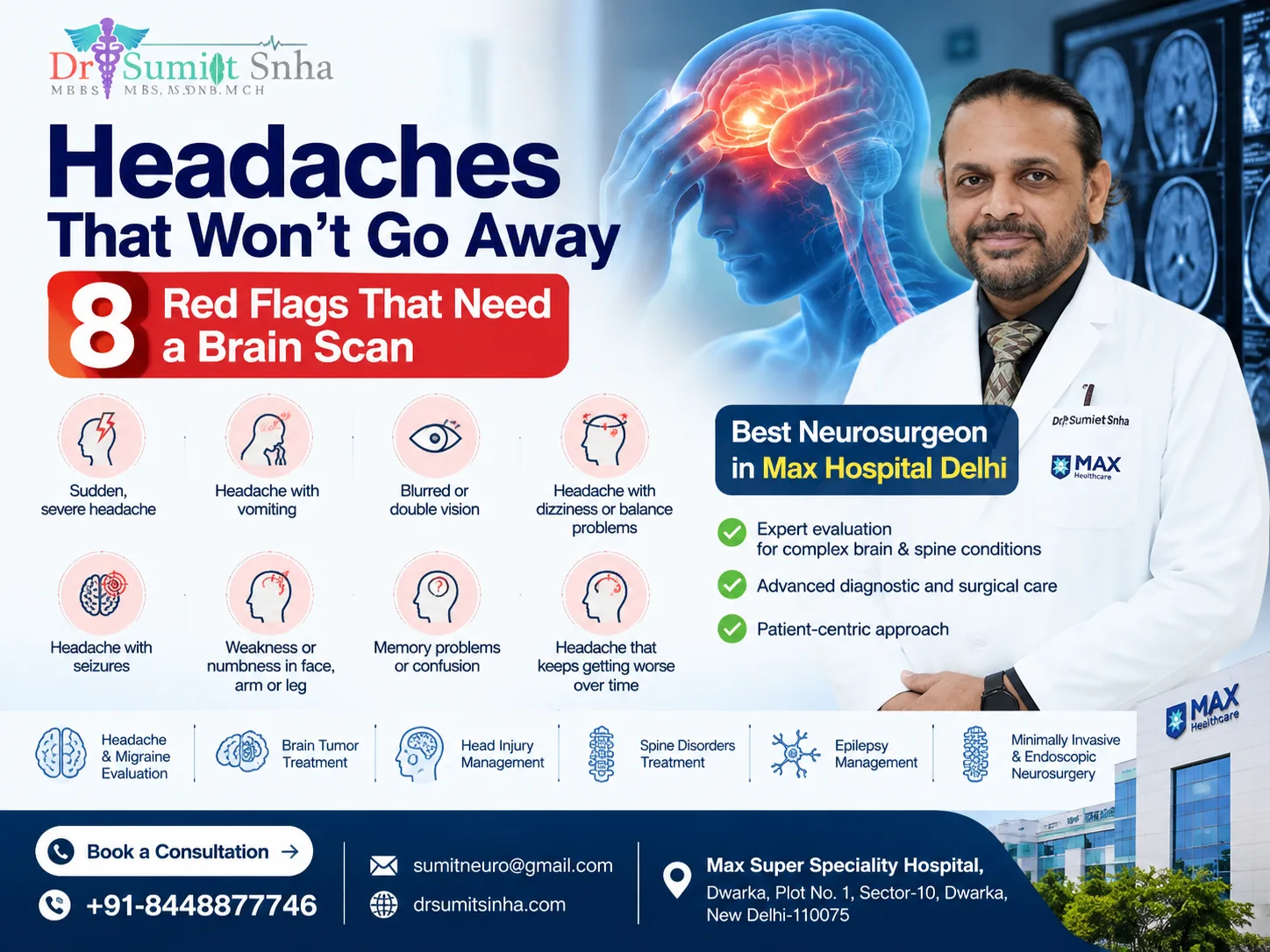
8 Red Flags That May Mean You Need a Brain Scan
A brain scan is not automatically required for every person with a headache. Doctors consider symptoms, medical history and examination findings before deciding whether imaging is appropriate.
However, the following warning signs deserve particular attention.
1. A Sudden, Extremely Severe Headache
A headache that begins suddenly and becomes extremely severe within a very short time should not be ignored.
People sometimes describe this as a headache that feels dramatically different from their usual headaches. A sudden severe headache can have several possible causes, some of which require urgent assessment.
If a severe headache appears suddenly, particularly if it is accompanied by vomiting, confusion, weakness, fainting, seizures, vision problems, or difficulty speaking, seek urgent medical care.
2. A New Headache That Is Progressively Getting Worse
A new headache that gradually becomes more frequent or severe may need evaluation, particularly when it represents a significant change from your usual pattern.
For example, if headaches that were previously occasional become almost daily, or if the pain continues to worsen despite usual measures, it is sensible to speak with a healthcare professional.
The doctor may assess your symptoms and neurological examination before deciding whether an MRI, CT scan, or another investigation is appropriate.
3. Headache With Weakness, Numbness, or Difficulty Speaking
A headache accompanied by neurological symptoms deserves prompt attention.
These symptoms may include:
- Weakness in an arm or leg
- Numbness or unusual sensation
- Facial weakness
- Difficulty speaking or understanding speech
- Problems with balance or walking
- Loss of coordination
These symptoms can have different causes, and some can be time-sensitive. If they appear suddenly, particularly with a severe headache, emergency medical assessment may be necessary.
4. Headache With Vision Changes or Loss of Vision
Changes in vision should not simply be attributed to a headache without considering the wider symptoms.
Blurred or double vision, difficulty seeing, temporary loss of vision, or new visual disturbances may occur with some headache disorders, but they can also be associated with other neurological or eye-related problems.
A healthcare professional can determine whether the symptoms are consistent with a primary headache disorder or whether further evaluation is needed.
5. Headache After a Head Injury
Headaches following a head injury deserve appropriate attention, especially when the pain is worsening or occurs with other symptoms.
Warning signs may include:
- Repeated vomiting
- Increasing drowsiness
- Confusion
- Loss of consciousness
- Seizures
- Weakness or numbness
- Increasingly severe headache
Depending on the circumstances and examination, a doctor may recommend a CT scan or another form of assessment.
If a significant head injury has occurred and concerning symptoms develop, do not wait for the headache to resolve on its own.
6. Headache With Fever, Neck Stiffness, or Confusion
A headache accompanied by fever and a stiff neck can sometimes indicate an infection or another condition requiring urgent assessment.
Confusion, significant changes in alertness, seizures, or severe illness together with a headache are also warning signs.
These symptoms should not be managed solely with home remedies. Urgent medical evaluation can help determine the cause and whether tests or brain imaging are necessary.
7. Headache With New Seizures, Memory Changes, or Personality Changes
A new headache accompanied by seizures, significant memory problems, confusion, or noticeable changes in behaviour or personality requires medical evaluation.
These symptoms do not automatically mean that a person has a brain tumour. There are many possible explanations, and only proper clinical assessment can help determine the cause.
When neurological symptoms accompany a new or changing headache, a doctor may consider whether brain imaging is appropriate.
8. A New or Unusual Headache in a Higher-Risk Situation
Certain circumstances may make doctors more cautious about a new headache.
These can include a history of certain cancers, problems affecting the immune system, pregnancy or the period shortly after childbirth, significant neurological conditions, or other relevant medical risk factors.
The importance of these factors varies from person to person. Your doctor will consider your individual history, symptoms and examination findings before deciding whether further investigation is necessary.
Does Every Persistent Headache Require an MRI or CT Scan?
No. Not every persistent headache requires brain imaging.
In many people, the history and neurological examination provide enough information for a doctor to identify a likely primary headache disorder. Imaging may not be useful when there are no concerning features.
When a scan is considered necessary, the choice between MRI and CT depends on the clinical situation.
MRI for Headaches
MRI provides detailed images of the brain and surrounding structures and may be used when a doctor needs to investigate particular neurological concerns.
CT Scan for Headaches
CT scans are widely used in emergency settings because they can be performed quickly. They may be particularly useful in certain situations, such as some types of acute head injury or sudden severe headache.
The important point is that the decision about a brain scan for headaches should be based on medical assessment rather than the duration of pain alone.
How Is the Cause of a Persistent Headache Diagnosed?
Diagnosing a headache usually begins with a detailed discussion about the symptoms.
A healthcare professional may ask:
- When did the headaches begin?
- How often do they occur?
- Where is the pain located?
- How long does each episode last?
- What does the pain feel like?
- Are there triggers?
- Are there associated symptoms such as nausea or visual changes?
- Have the headaches changed recently?
- What medications are being taken?
A neurological examination may also be performed. Depending on the findings, additional tests or imaging may be recommended.
This step-by-step approach is important because the goal is not simply to find something on a scan. The goal is to understand what is causing the symptoms and choose an appropriate treatment plan.
When Should You See a Brain Specialist in Delhi?
If headaches are persistent, recurrent, changing in pattern, difficult to control, or associated with neurological symptoms, discussing them with an appropriate medical professional can be helpful.
A brain specialist in Delhi may evaluate symptoms from a neurological perspective and determine whether additional investigation is appropriate. Depending on the symptoms, this may involve a neurologist, neurosurgeon, emergency physician, or another healthcare professional.
Most headaches are not caused by a dangerous brain condition. However, unusual symptoms should not be ignored simply because headaches are common.
About Dr.(Prof.) Sumiet Snha
Dr.(Prof.) Sumiet Snha is a neurosurgeon with more than 25 years of experience in the field of neurosurgery. He completed his neurosurgical training at the All India Institute of Medical Sciences (AIIMS), New Delhi, and holds MBBS, MS, DNB and MCh (AIIMS), New Delhi qualifications.
According to his professional profile, he was appointed as faculty at AIIMS in 2005 and has undertaken additional training and professional exposure with neurosurgical specialists in Japan, Brazil and Germany. His areas of professional interest include brain surgery, spine surgery, minimally invasive and endoscopic procedures, and peripheral nerve surgery.
His profile also describes involvement in teaching, research and professional organizations related to neurotrauma and peripheral nerve surgery.
Frequently Asked Questions
1. Can a headache that won't go away be a sign of a serious brain problem?
A persistent headache can have many causes, and most are not related to a serious brain condition. However, a new, worsening, or unusual headache—especially one accompanied by neurological symptoms—should be evaluated by a healthcare professional.
2. When should I get a brain scan for a headache?
A brain scan may be considered when a headache has concerning features, such as sudden severe onset, neurological symptoms, significant changes in an established headache pattern, or a relevant history of injury or other medical conditions. The decision should be made by a healthcare professional.
3. Is an MRI necessary for persistent headaches?
Not necessarily. Many persistent headaches do not require imaging. An MRI may be recommended when the medical history or examination suggests that further investigation is appropriate.
4. What is the difference between an MRI and CT scan for headaches?
MRI uses magnetic fields and provides detailed images of brain structures. CT uses X-rays and is generally faster, making it particularly useful in many emergency situations. The appropriate test depends on the symptoms and clinical circumstances.
5. What type of headache requires urgent medical attention?
A sudden, extremely severe headache or a headache accompanied by weakness, difficulty speaking, seizures, confusion, loss of consciousness, severe vision changes, or other significant neurological symptoms requires prompt medical assessment.
6. Can a brain tumour cause persistent headaches?
Headaches can occur with brain tumours, but a persistent headache alone does not mean that a person has a brain tumour. Other symptoms and examination findings are important when assessing the possibility of a neurological condition.
7. Can headaches cause vision problems?
Some headache disorders, including migraine, can be associated with visual symptoms. However, new or significant vision changes should be assessed medically, particularly when they occur with other neurological symptoms.
8. When should I see a brain specialist in Delhi for headaches?
Consider seeking specialist medical advice when headaches are new, persistent, progressively worsening, significantly different from previous headaches, or accompanied by neurological symptoms. A healthcare professional can determine what type of evaluation is appropriate.
9. Can headaches after a head injury require a brain scan?
Yes, depending on the injury and symptoms. Worsening headache, repeated vomiting, confusion, drowsiness, seizures, weakness, or loss of consciousness after head trauma can require urgent assessment and, in some situations, brain imaging.
10. Are frequent headaches always a sign of a neurological problem?
No. Frequent headaches can result from migraine, tension-type headaches, medication overuse, sleep problems, stress, dehydration, and other factors. However, a significant change in headache pattern should be discussed with a healthcare professional.
11. What neurological symptoms can occur with a serious headache?
Possible warning symptoms include weakness, numbness, difficulty speaking, confusion, seizures, loss of balance, significant vision changes, or loss of consciousness. Sudden onset of these symptoms requires urgent medical attention.
12. What happens during an evaluation for persistent headaches?
The healthcare professional will usually review the headache history, associated symptoms, medical history, medications, and possible triggers. A neurological examination may also be performed. Further tests, including MRI or CT, are recommended only when clinically appropriate.
Conclusion
A headache that does not go away can be frustrating and concerning, but persistence alone does not mean that a serious brain condition is present. Many headaches have treatable and non-dangerous causes.
What matters is recognizing changes and warning signs. A sudden severe headache, neurological symptoms, significant vision changes, headache after head injury, seizures, confusion, or a progressively changing headache pattern should receive appropriate medical attention.
If you have a persistent or unusual headache, a brain specialist in Delhi or another qualified healthcare professional can assess your symptoms and determine whether further testing, including a brain scan, is necessary. Avoid self-diagnosing based only on symptoms and seek professional medical advice when you are concerned.




0 Comments