A person who struggles to turn their head comfortably may assume that the problem is ordinary neck stiffness. But what if the discomfort comes from the two small bones directly beneath the skull? These bones do more than support head movement. They also surround a section of the spinal cord that carries important messages between the brain and the body.
Atlanto Axial Dislocation occurs when the normal alignment between the first two cervical vertebrae becomes disrupted. The condition may develop after an injury or because of abnormalities affecting the bones, joints, or supporting ligaments.
Some people have relatively stable abnormalities without significant neurological problems. Others develop weakness, walking difficulties, or dangerous pressure on the spinal cord.
The important question is not simply whether the joint is displaced. Doctors must also determine whether it remains stable and whether the spinal cord is at risk.
This article explains why atlanto-axial dislocation can become serious, which complications deserve attention, and how treatment decisions are made.
Understanding the Atlanto-Axial Joint: Why Are C1 and C2 Important?
The upper cervical spine contains two specially shaped vertebrae.
The atlas (C1) sits immediately below the skull and supports the head. Beneath it is the axis (C2), which has a bony projection called the dens. This structure helps the head rotate from side to side.
Unlike many other spinal joints, the C1–C2 joint allows considerable rotational movement.
Ligaments help control this movement and keep the bones properly aligned.
When these supporting structures are damaged, weakened, or affected by a developmental abnormality, the relationship between the vertebrae may change.
What Is the Difference Between Instability, Subluxation, and Dislocation?
These terms describe related but different structural problems.
A diagnosis must be interpreted alongside symptoms and imaging findings. An abnormal joint position does not automatically establish the severity of spinal cord involvement.
Is Atlanto-Axial Dislocation Dangerous for Every Patient?
No. The level of danger differs considerably between individuals.
For example, someone may have a longstanding anatomical abnormality that remains stable during medical follow-up. Another person may develop an unstable C1–C2 injury after a fall and experience rapidly worsening weakness.
These situations cannot be managed in the same way.
Factors That Influence the Risk
Degree of instability: Greater or uncontrolled movement may increase the possibility of neurological injury.
Spinal cord involvement: Compression or injury to the cord changes the urgency of assessment.
Underlying cause: Traumatic injuries, inflammatory disorders, and congenital abnormalities have different clinical considerations.
Progression of symptoms: Increasing weakness or walking difficulty may indicate worsening neurological function.
Associated structural damage: Fractures, ligament injuries, and other abnormalities may complicate the condition.
The absence of severe neck pain does not necessarily mean that the upper cervical spine is stable.
What Are the Early Symptoms of Atlanto-Axial Dislocation?
Atlanto Axial Dislocation Symptoms can range from local discomfort to problems involving movement and coordination.
Neck Pain and Restricted Movement
Some patients notice discomfort near the base of the skull. Turning the head may feel uncomfortable or restricted.
However, these symptoms are common in several other neck conditions and are not diagnostic on their own.
Changes in Hand Function
A person may begin dropping objects, struggling with buttons, or noticing changes in handwriting.
Such problems can occur when neurological pathways responsible for precise movement are affected.
Difficulty Maintaining Balance
Walking may feel less steady than before. Patients sometimes describe frequent stumbling or difficulty navigating stairs.
Tingling, Numbness, or Weakness
Changes in sensation or strength can affect the arms, hands, legs, or multiple limbs.
These symptoms require evaluation because they may indicate neurological involvement.
Symptoms That Need Immediate Attention
Seek emergency medical care for:
Sudden weakness or paralysis
Rapidly worsening walking difficulties
Breathing problems after a neck injury
Significant neurological changes following trauma
Reduced consciousness associated with suspected cervical injury
Can Atlanto-Axial Dislocation Damage the Spinal Cord?
Yes. The possibility of C1 C2 Spinal Cord Compression is one of the main reasons doctors take significant upper cervical instability seriously.
The spinal cord passes through the spinal canal behind the vertebral bodies and related structures.
When the C1–C2 relationship becomes abnormal, the space available for the spinal cord may be reduced.
How Does Spinal Cord Compression Affect the Body?
The spinal cord contains pathways that help control movement, sensation, and coordination.
When these pathways are compressed or injured, patients may experience:
Reduced muscle control: Activities such as walking or using the hands may become difficult.
Abnormal sensations: Tingling, numbness, or changes in body-position awareness may develop.
Muscle stiffness: Certain forms of spinal cord dysfunction can produce increased muscle tone.
Weakness: Significant compression may interfere with signals controlling the limbs.
Severe upper cervical spinal cord injury can also affect breathing.
Not every C1–C2 displacement causes spinal cord compression. MRI findings and neurological examination help establish whether the cord is involved.
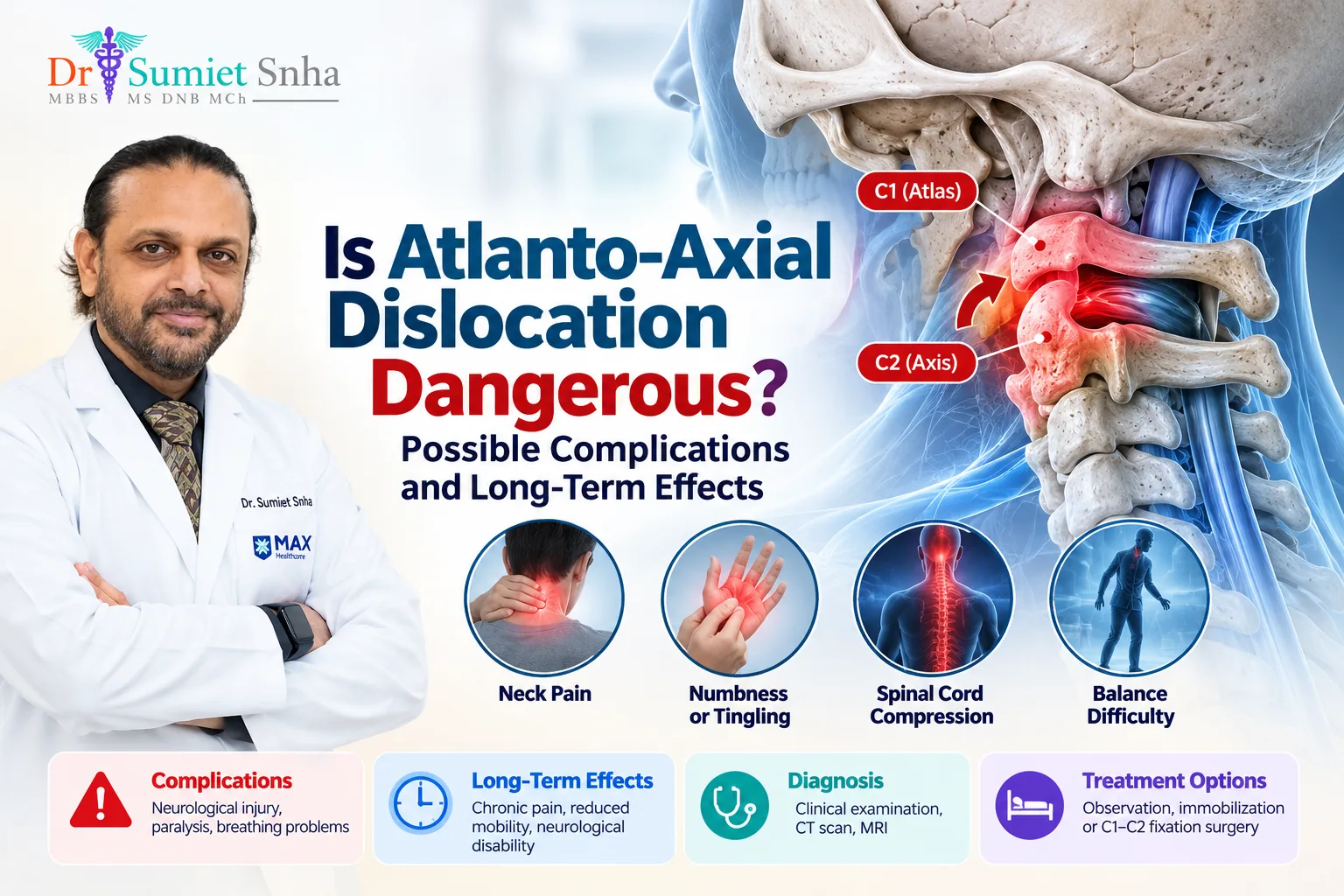
What Are the Possible Complications of Atlanto-Axial Dislocation?
The potential Atlanto Axial Dislocation Complications depend on the severity of the condition and whether neurological damage has developed.
Cervical Myelopathy
Cervical myelopathy describes dysfunction of the spinal cord in the neck.
A patient may notice increasing difficulty walking, reduced hand coordination, unusual muscle stiffness, or weakness.
Progressive Neurological Disability
If spinal cord dysfunction worsens, everyday tasks may become more difficult.
Activities such as dressing, climbing stairs, or carrying objects may require additional assistance.
Paralysis
Severe spinal cord injury can result in partial or extensive paralysis.
This is a possible complication of serious upper cervical instability, but it is not an expected outcome for every patient.
Respiratory Impairment
Major injury near the upper cervical spinal cord can disrupt pathways involved in breathing.
Such injuries require emergency management.
Vascular Complications
Certain upper cervical injuries may also affect nearby vertebral arteries.
These complications are uncommon in many clinical settings but can be important in selected traumatic injuries.
Comparing Mild and Severe Neurological Involvement
The following comparison illustrates why symptoms and neurological findings matter.
Important: This table is educational, not a method of self-diagnosis. Some dangerous injuries produce limited symptoms initially.
Can Atlanto-Axial Dislocation Cause Permanent Paralysis?
Patients often worry that a diagnosis involving the upper cervical spine means they will eventually lose movement.
That is not necessarily true.
Paralysis generally becomes a concern when the spinal cord experiences severe compression or injury.
The outcome depends on several factors, including the mechanism of injury, the severity of neurological involvement, and the duration of any compression.
Some neurological problems may improve after appropriate treatment. Others may persist, especially when substantial spinal cord damage has already occurred.
The objective of timely assessment is to identify threats to neurological function and determine whether intervention could prevent further deterioration.
What Are the Long-Term Effects of Untreated Atlanto-Axial Dislocation?
The Atlanto Axial Dislocation Long-Term Effects are not identical for every patient.
Some abnormalities remain stable under appropriate medical observation. Others may progress or contribute to persistent neurological problems.
Chronic Pain and Restricted Mobility
Ongoing discomfort may interfere with sleep, travel, or routine activities.
Reduced Independence
When weakness or balance difficulties develop, patients may need assistance with activities that were previously manageable.
Persistent Neurological Changes
Longstanding spinal cord injury can leave lasting problems with movement, coordination, or sensation.
Emotional and Lifestyle Effects
Uncertainty about neck stability, changes in mobility, and fear of injury can affect confidence and daily life.
The difference between monitored observation and leaving a potentially dangerous condition unassessed is important. A specialist-directed monitoring plan is an active clinical decision.
What Causes Atlanto-Axial Dislocation?
Several conditions can disrupt the normal relationship between C1 and C2.
Traumatic Injuries
Falls, road accidents, and other significant injuries may damage the ligaments or bones supporting the joint.
Congenital Abnormalities
Some individuals have structural differences from birth that influence upper cervical stability.
Inflammatory Joint Disease
Rheumatoid arthritis and certain other inflammatory conditions can damage supporting tissues.
Connective Tissue and Skeletal Disorders
Conditions associated with ligament laxity or unusual skeletal development may increase the likelihood of instability.
Infection or Destructive Bone Disease
Less commonly, disease affecting the upper cervical bones or surrounding tissues may weaken the joint.
Identifying the underlying Atlanto Axial Dislocation Causes helps doctors select an appropriate management strategy.
How Is Atlanto-Axial Dislocation Diagnosed?
An accurate Atlanto Axial Dislocation Diagnosis requires more than identifying an abnormality on one scan.
The doctor considers the patient's history, neurological examination, and imaging findings.
Neurological Examination
The specialist may assess:
Strength in the arms and legs
Reflexes and muscle tone
Sensation
Walking and coordination
Evidence of spinal cord dysfunction
CT Scan
CT provides detailed information about the bones and their alignment.
It is particularly useful when fractures or complex bony abnormalities are suspected.
MRI Scan
MRI helps evaluate the spinal cord, ligaments, and other soft tissues.
It may show compression or changes associated with spinal cord injury.
X-Rays
X-rays may help assess alignment in selected patients.
Movement-based imaging should only be performed when a qualified clinician determines it is safe. It must not be attempted casually when acute injury or dangerous instability is suspected.
Can Atlanto-Axial Dislocation Be Treated Without Surgery?
Atlanto Axial Dislocation Treatment depends on the cause, stability, neurological findings, and individual health circumstances.
Some patients may be suitable for monitoring or supervised immobilization.
However, nonsurgical management is not appropriate for every case.
When Nonsurgical Care May Be Considered
A specialist may consider a nonsurgical approach when:
The condition is sufficiently stable.
There is no progressive neurological deterioration.
Imaging does not identify a threat requiring operative treatment.
A safe follow-up and reassessment plan can be established.
These are general considerations, not independent criteria for choosing treatment.
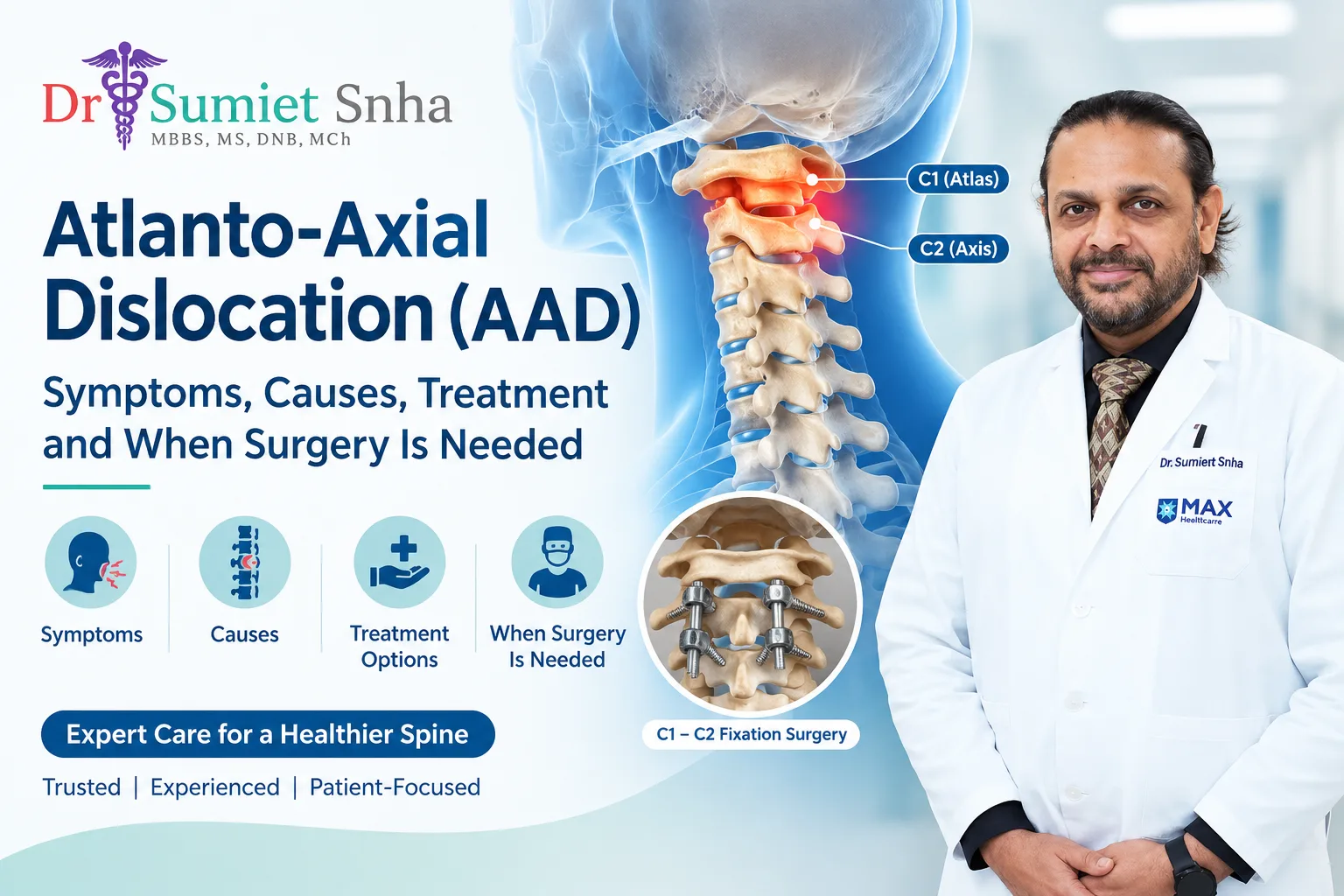
When Is Atlanto-Axial Fixation Surgery Necessary?
Atlanto Axial Fixation Surgery may be recommended when the C1–C2 joint cannot maintain adequate stability or when neurological structures are threatened.
The procedure is planned according to the patient's anatomy, underlying condition, and surgical objectives.
What Happens During C1–C2 Fixation?
Depending on the case, the surgeon may use specialized implants to stabilize the vertebrae.
Bone grafting may be performed to promote fusion.
Some patients also require correction of alignment or decompression of affected neurological structures.
What Are the Benefits and Limitations?
The intended benefit is improved stability and protection of neurological structures.
However, surgery has risks, including bleeding, infection, neurological injury, and complications involving nearby structures.
Fusion also reduces movement at the treated joint, particularly head rotation.
The expected benefits and risks should be discussed before treatment.
What Should Patients Avoid When C1–C2 Instability Is Suspected?
Until a specialist has assessed the condition, patients should avoid activities that may place unnecessary stress on an unstable upper cervical joint.
Potentially unsafe actions include:
Forceful neck stretching
High-velocity neck manipulation
Unsupervised traction
Attempting to reposition the neck
Continuing strenuous activity despite new neurological symptoms
Following significant trauma, suspected cervical instability requires emergency assessment and appropriate movement precautions.
About Dr. Sumiet Snha
Dr. Sumiet Snha is a neurosurgeon with 30+ years of experience in the assessment and management of neurological and neurosurgical conditions.
He is associated with Max Super Speciality Hospital, Dwarka, New Delhi, and Max Hospital, Gurugram.
Upper cervical spine conditions require careful evaluation because instability around C1 and C2 may affect important neurological structures.
Patients experiencing symptoms associated with Atlanto Axial Dislocation, cervical instability, or possible spinal cord compression can seek specialist assessment to understand their condition.
Treatment decisions depend on clinical examination, imaging findings, neurological function, and the individual's overall health.
Frequently Asked Questions About Atlanto-Axial Dislocation
1. Is atlanto-axial dislocation always dangerous?
No. The level of risk depends on joint stability, spinal cord involvement, symptoms, and the underlying cause.
2. What are the earliest symptoms of C1–C2 instability?
Possible symptoms include upper neck discomfort, restricted movement, changes in hand coordination, weakness, and walking difficulties.
3. Can atlanto-axial dislocation occur without an accident?
Yes. Congenital abnormalities, inflammatory diseases, and certain connective tissue conditions can contribute to instability.
4. Can atlanto-axial dislocation cause paralysis?
Severe spinal cord injury can cause paralysis, but this does not happen in every case.
5. Is neck pain enough to diagnose the condition?
No. Neck pain has many possible causes. Diagnosis requires appropriate medical assessment and imaging.
6. Can C1–C2 instability cause difficulty walking?
Yes. Walking difficulties may occur when the upper cervical spinal cord is affected.
7. Which imaging test is used for diagnosis?
CT is useful for bone anatomy, while MRI evaluates the spinal cord and soft tissues. The appropriate investigation depends on the clinical situation.
8. Can atlanto-axial dislocation improve without surgery?
Some stable conditions may be managed without an operation, but significant instability may require surgical treatment.
9. Is physiotherapy safe for patients with C1–C2 instability?
Physiotherapy should only begin after specialist assessment confirms which movements and activities are safe.
10. Does C1–C2 fixation affect neck rotation?
Yes. Fusion at this level generally reduces the ability to rotate the head, although the overall effect varies.
11. Can neurological damage improve after treatment?
Some patients improve, but recovery depends on the extent and duration of spinal cord injury.
12. When should someone seek emergency care?
Sudden weakness, paralysis, breathing difficulty, or neurological symptoms following a neck injury require emergency medical attention.
Conclusion
Atlanto Axial Dislocation can become dangerous when instability threatens the upper cervical spinal cord.
The condition varies from relatively stable abnormalities to serious injuries involving neurological dysfunction. Possible complications include spinal cord compression, weakness, walking difficulties, and, in severe circumstances, paralysis or respiratory impairment.
Early recognition of neurological warning signs is important, particularly when symptoms are progressing or follow an injury.
Clinical examination and appropriate imaging help doctors determine the severity of the problem and whether monitoring, immobilization, or surgical stabilization is necessary.
Patients should avoid unsafe neck manipulation when instability is suspected and seek emergency care for sudden neurological changes.
An individualized treatment plan and appropriate follow-up remain essential for protecting neurological function and supporting long-term health.


0 Comments