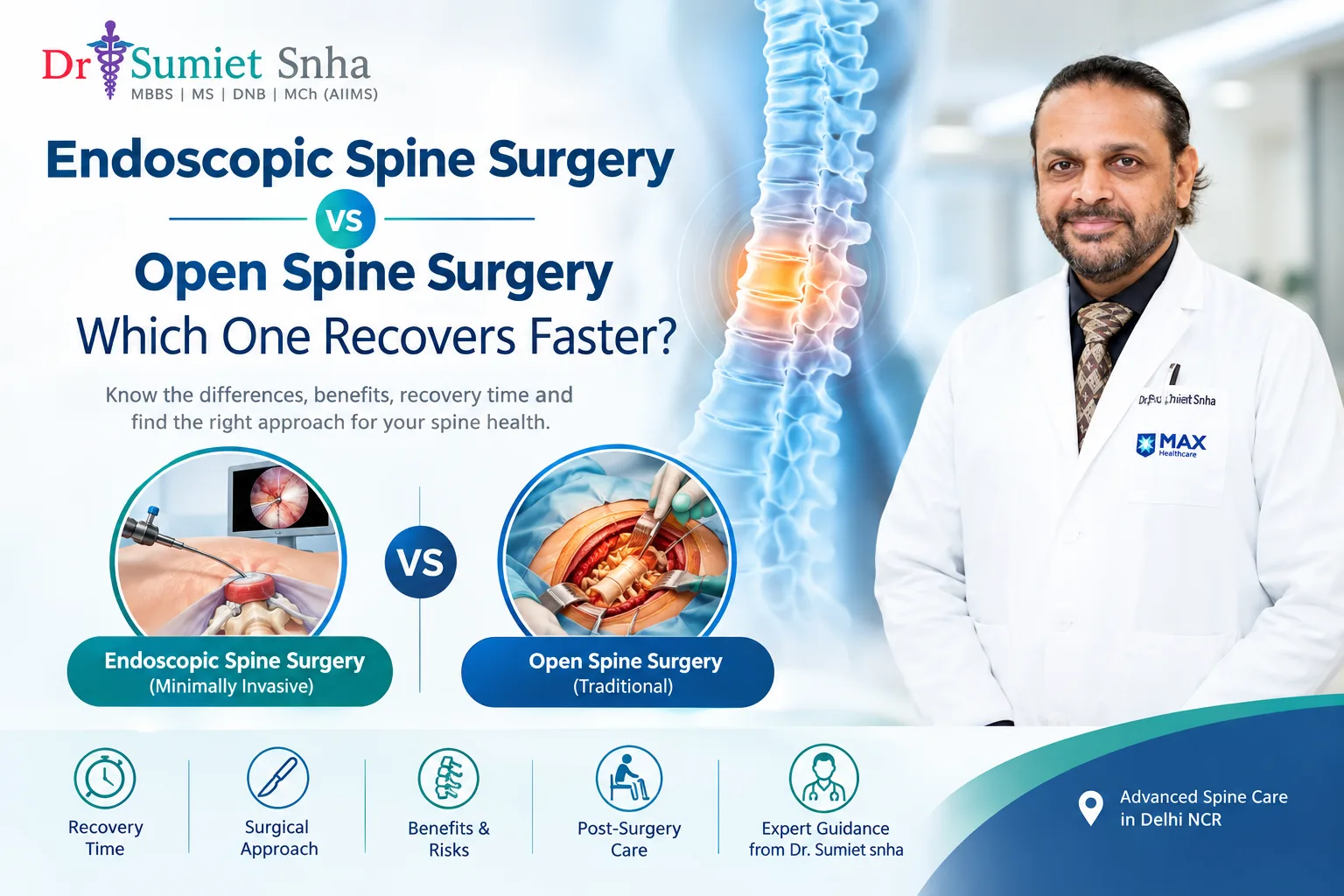
Back pain, leg pain, numbness and sciatica can sometimes continue despite medicines, physiotherapy and other non-surgical treatments. When surgery becomes necessary, patients often ask an important question: Will endoscopic spine surgery help me recover faster than traditional open spine surgery?
The answer depends on the type of spinal problem, the procedure required and the patient's overall health. In selected cases, endoscopic spine surgery Delhi can provide a less invasive way to reach the affected part of the spine, with less disruption to nearby muscles and soft tissues. This may support earlier mobility and a shorter recovery. However, endoscopic surgery is not suitable for every spinal condition.
Let's understand the differences in simple terms.
What Is Endoscopic Spine Surgery?
Endoscopic spine surgery is a minimally invasive technique in which a surgeon uses a small incision and an endoscope — a thin instrument with a camera — to see and treat the affected area of the spine.
Instead of creating a large surgical opening, the surgeon works through a small access pathway using specialized instruments.
How Does Endoscopic Spine Surgery Work?
Depending on the condition, the surgeon may:
- Identify the compressed nerve or affected disc.
- Use an endoscope to visualize the surgical area.
- Remove a portion of a herniated disc or other tissue causing nerve compression.
- Relieve pressure on the affected nerve.
- Close the small incision after completing the procedure.
Minimally invasive approaches are used for selected conditions such as herniated discs and certain forms of spinal stenosis. However, the exact technique depends on the patient's diagnosis and anatomy.
What Is Open Spine Surgery?
Open spine surgery uses a larger surgical exposure to give the surgeon access to the affected part of the spine. Depending on the procedure, muscles and other tissues may need to be moved or exposed to reach the spinal structures.
Open surgery continues to have an important role, particularly when a patient has a complex spinal problem that requires wider access, reconstruction, stabilization or fusion.
The decision between an open and minimally invasive approach is therefore not simply about choosing the smaller incision. The surgical technique needs to match the patient's condition.
Endoscopic Spine Surgery vs Open Spine Surgery: Key Differences
|
Feature |
Endoscopic Spine Surgery |
Open Spine Surgery |
|
Surgical access |
Small access pathway |
Larger surgical exposure |
|
Incision |
Usually smaller |
Usually larger |
|
Muscle disruption |
Generally less in suitable procedures |
May involve greater tissue exposure |
|
Blood loss |
May be lower in selected procedures |
Can be greater depending on surgery |
|
Postoperative discomfort |
May be less in some procedures |
Can be higher depending on procedure |
|
Hospital stay |
May be shorter for selected procedures |
Depends on complexity |
|
Recovery |
May be quicker for suitable patients |
Can take longer after extensive surgery |
|
Suitable for |
Selected spinal conditions |
A wide range of conditions, including complex cases |
The potential recovery advantages of minimally invasive surgery are associated partly with reduced disruption to muscles and soft tissues.
Endoscopic Spine Surgery Recovery Time vs Open Spine Surgery Recovery
One of the main reasons patients consider endoscopic spine surgery is the possibility of a shorter recovery.
In appropriate cases, smaller incisions and reduced muscle disruption may make it possible for patients to move sooner after surgery. Some minimally invasive procedures can also be performed as day-care or short-stay procedures.
However, endoscopic spine surgery recovery time is not the same for everyone.
It can depend on:
- The spinal condition being treated
- The location of the problem
- The number of spinal levels involved
- The complexity of the procedure
- Age and general health
- Pre-existing medical conditions
- Physical activity before surgery
- Postoperative rehabilitation
Open spine surgery can require a longer recovery, particularly when the procedure involves extensive decompression, fusion or reconstruction. But the recovery period should always be discussed according to the specific operation rather than simply comparing “endoscopic” with “open.”
Why Can Endoscopic Spine Surgery Offer Faster Recovery?
A major difference between minimally invasive and traditional approaches is how the surgeon reaches the spine.
With minimally invasive techniques, the surgical pathway is designed to limit damage to surrounding muscles and soft tissues. This can contribute to less postoperative pain, earlier mobility and a shorter recovery in appropriately selected patients.
Potential benefits can include:
- Smaller incision
- Less disruption of surrounding tissues
- Less postoperative discomfort in some cases
- Reduced blood loss in selected procedures
- Earlier movement
- Potentially shorter hospital stay
- Earlier return to routine activities for suitable patients
However, faster recovery does not mean immediate recovery. The spine and surrounding tissues still need time to heal.
Is Endoscopic Spine Surgery Suitable for Everyone?
No. Endoscopic surgery is not automatically the right choice simply because it uses a smaller incision.
A spine specialist may evaluate:
- MRI or CT findings
- The exact location of nerve compression
- The cause of pain or neurological symptoms
- Spinal stability
- Number of affected levels
- Previous spine surgeries
- Overall health
- Whether the problem can be safely reached through a minimally invasive approach
Some patients may benefit from endoscopic treatment, while others may need a different minimally invasive technique or conventional open surgery. In some situations, traditional surgery may be more appropriate.
Endoscopic Spine Surgery Delhi: How Is the Right Approach Chosen?
If you are considering endoscopic spine surgery Delhi, the first step should be an accurate diagnosis rather than choosing a procedure based only on its name.
A specialist may consider:
- Your symptoms and how long you have had them.
- Your neurological examination.
- MRI, CT or other relevant imaging.
- Whether non-surgical treatment has been effective.
- The exact cause of nerve compression.
- Whether endoscopic surgery can safely address the problem.
- Your expected recovery and rehabilitation needs.
A proper consultation helps patients understand both the potential benefits and limitations of the available surgical options.
Endoscopic vs Open Spine Surgery: Recovery Comparison
|
Recovery Factor |
Endoscopic Approach |
Open Approach |
|
Early movement |
May be earlier in suitable cases |
Depends on the operation |
|
Incision healing |
Smaller wound in many procedures |
Larger wound may require more healing |
|
Postoperative pain |
May be lower in selected cases |
Varies according to surgery |
|
Hospital stay |
May be shorter |
May be longer after extensive procedures |
|
Return to activities |
May occur sooner in suitable cases |
Often more gradual |
|
Rehabilitation |
Depends on the procedure |
Depends on the procedure |
These are general differences. They should not be treated as a guaranteed recovery timeline for an individual patient. Recovery after minimally invasive spine surgery can range from weeks to months depending on the procedure and the patient's circumstances.
Benefits and Risks of Endoscopic Spine Surgery
Like every surgical procedure, endoscopic spine surgery has potential benefits as well as risks.
Potential Benefits
- Smaller surgical incision
- Less disruption to muscles and soft tissues
- Potentially less postoperative pain
- Reduced blood loss in selected procedures
- Potentially shorter hospital stay
- Faster recovery for appropriately selected patients
Possible Risks
Potential risks can include:
- Infection
- Bleeding
- Nerve irritation or injury
- Spinal fluid leakage
- Persistent symptoms
- Recurrence of a disc problem
- Reaction to anesthesia
- Need for another procedure
Occasionally, a minimally invasive operation may not be sufficient for the patient's condition, and the surgical approach may need to be changed.
How to Support Recovery After Spine Surgery
Recovery does not end when the operation is completed. Following postoperative instructions is an important part of healing.
Patients may be advised to:
- Take medicines as prescribed.
- Keep the surgical wound clean according to instructions.
- Avoid heavy lifting until cleared by the surgeon.
- Gradually increase physical activity.
- Follow recommended physiotherapy.
- Attend scheduled follow-up appointments.
- Report new or worsening weakness, numbness, severe pain or other concerning symptoms promptly.
Physical therapy may be recommended depending on the procedure and the patient's physical condition.
About Dr.(Prof.) Sumiet Snha
Dr.(Prof.) Sumiet Snha is a neurosurgeon and spine surgeon with 25+ years of experience in neurosurgery, according to the professional information provided for this profile.
He completed his neurosurgical training at All India Institute of Medical Sciences (AIIMS), New Delhi, and holds MBBS | MS | DNB | MCh (AIIMS), New Delhi qualifications. He was appointed as faculty at AIIMS in 2005.
His professional experience includes work as Principal Director – Neuro & Spine Surgery, MAX Hospital, Dwarka, New Delhi, and previously as Professor in the Department of Neurosurgery at AIIMS, New Delhi. His areas of expertise include minimally invasive spine surgery, spinal injuries, brachial plexus surgery and peripheral nerve surgery.
He has also been involved in teaching and professional activities, including work associated with AO Spine and ATLS, as stated in his professional profile.
Frequently Asked Questions About Endoscopic Spine Surgery Delhi
1. What is endoscopic spine surgery?
It is a minimally invasive spine procedure that uses an endoscope and specialized instruments through a small surgical opening to access and treat selected spinal problems.
2. Is endoscopic spine surgery better than open spine surgery?
Neither approach is automatically better for every patient. The appropriate technique depends on the spinal condition, anatomy and procedure required.
3. Does endoscopic spine surgery recover faster?
For appropriately selected procedures, recovery may be faster because there is generally less disruption to nearby muscles and soft tissues.
4. What is the recovery time after endoscopic spine surgery?
Recovery varies from person to person. Some patients return to routine activities relatively quickly, while others require several weeks or longer depending on the procedure.
5. How long does open spine surgery recovery take?
There is no single recovery time. Recovery depends on whether the surgery involves decompression, fusion, reconstruction or another procedure.
6. Can endoscopic spine surgery treat a slipped disc?
Endoscopic or other minimally invasive techniques may be used for selected herniated or slipped discs, depending on the location and characteristics of the disc problem.
7. Can endoscopic spine surgery treat sciatica?
If sciatica is caused by nerve compression that can be appropriately treated through an endoscopic approach, surgery may be considered after proper evaluation.
8. Is endoscopic spine surgery painful?
Some discomfort after surgery is normal. Minimally invasive techniques may reduce postoperative pain compared with some open procedures, but individual experiences vary.
9. What are the risks of endoscopic spine surgery?
Risks may include infection, bleeding, nerve-related complications, persistent symptoms and the possibility of needing further treatment.
10. When is open spine surgery preferred?
Open surgery may be considered when a spinal condition requires wider surgical access or when an endoscopic approach is not appropriate.
11. How do I find an endoscopic spine surgeon in Delhi?
Look for a qualified spine specialist who can evaluate your diagnosis, imaging and treatment options and explain whether an endoscopic approach is suitable for you.
12. When can I return to normal activities after spine surgery?
The timing varies according to the surgery and individual recovery. Your surgeon can provide activity restrictions and a personalized timeline during follow-up.
Conclusion
So, which one recovers faster — endoscopic spine surgery or open spine surgery?
For selected spinal conditions, endoscopic spine surgery can support a faster recovery because it may involve smaller incisions and less disruption to surrounding muscles and soft tissues. However, it is not suitable for every patient, and recovery depends on the specific procedure and individual health factors.
If you are considering endoscopic spine surgery Delhi, a detailed evaluation can help determine whether an endoscopic approach, another minimally invasive technique or open surgery is appropriate for your condition. The goal should be to choose the procedure that safely addresses the underlying spinal problem while supporting a meaningful recovery.

0 Comments