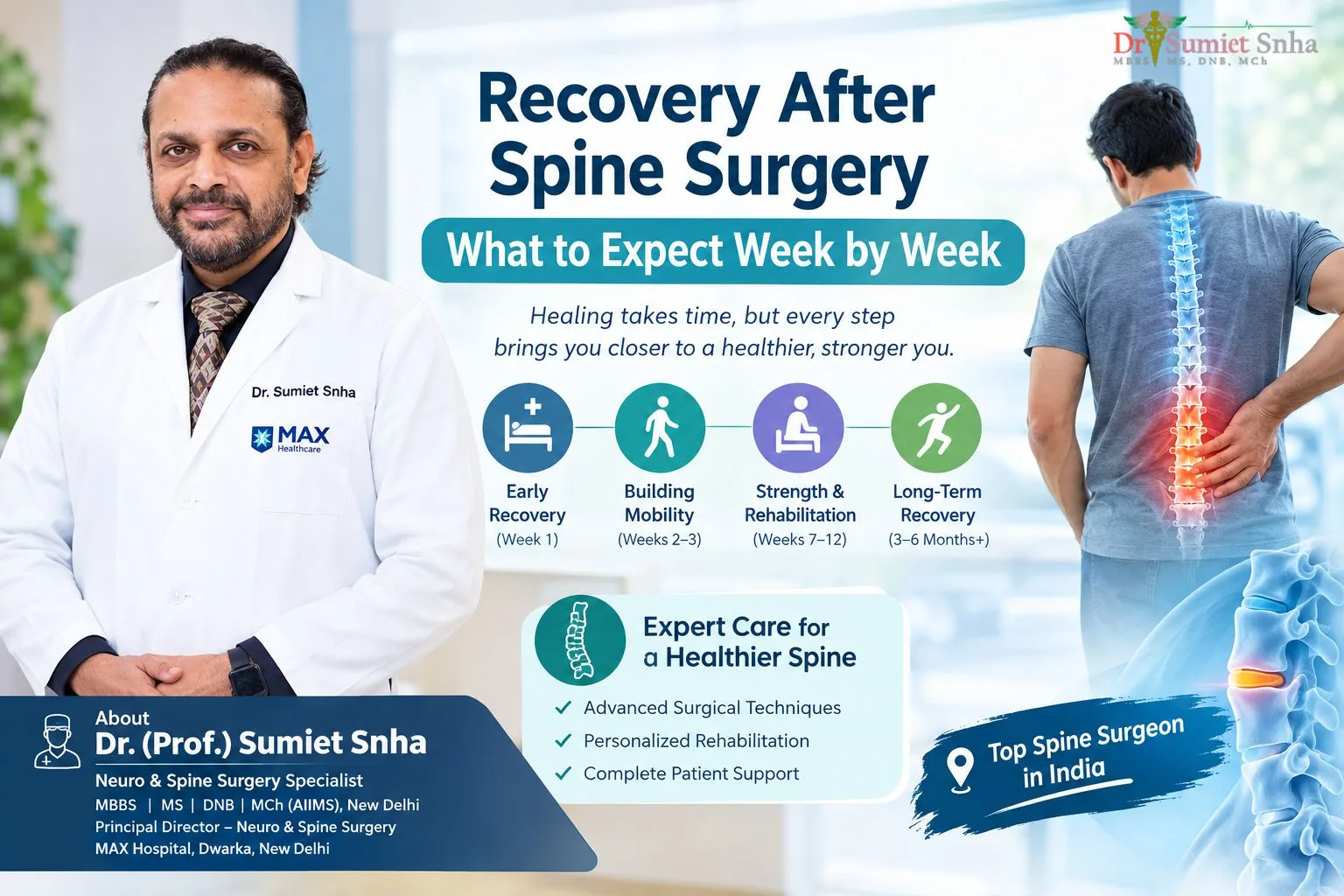
Spine surgery can be an important step toward relieving pressure on nerves, stabilizing the spine, or treating a condition that has not improved with other treatments. But many patients have one big question after surgery: How long will recovery take?
The answer is different for everyone. Recovery after spine surgery depends on the type of procedure, the part of the spine treated, whether a fusion was performed, your general health, and the nature of your work and daily activities. Some patients return to normal activities within several weeks, while more extensive procedures can take several months to heal fully.
If you are researching a top spine surgeon in India, it is equally important to understand that surgical expertise is only one part of the journey. Proper postoperative care, rehabilitation, follow-up and patience also play an important role in recovery.
What Does Recovery After Spine Surgery Involve?
Recovery is not simply about waiting for the pain to disappear. Your body needs time to heal the surgical area, while nerves, muscles and other tissues may also need time to recover.
Depending on the operation, your recovery may involve:
- Gradually increasing your walking and daily activity
- Taking prescribed medicines correctly
- Caring for the surgical wound
- Following lifting, bending and twisting restrictions
- Attending follow-up appointments
- Starting physical therapy when recommended
- Slowly rebuilding strength and flexibility
- Returning to work and driving only when medically appropriate
Your surgeon's instructions should always take priority over a general recovery timeline found online.
Spine Surgery Recovery Week by Week
Week 1: Rest, Healing and Gentle Movement
The first week is mainly about allowing your body to settle after surgery.
Depending on the procedure, you may spend some time in the hospital or go home relatively soon. For example, some patients undergoing diskectomy may be discharged the same day, while more extensive procedures can require a longer stay.
During the first week, your priorities may include:
- Controlling postoperative pain
- Keeping the incision clean and protected
- Taking medicines as prescribed
- Getting enough rest
- Walking for short periods as advised
- Avoiding unnecessary bending, twisting and lifting
- Learning how to get in and out of bed safely
Feeling tired during this stage is common. Try not to judge your recovery by how quickly someone else improved.
Weeks 2–3: Gradually Becoming More Active
By the second and third weeks, many patients begin feeling more comfortable with basic movement.
Walking may gradually become easier, but this does not mean you should suddenly return to your previous activity level.
Your focus should be on steady progress rather than speed.
You may begin to:
- Walk for slightly longer periods
- Perform basic household activities if permitted
- Sit and stand with better comfort
- Follow wound-care instructions
- Attend your scheduled follow-up
- Begin rehabilitation if recommended
Some procedures require temporary restrictions on bending, lifting and twisting. These restrictions are particularly important during the early healing period.
Weeks 4–6: Building Confidence and Mobility
Around the fourth to sixth week, many patients notice a meaningful improvement in mobility. However, the exact recovery timeline after spine surgery still depends heavily on the procedure.
For some less extensive operations, patients may return to work within a few weeks. The timing can be different for physically demanding jobs.
At this stage, your care plan may include:
- Longer walks
- Structured physical therapy
- Gentle strengthening
- Improved posture and movement
- Gradual return to selected daily activities
- Continued protection of the surgical area
Do not assume that feeling better means the spine has completely healed.
Weeks 7–12: Strength and Rehabilitation
Between approximately seven and twelve weeks, rehabilitation often becomes more focused on restoring strength, flexibility and endurance.
If physical therapy has been prescribed, exercises may progress according to your condition and surgical procedure.
You may work toward:
- Better core and muscle strength
- Improved balance
- Longer walking periods
- Better posture
- Greater independence with daily activities
- Gradual return to normal routines
Gradual improvement is generally expected during the first few months after spine surgery, although each patient's recovery is different.
Three to Six Months and Beyond: Long-Term Recovery
Some patients feel substantially better by this stage, while others continue to improve.
This is especially important after spinal fusion. During fusion surgery, two or more spinal bones are joined, and the bone needs time to heal and fuse. This process can take several months.
Your long-term recovery may involve:
- Continued strengthening
- Gradual return to approved exercise
- Maintaining a healthy level of physical activity
- Using safe lifting techniques
- Continuing recommended follow-up
- Protecting the spine during work and daily activities
Remember: symptom improvement and complete biological healing are not always the same thing.
Spine Surgery Recovery Timeline: Quick Comparison
|
Recovery Stage |
What You May Focus On |
Important Point |
|
Week 1 |
Pain control, wound care, short walks |
Follow discharge instructions |
|
Weeks 2–3 |
Gradual movement |
Avoid restricted activities |
|
Weeks 4–6 |
Walking and rehabilitation |
Work return varies |
|
Weeks 7–12 |
Strength and endurance |
Increase activity gradually |
|
3–6 months |
Functional recovery |
Fusion may still be healing |
|
Beyond 6 months |
Long-term fitness and function |
Follow individual medical advice |
This table is a general guide. It should not be used as an individual recovery schedule.
What Can Affect Your Spine Surgery Recovery Time?
There is no single spine surgery recovery time that applies to every patient.
Several factors can change the pace of recovery, including:
- Type of spine surgery
- Cervical, thoracic or lumbar location
- Decompression versus spinal fusion
- Number of spinal levels treated
- Minimally invasive versus more extensive surgery
- Age and general health
- Muscle strength before surgery
- Existing medical conditions
- Physical demands of your job
- Progress with rehabilitation
- Following postoperative instructions
For example, recovery after a straightforward diskectomy may be different from recovery after a multilevel spinal fusion.
What Activities Should You Avoid After Spine Surgery?
Your restrictions will depend on your operation. In the early recovery period, patients may be advised to avoid:
- Heavy lifting
- Repeated bending
- Excessive twisting
- High-impact exercise
- Sudden strenuous movements
- Returning to physically demanding work too soon
- Driving while taking medicines that affect alertness
At the same time, prolonged unnecessary bed rest is generally not the goal. Appropriate movement and walking may be encouraged when medically safe. Your surgeon should tell you how much activity is appropriate for your particular operation.
When Should You Contact Your Doctor After Spine Surgery?
Some discomfort can occur during recovery, but certain symptoms should not be ignored.
Contact your healthcare team if you develop:
- Fever or chills
- Increasing redness or swelling around the wound
- Fluid or pus-like drainage
- Severe or worsening pain
- New weakness
- New or worsening numbness
- Difficulty walking
- New bowel or bladder problems
- Sudden neurological changes
These symptoms can sometimes indicate a complication and should be evaluated by your medical team.
How Can You Support a Safer Spine Surgery Recovery?
Small habits can make the recovery period easier.
Try to:
- Follow your postoperative instructions carefully.
- Take medicines exactly as prescribed.
- Walk and exercise only as recommended.
- Keep your follow-up appointments.
- Follow wound-care instructions.
- Eat a balanced diet that supports healing.
- Avoid activities that have not yet been cleared.
- Increase activity gradually.
- Ask your doctor before returning to driving, work or strenuous exercise.
Most importantly, do not compare your recovery with another patient's timeline.
About Dr. (Prof.) Sumiet Snha
Dr. (Prof.) Sumiet Snha is a neuro and spine surgeon with more than 25 years of experience in neurosurgery. He completed his neurosurgical training at the All India Institute of Medical Sciences (AIIMS), New Delhi, and holds MBBS, MS, DNB and MCh (AIIMS), New Delhi qualifications.
He is currently associated with MAX Hospital, Dwarka, New Delhi, as Principal Director – Neuro & Spine Surgery, and has also held academic and leadership positions, including Professor of Neurosurgery at AIIMS and Director – Neuro & Spine Surgery at Paras Health, Gurugram.
His professional experience includes spine surgery, spinal injuries, minimally invasive spine procedures, peripheral nerve surgery and complex neuro and spine conditions. He has also been involved in teaching, research and professional education, including work associated with AO Spine and spinal injury training.
For patients researching a top spine surgeon in India looking at qualifications, surgical experience, areas of expertise, academic involvement and the approach to individualized patient care can provide more useful information than relying on promotional labels alone.
Frequently Asked Questions
How long does it take to recover from spine surgery?
Recovery can range from several weeks to several months. The timeline depends on the type of surgery, whether fusion was performed, overall health and the patient's rehabilitation progress.
Can I walk after spine surgery?
Many patients are encouraged to begin appropriate movement and walking relatively early. However, the amount and timing should be based on the specific operation and your surgeon's instructions.
How long does pain last after spine surgery?
Pain usually improves gradually, although some discomfort can remain during healing. Severe, worsening or unusual pain should be discussed with your healthcare team.
When can I return to work after spine surgery?
It depends on your operation and job. Desk-based work may resume sooner than heavy physical work. Your surgeon should assess your recovery before clearing you to return.
When can I drive after spine surgery?
Driving should wait until you can move safely, react normally and are no longer affected by medicines that impair alertness. Your surgeon should confirm when driving is appropriate.
Do I need physical therapy after spine surgery?
Some patients benefit from supervised physical therapy to rebuild strength, flexibility and movement. Whether you need it depends on your surgery and individual recovery.
How long does spinal fusion take to heal?
Spinal fusion healing takes several months. Even if pain and mobility improve earlier, the bones may still be undergoing the fusion process.
Can I bend after spine surgery?
Some procedures require patients to limit bending during the early recovery period. Follow the specific restrictions provided by your surgical team rather than a general online recommendation.
When can I exercise after spine surgery?
Light activity may be introduced gradually, but the timing for strengthening, gym workouts or high-impact exercise varies. Get clearance before progressing to strenuous activity.
Is numbness normal after spine surgery?
Some nerve symptoms can take time to improve, particularly when a nerve was compressed before surgery. New or worsening numbness should be reported to your doctor.
What are warning signs after spine surgery?
Fever, wound drainage, increasing swelling, worsening pain, new weakness, new sensory changes or bowel and bladder problems require prompt medical attention.
Does everyone recover at the same speed after spine surgery?
No. Recovery differs between patients. The procedure, surgical extent, age, health, preoperative condition, physical demands and rehabilitation can all influence recovery.
Conclusion
Recovery after spine surgery is a gradual process. One patient may feel comfortable walking within days, while another may need several months to regain strength and confidence, particularly after a more extensive procedure such as spinal fusion.
The most important goal is not to recover as quickly as possible. It is to recover safely and appropriately for your specific surgery. Follow your surgeon's instructions, attend follow-up appointments, increase activity gradually and report symptoms that concern you.
If you are considering spine surgery, discuss your expected recovery timeline with your neurosurgeon before the procedure. Understanding what lies ahead can make the recovery period less stressful and help you prepare for each stage.




0 Comments