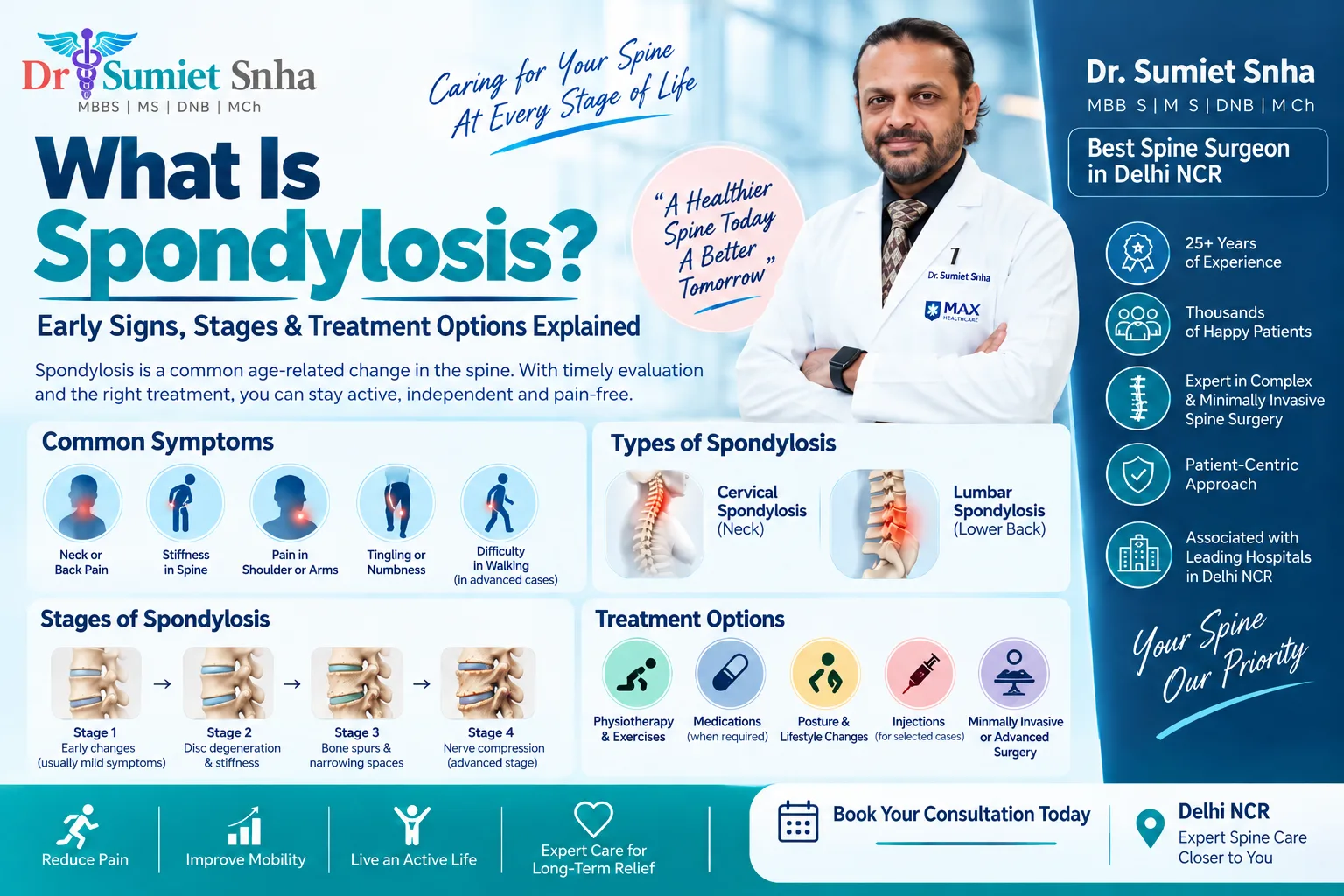
Spondylosis is a broad medical term used for age-related degenerative changes in the spine. These changes can affect the spinal discs, joints, ligaments, and bones. Depending on where they occur, spondylosis may affect the neck, lower back, or other parts of the spine.
A scan showing spondylosis does not automatically mean that a person has a serious spine problem. Many age-related changes cause few or no symptoms. Problems become more important when degeneration begins to irritate a nerve, narrow the spinal canal, or affect the spinal cord. Mayo Clinic notes that cervical spondylosis is common with ageing and often produces no symptoms; when symptoms occur, nonsurgical treatment is frequently effective.
People looking for spondylosis treatment in Delhi should therefore focus on identifying which spinal changes are actually responsible for their symptoms rather than treating an MRI or X-ray report alone.
What Is Spondylosis?
Spondylosis describes degenerative changes that gradually develop in the structures of the spine. It is commonly associated with ageing, although previous injuries, repetitive physical stress, smoking, and certain occupational demands may contribute to symptoms or progression.
What Changes Inside the Spine?
The spine consists of vertebrae separated by discs that help absorb load and allow movement. With time, these discs can lose water and height. The joints may develop arthritic changes, ligaments can become stiffer, and additional bone may form around the edges of the vertebrae.
In the cervical spine, these changes can include disc dehydration, disc herniation, bone spurs, and ligament stiffness. If those structures begin pressing on spinal nerves or the spinal cord, neurological symptoms may develop.
What Is the Difference Between Cervical and Lumbar Spondylosis?
The meaning of spondylosis remains similar, but symptoms differ according to where degeneration occurs.
Cervical Spondylosis Affects the Neck
Cervical spondylosis develops in the cervical vertebrae. Many patients mainly notice neck stiffness or discomfort, while nerve compression can cause symptoms extending into the shoulder, arm, hand, or fingers.
When more significant spinal cord compression develops, balance, walking, coordination, and hand function can also be affected.
Lumbar Spondylosis Affects the Lower Back
Lumbar spondylosis refers to degenerative changes affecting the lower spine. These may contribute to lower-back stiffness or pain. When degeneration is accompanied by disc disease or spinal canal narrowing, symptoms can sometimes extend into the buttock or leg.
Age-related changes in spinal discs can also contribute to herniation and nerve compression, producing pain, numbness, or weakness in the limbs depending on the affected level.
What Are the Early Signs of Spondylosis?
Early spondylosis can be easy to overlook because symptoms may initially be mild or intermittent. Some people have degenerative changes without realizing it.
Symptoms That May Develop Gradually
Possible early signs include:
- Recurrent neck or lower-back stiffness
- Pain after prolonged sitting or standing
- Reduced flexibility of the neck or back
- Pain that becomes worse with certain movements
- Mild shoulder or arm discomfort with cervical involvement
- Pain travelling toward the buttock or leg with lumbar involvement
- Intermittent tingling or numbness
- Symptoms that improve and return over time
Neck pain, shoulder discomfort, stiffness, and headaches beginning near the back of the neck are among symptoms associated with cervical spondylosis.
Having one of these symptoms does not confirm spondylosis. Muscle strain, disc problems, nerve disorders, inflammatory conditions, and other causes can produce similar complaints.
Does Spondylosis Have Different Stages?
Patients frequently hear terms such as “early-stage” or “advanced spondylosis.” In routine patient discussions, these terms generally describe the severity and consequences of degenerative changes, rather than one universal staging system that applies to every part of the spine.
Early or Mild Degenerative Changes
At an early stage, discs may begin losing hydration and flexibility while the joints show relatively minor wear. A patient may have occasional stiffness or pain, or no symptoms at all.
This is an important point because radiological degeneration and clinical symptoms do not always progress together.
Moderate Spondylosis
As degeneration progresses, disc height may decrease further and arthritic changes or bone spurs can become more noticeable.
Symptoms may become more frequent. If a nerve root becomes irritated, pain can radiate into an arm or leg and may be accompanied by tingling or numbness.
Advanced Spondylosis
More advanced structural changes can sometimes narrow the spaces available for the spinal nerves or spinal cord.
At this point, patients may develop significant weakness, loss of coordination, difficulty walking, or other neurological problems. Severe spinal cord or nerve-root compression can lead to lasting neurological damage in some cases, which is why progressive neurological symptoms need appropriate assessment.
Why Does Spondylosis Develop?
Ageing is a major contributor, but it is not the only factor that influences spinal degeneration.
Everyday Stress Accumulates Over Time
Spinal discs repeatedly absorb pressure from standing, sitting, lifting, bending, and movement. As discs gradually lose water content, their mechanical properties change.
Mayo Clinic identifies factors associated with cervical spondylosis including increasing age, repetitive neck movements or awkward occupational positioning, previous neck injury, genetic factors, and smoking.
This does not mean that normal movement should be avoided. In fact, appropriate activity and exercise are commonly part of conservative spine care.
How Can Spondylosis Cause Nerve Compression?
Spondylosis itself may remain relatively quiet until degenerative changes begin reducing the space available for nerves.
Disc Changes and Bone Spurs Can Affect Nearby Nerves
A degenerating disc can become thinner or herniate. Arthritic joints may enlarge, and bone spurs can form. Together, these changes can narrow the spinal canal or nerve openings.
In cervical spondylosis, compression of a nerve root may produce cervical radiculopathy, while compression of the spinal cord may produce cervical myelopathy.
These are more clinically important than an isolated imaging finding because they can affect sensation, strength, coordination, and mobility.
When Should Spondylosis Symptoms Be Taken More Seriously?
Persistent pain deserves assessment when it begins interfering with sleep, work, walking, or ordinary activities. Neurological symptoms require even greater attention.
Warning Signs That Should Not Be Ignored
Seek prompt medical assessment if you develop:
- Increasing arm or leg weakness
- New difficulty walking or maintaining balance
- Loss of hand coordination
- Rapidly worsening numbness
- New bladder or bowel control problems
- Numbness around the groin or saddle region
- Severe pain accompanied by significant neurological changes
Mayo Clinic advises medical attention for sudden numbness or weakness or loss of bladder or bowel control, while the NHS identifies new walking problems, coordination difficulty, and bladder or bowel disturbance as emergency warning signs in the context of cervical spondylosis.
How Is Spondylosis Diagnosed?
Diagnosis begins with understanding the patient's symptoms, not with ordering a scan automatically.
Clinical Examination Helps Locate the Problem
A spine specialist may check neck or back movement, muscle power, sensation, reflexes, coordination, and walking pattern.
Imaging may then be selected according to the clinical problem. X-rays can show degenerative bony changes and bone spurs, while MRI provides more detailed information about discs, nerves, the spinal canal, and spinal cord. CT and nerve-conduction studies may be useful in selected cases.
The important question is whether the imaging abnormality matches the patient's symptoms and examination.
Does Every Patient With Spondylosis Need an MRI?
No. Mild symptoms without neurological concerns may initially be managed clinically.
MRI Becomes More Useful When Nerves May Be Involved
MRI may be considered when symptoms persist, pain radiates into an arm or leg, numbness or weakness develops, walking changes occur, or a doctor suspects significant nerve or spinal cord compression.
MedlinePlus notes that MRI or CT may be used when severe neck or arm pain does not improve with treatment or when weakness or numbness develops.
An MRI showing degeneration is only one part of the diagnosis.
What Are the Treatment Options for Spondylosis?
The right treatment depends on whether symptoms arise mainly from muscular stiffness, joint degeneration, nerve irritation, spinal stenosis, or spinal cord compression.
Treatment Usually Starts Conservatively
For many patients, spondylosis treatment options may include:
- Physiotherapy and targeted exercises
- Maintaining suitable physical activity
- Posture and ergonomic modification
- Medicines when medically appropriate
- Heat or cold for temporary symptom relief
- Selected injections when clinically indicated
- Weight and general health management where relevant
- Specialist monitoring if neurological symptoms are present
Physical therapy can help improve flexibility and strengthen supporting muscles. Mayo Clinic also notes that therapy and medication are frequently used before surgery is considered.
Treatment should be personalized because a plan suitable for uncomplicated neck stiffness may be completely different from one required for spinal cord compression.
Can Physiotherapy Help With Spondylosis?
For many patients with uncomplicated spondylosis, physiotherapy can play an important role.
Exercise Is About Function, Not Reversing Ageing
Physiotherapy does not make age-related degeneration disappear. Instead, its purpose may include improving movement, strengthening supporting muscles, reducing stiffness, and helping a patient remain active.
A physiotherapist can also adapt exercises according to whether symptoms arise from the cervical or lumbar spine.
Patients with significant weakness, severe nerve compression, or spinal cord symptoms should first obtain medical advice before attempting an unsupervised exercise program.
When Are Medicines or Injections Used?
Medication can sometimes reduce pain or muscle spasm enough to allow a patient to remain active and participate in rehabilitation.
Treatment Depends on the Type of Pain
Different symptoms may require different approaches. A doctor may consider analgesic or anti-inflammatory medicines, muscle-relaxing medication, or treatment for neuropathic pain depending on the clinical situation.
Selected injections can sometimes be used for pain related to nerve irritation, but they are not suitable or necessary for every patient.
Medicines should be selected according to individual health conditions because treatments such as anti-inflammatory drugs can have gastrointestinal, kidney, cardiovascular, and other risks.
When Is Surgery Considered for Spondylosis?
Most patients with age-related spondylosis do not automatically need an operation.
Surgery Is Usually About Nerve or Spinal Cord Protection
Surgery may be considered when conservative treatment has not controlled significant symptoms or when neurological problems such as progressive weakness develop.
In cervical spondylosis, procedures may create more space for compressed nerve roots or the spinal cord. Depending on the problem, surgery can involve removing disc material, bone spurs, part of a vertebral structure, or stabilizing part of the spine.
The NHS similarly notes that surgery is generally considered when nerve-root compression or spinal cord involvement is present rather than for uncomplicated age-related changes alone.
Can Minimally Invasive or Endoscopic Surgery Be Used?
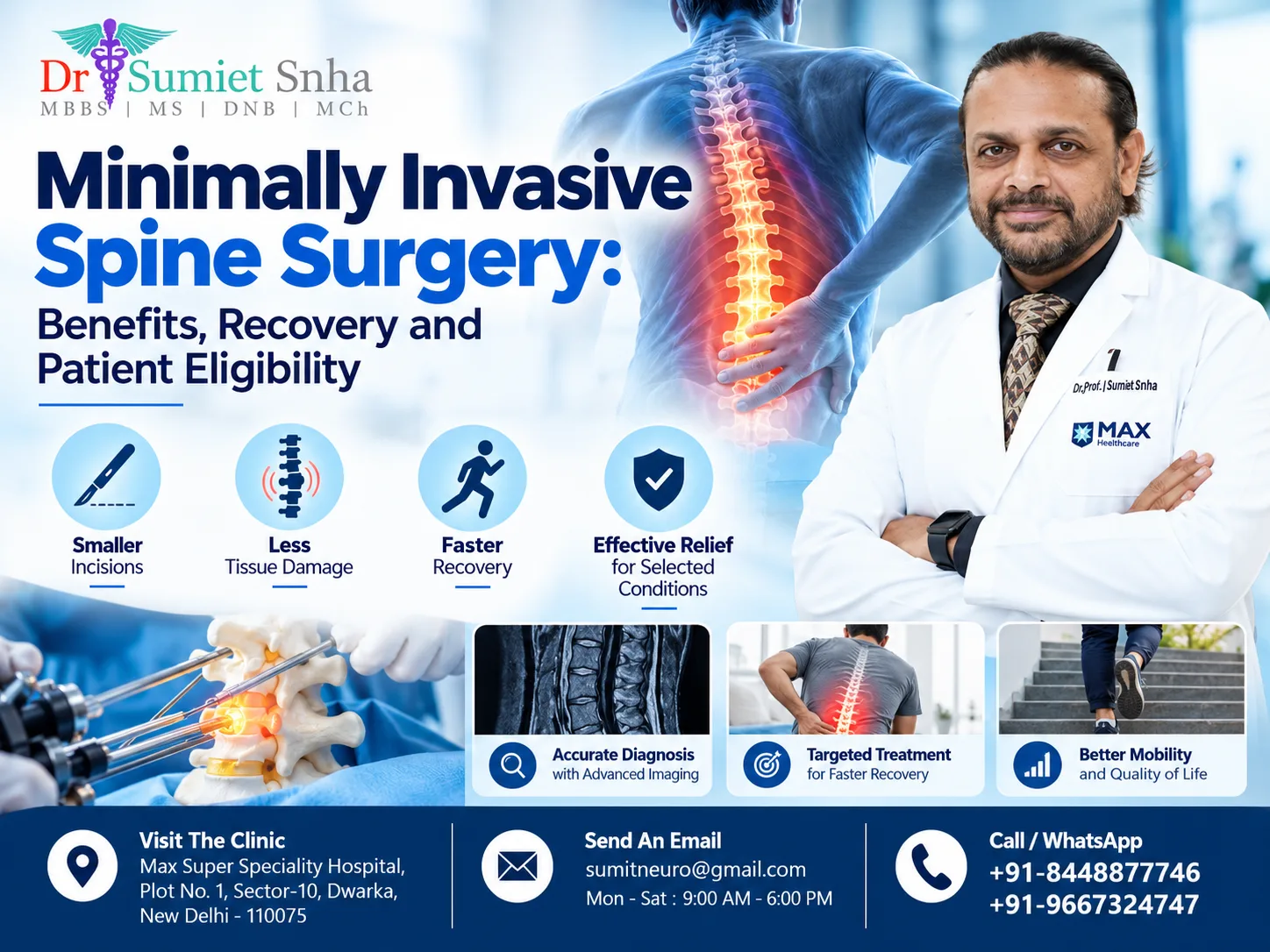
Certain degenerative spine problems can be treated with minimally invasive techniques when the patient's anatomy and diagnosis make that approach suitable.
The Procedure Must Match the Cause of Symptoms
For example, endoscopic or minimally invasive techniques may sometimes be used when a disc or narrowed spinal canal is producing a clearly localized nerve compression.
However, major instability, extensive compression, deformity, or other complex conditions may require another surgical approach.
The priority should be adequate treatment of the neurological problem rather than simply choosing the smallest possible incision.
How Do You Choose Spondylosis Treatment in Delhi?
A local search can produce many clinics, procedures, and claims, but spondylosis care should begin with diagnosis rather than marketing terminology.
Look for a Clear Clinical Explanation
When considering spondylosis treatment in Delhi, patients should ask whether the doctor can explain what is causing the symptoms, whether nerves or the spinal cord are involved, and why a particular treatment is being recommended.
A useful consultation should also explain whether conservative treatment remains appropriate and, if surgery is being discussed, what the operation is expected to accomplish.
Can Spondylosis Be Completely Cured?
Age-related changes in the spine cannot usually be reversed completely.
Treatment Focuses on Symptoms and Function
This does not mean that every patient will continue getting worse. Many people live active lives despite degenerative changes in imaging.
Treatment focuses on reducing symptoms, maintaining mobility, improving strength, protecting neurological function, and addressing specific nerve compression when necessary.
The presence of degeneration on imaging should therefore not be interpreted as a prediction of disability.
About Dr. Sumiet Snha
Dr.(Prof.) Sumiet Snha is an AIIMS-trained neurosurgeon and spine surgeon with more than 25 years of experience in neurosurgery. His listed qualifications include MBBS, MS, DNB and MCh (AIIMS), New Delhi. His professional profile also notes training in spinal injuries, involvement as AO Spine teaching faculty, and experience in minimally invasive spine surgery.
Experience Relevant to Degenerative Spine Conditions
His published clinical profile includes endoscopic treatment of cervical and lumbar disc conditions, lumbar canal stenosis, spinal tumors, spinal fractures, and other complex spinal disorders.
For patients seeking spondylosis treatment in Delhi, the objective of specialist evaluation is to determine whether symptoms can be managed conservatively or whether nerve or spinal cord compression requires further intervention.
Frequently Asked Questions About Spondylosis
1. Is spondylosis the same as arthritis?
Spondylosis is a broad term for degenerative changes in the spine. These changes may include osteoarthritis of spinal joints as well as disc degeneration, bone spurs, and ligament changes.
2. At what age does spondylosis start?
Degenerative spinal changes become increasingly common with age. Mayo Clinic notes that cervical spondylosis is very common in older adults, although imaging changes do not necessarily cause symptoms.
3. What are the first symptoms of cervical spondylosis?
Early symptoms may include neck stiffness, intermittent neck or shoulder pain, reduced flexibility, and sometimes headache originating near the back of the neck.
4. What are common lumbar spondylosis symptoms?
Lumbar spondylosis may cause lower-back pain or stiffness. When associated degenerative changes compress a nerve, pain, tingling, numbness, or weakness may extend into the leg.
5. Can spondylosis cause numbness?
Yes. Numbness can occur when degenerative changes contribute to nerve-root or spinal cord compression. Persistent or progressive numbness deserves medical assessment.
6. Can spondylosis cause difficulty walking?
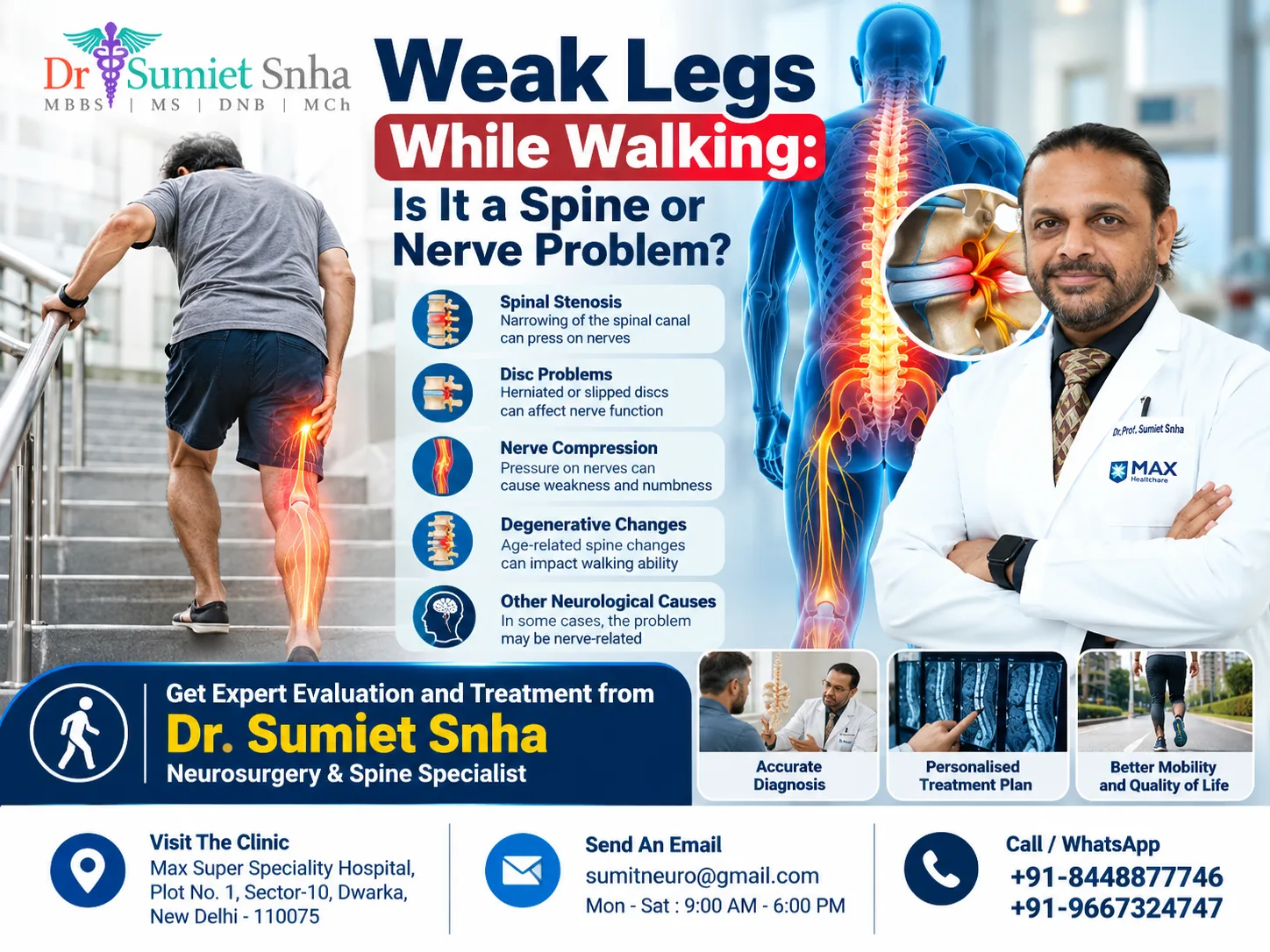
Advanced cervical spinal cord compression or significant lumbar nerve compression can affect walking. New or progressively worsening walking problems should be evaluated promptly.
7. Is spondylosis visible on an MRI?
Yes. MRI can show discs, nerves, the spinal canal, and spinal cord in detail. The findings must still be interpreted alongside symptoms and neurological examination.
8. Does every patient with spondylosis need surgery?
No. Many patients are treated without surgery. Surgery is usually considered when significant neurological compression exists or troublesome symptoms persist despite appropriate conservative management.
9. Is walking good for spondylosis?
Appropriate activity can be helpful for many patients, and prolonged bed rest is generally not recommended for uncomplicated back pain. The amount and type of exercise should be individualized when significant nerve or spinal cord symptoms exist.
10. Can physiotherapy improve spondylosis symptoms?
Physiotherapy can help some patients improve flexibility, strength, posture, and functional movement. It treats the impact of degeneration rather than reversing the underlying ageing process.
11. When should I see a spine specialist for spondylosis?
Specialist assessment is particularly useful when pain remains persistent, symptoms radiate into an arm or leg, weakness develops, walking becomes difficult, or treatment has not produced adequate improvement.
12. Which doctor should I consult for spondylosis treatment in Delhi?
The appropriate specialist depends on symptoms. Patients with significant nerve compression, weakness, cervical myelopathy, spinal stenosis, or a possible surgical condition may be evaluated by a spine surgeon or neurosurgeon. Dr. Sumiet Snha provides specialist assessment for cervical, lumbar, and other complex spine conditions.
Conclusion
Spondylosis is a common form of spinal degeneration rather than a single disease with the same course in every patient. Early changes may cause little more than intermittent stiffness, while more advanced degeneration can sometimes lead to nerve compression, spinal stenosis, weakness, or spinal cord involvement.
The presence of spondylosis on an X-ray or MRI does not automatically mean surgery is necessary. Treatment should depend on symptoms, neurological examination, imaging findings, general health, and how much the condition affects everyday function.
For people considering spondylosis treatment in Delhi, an assessment with Dr. Sumiet Snha can help clarify whether physiotherapy, medication, lifestyle modification, further investigation, minimally invasive treatment, or another surgical approach is appropriate for the specific condition.

0 Comments